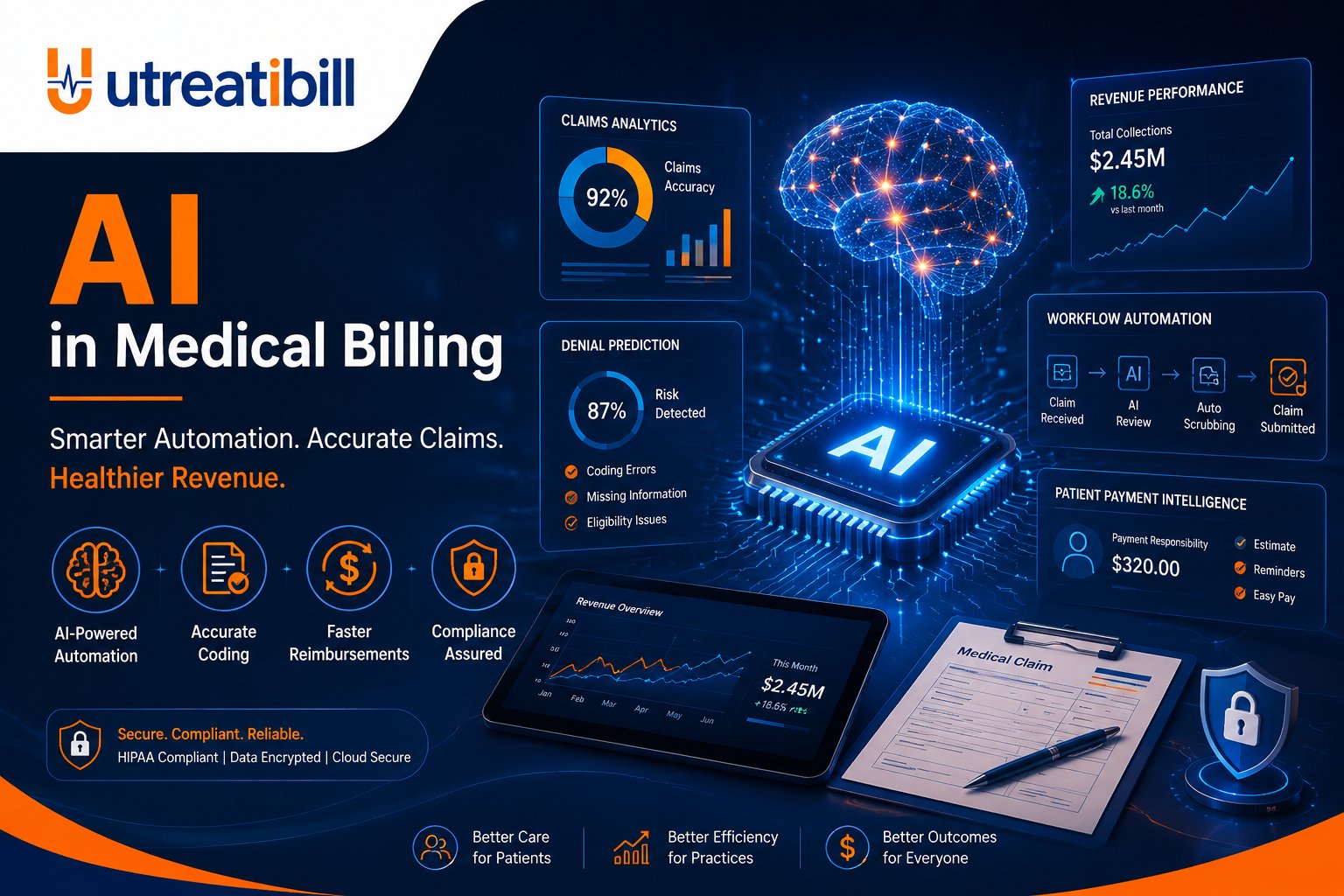

Healthcare organizations across the United States continue facing growing pressure to improve operational efficiency while reducing denied claims and administrative costs. Traditional billing workflows often depend heavily on manual reviews, repetitive claim checks, and time-consuming coding processes.
As insurance payer requirements become more complex, healthcare providers are increasingly adopting automation technologies to improve reimbursement performance. This is where Healthcare Automation Technologies is changing the healthcare industry.
Artificial intelligence now helps healthcare organizations automate coding reviews, improve denial prediction, streamline claim scrubbing, and optimize revenue cycle management workflows. At UtreatiBill, healthcare providers are already using AI-assisted reimbursement systems to reduce denial rates, improve coding accuracy, and accelerate collections.
According to Centers for Medicare & Medicaid Services (CMS), healthcare automation and digital operational technologies continue improving reimbursement efficiency across the healthcare industry.
What is AI in Medical Billing?
AI in medical billing refers to the use of machine learning and natural language processing (NLP) to automate coding, claim scrubbing, denial prediction, and payment posting. Unlike traditional rule-based software, AI learns from historical claims data and improves its recommendations over time.
In simple terms: AI reads clinical notes, flags errors before submission, predicts which claims payers are likely to deny, and helps your team work faster—without replacing human judgment. The technology works alongside existing systems. At UtreatiBill, we integrate AI directly into the platforms your team already uses, so there is no disruptive overhaul—just added intelligence.
1. AI in Medical Billing for Coding Accuracy Improvements
Medical coding is one of the most error-prone activities in healthcare. A single patient visit can involve multiple diagnosis codes from the ICD-10 set, several procedure codes from Current Procedural Terminology (CPT), modifiers, and payer-specific rules. Even experienced coders make errors in 5–15% of claims.
AI in medical billing doesn’t guess—it references CMS guidelines in real time.
How AI Improves Coding Accuracy
AI-powered coding tools act as a co-pilot, not a replacement. Using NLP, they scan physician notes and suggest appropriate codes in real time. The system cross-references the documentation against official Centers for Medicare & Medicaid Services (CMS) guidelines and payer-specific policies.
Example from practice:
A coder using UtreatiBill’s AI module uploads a dictated note about a diabetic patient with neuropathy. The AI instantly suggests:
- 40– Type 2 diabetes with diabetic neuropathy
- Flags missing laterality (left versus right)
- Alerts the coder if documentation is too vague to support the code
Measurable outcomes:
Practices implementing AI-assisted coding typically see a 15–25% reduction in coding errors within three months. New coders reach productivity milestones 40% sooner when working alongside AI guidance.
Where AI Still Needs Humans
AI struggles with ambiguous physician handwriting, rare clinical scenarios, and situations where documentation contradicts itself. It also cannot judge clinical intent—whether a physician deliberately chose a less specific diagnosis due to evolving symptoms. Human coders remain essential for clinical nuance, complex audits, and compliance decisions.

2. AI in Medical Billing for Automated Claim Scrubbing
Claim scrubbing is the process of reviewing a claim for errors before it reaches the payer. Manual scrubbing is slow, inconsistent, and prone to oversight. Even diligent billers can miss a modifier or overlook a medical necessity requirement.
Automated claims management improves first-pass acceptance rates.
The Difference AI Makes
| Manual Scrubbing | AI-Powered Scrubbing |
| Checks 5–10 error types | Checks 50+ error types |
| Takes 3–5 minutes per claim | Takes milliseconds |
| Payer rules applied inconsistently | Payer-specific rules applied automatically |
| Misses hidden modifier conflicts | Flags all modifier mismatches |
Real-world example:
A physical therapy claim submitted to Medicare requires a GP modifier and functional limitation reporting. Many commercial payers do not. A generic scrubber might miss this distinction. An AI-powered scrubber trained on each payer’s medical policies catches the mismatch before submission, prompting the biller to correct it.
Financial impact:
Claims scrubbed by AI have a first-pass acceptance rate 10–20% higher than manually scrubbed claims. Rejected claims—those returned for format errors or missing data—drop by up to 60%, reducing administrative rework. Clean claims pay 12–15 days faster on average.
What AI Scrubbers Cannot Fix
AI cannot correct front-end registration errors. If a patient’s insurance ID is wrong or their address is outdated, the AI has no way of knowing. That requires front-desk training and patient verification. AI also cannot negotiate with payers on complex appeals. Human billers still own those conversations.
3. Automated Claims Management for Denial Prediction
Denials are the single largest drain on revenue cycle efficiency. Industry data shows that 10–15% of all claims are initially denied. Of those, more than 60% are never reworked or appealed, representing pure lost revenue.
Traditional denial management is reactive: claim denied → review → correct → resubmit → weeks lost. By then, timely filing deadlines may be approaching, and patients may have received confusing bills.
How Predictive Denial Analytics Works
AI denial prediction flips the model from reactive to proactive. The system analyzes historical claims data, payer behavior, and documentation patterns to flag claims likely to be denied before they leave your system.
A typical flag from UtreatiBill’s system:
“Payer A has denied E/M level 4 visits from this provider 34% of the time over the past six months due to insufficient documentation of medical decision making. This claim shows similar patterns. Consider adding more detailed clinical notes before submission.”
Results that matter:
Automated medical billing systems to reduce claim denials are becoming increasingly common.Clinics using AI denial prediction report 30–50% fewer preventable denials. Appeals move faster because potential denials are flagged early, and appeal letters can be drafted before the denial even occurs. Over time, aggregated denial prediction data reveals which payers have unreasonable denial patterns, giving providers leverage in negotiations.
Limitations of Prediction Models
AI prediction models are only as good as the data they are trained on. A new practice with no claims history will have less accurate predictions. Over-reliance can also lead to “alert fatigue”—billers ignoring warnings if too many false positives occur. Continuous model retraining and human oversight remain mandatory.

4. Impact of AI in Medical Billing on Biller and Coder Jobs
This is the most common and honest question we hear at UtreatiBill: Will AI replace me or my team?
Short answer: No.
Long answer: The job is changing in ways that benefit skilled professionals.
What AI Eliminates (Tedious Tasks)
- Manually looking up code books
- Checking every claim for every field
- Routine payment posting
- Flagging obvious mismatches (male procedure code on female patient)
- Generating simple appeal letters from templates
These tasks once consumed 40–60% of a biller’s typical day. AI now handles them in seconds.
What AI Cannot Do (And Likely Never Will)
- Clinical nuance– Understanding why a physician chose a less specific diagnosis due to evolving symptoms
- Payer negotiations– Speaking with a claims adjuster about a unique, non-standard case
- Patient empathy– Explaining a complex bill to an upset patient without sounding robotic
- Compliance judgment– Knowing when an aggressive coding suggestion crosses into upcoding or fraud
- Training the AI– Feeding corrected examples back into the system to improve future performance
The Evolving Role: From Data Entry to Revenue Strategist
According to the American Health Information Management Association (AHIMA) , the role of medical coders and billers is shifting from transactional work to analytical oversight. The organization projects stable employment through 2030, but with a clear trend: entry-level, pure data-entry positions will decline, while demand for AI-savvy revenue cycle analysts and denial specialists will grow. These roles pay better and offer more intellectual challenge.
The biller or coder of 2026 and beyond will:
- Supervise AI queues and review high-risk flags
- Investigate why the AI mispredicted a denial for a specific payer
- Handle the 5–10% of claims that require human judgment
- Train AI models with corrected examples
- Advise clinicians on documentation improvements
At UtreatiBill, we design AI systems to augment human workers, not replace them. Our platform provides clear flags, explanations, and suggested actions—never silent auto-correction.
How Accurate Is Medical Billing Automation in 2026?
Accuracy varies by use case and implementation quality. For routine coding of common diagnoses and procedures, AI-assisted systems can achieve 90–95% accuracy when supervised by experienced coders. For complex or rare cases, accuracy drops, and human review becomes essential.
The most successful practices treat AI as a 95% solution—extremely helpful for volume, but always verified by human judgment for high-risk or high-dollar claims.
AI in Medical Billing for Small Healthcare Practices
Yes. The market for AI in RCM has matured significantly. Solutions like UtreatiBill offer scalable pricing based on claim volume, not large upfront fees. Many small to mid-sized practices see a positive return on investment within 3–6 months from reduced denials, faster payments, and lower administrative costs.
For a typical small practice with 5–10 providers, the monthly cost of AI-assisted billing tools is often less than the revenue lost to a single preventable denial each week.
Risks of AI in Medical Billing and Revenue Cycle Management
Like any technology, AI in medical billing carries risks that responsible practices should understand:
Data quality dependence – AI models trained on incomplete or incorrect historical data will produce poor recommendations. Garbage in, garbage out.
Over-automation – Some vendors offer “fully automated” billing that corrects claims without human review. This is dangerous. Silent auto-correction can embed errors permanently. Always choose systems that flag, explain, and seek approval.
Payer policy changes – Payers update medical policies quarterly. AI models must be retrained regularly. A model left untouched for six months will become increasingly inaccurate.
Staff resistance – The biggest AI failures happen not because the technology is bad, but because staff distrust it or do not understand its limitations. Training and transparency are non-negotiable.
How to Implement AI in Your Practice (Practical Roadmap)
If you are ready to bring AI into your revenue cycle, follow this step-by-step approach.
Step 1: Identify Your Biggest Pain Point
- High coding errors? → Start with AI-assisted coding
- Many front-end rejections? → Start with automated claim scrubbing
- Slow denial recovery? → Start with denial prediction
Step 2: Choose an Integrated Vendor
Avoid standalone AI tools that require your team to learn a completely new system. At UtreatiBill, we integrate with existing practice management systems and EHRs. Your team logs into the same interface—just with added intelligence.
Step 3: Pilot with a Small Team
Select one team, one complex payer, and one metric (for example, denial rate or coding accuracy). Measure baseline performance for 30 days, then measure again after 60–90 days with AI assistance.
Step 4: Train Your People First
Invest in hands-on workshops where billers and coders test the AI, challenge its suggestions, and learn its limitations. The goal is confidence, not blind trust.
Step 5: Monitor and Iterate
AI in medical billing is not a “set and forget” tool. Payers change policies quarterly. Documentation styles evolve. Dedicate 3–5 hours per week of a senior biller’s time to reviewing AI performance and feeding corrections back into the system.
AI in Medical Billing and Healthcare Compliance
Why Compliance Matters in AI in Medical Billing
Healthcare compliance remains one of the most important aspects of revenue cycle management. Insurance companies, government programs, and regulatory agencies all require healthcare providers to follow strict coding and reimbursement standards.
This is one reason why AI in Medical Billing has become increasingly valuable for healthcare organizations trying to improve operational accuracy while reducing compliance risks.
Traditional billing systems often rely heavily on manual reviews. However, human error can result in:
- Incorrect coding
- Missing documentation
- Claim submission mistakes
- Delayed reimbursements
- Audit risks
- Compliance penalties
AI-powered reimbursement systems help healthcare providers identify operational risks before claims are submitted to insurance payers.
How AI Improves Compliance Monitoring
- Detects coding inconsistencies
- Flags missing documentation
- Monitors payer policy changes
- Improves medical necessity validation
- Tracks claim submission accuracy
- Reduces duplicate billing risks
therefore, healthcare organizations using AI in Medical Billing systems often experience fewer preventable denials because automation tools continuously analyze historical reimbursement data.
Healthcare providers can also review coding and compliance resources through American Academy of Professional Coders (AAPC) and Centers for Medicare & Medicaid Services (CMS).
Benefits of AI in Medical Billing for Small Practices
Why Independent Healthcare Providers Use AI in Medical Billing
Many smaller healthcare practices assume advanced automation technologies are designed only for large hospital systems. In reality, independent providers often benefit the most from Medical Billing Automation.
Smaller practices usually operate with limited administrative staff and tighter financial resources. Manual reimbursement workflows can quickly overwhelm employees and create operational inefficiencies.
Key Advantages for Small Practices
- Reduced administrative workload
- Faster claims processing
- Lower denial rates
- Improved coding accuracy
- Better reimbursement tracking
- Increased operational efficiency
cloud-based AI in Medical Billing platforms now offer affordable pricing models designed specifically for independent healthcare providers.
Healthcare organizations looking to improve operational workflows can also explore Revenue Cycle Management Services for customized reimbursement support.
According to Healthcare Financial Management Association (HFMA), automation technologies continue improving healthcare operational efficiency nationwide.
AI in Medical Billing and Data Analytics
Predictive Analytics in Revenue Cycle Management
AI-powered revenue cycle management systems help identify denial trends.
Traditional reimbursement workflows often provide limited visibility into operational performance. Healthcare providers may struggle to identify denial patterns, coding inefficiencies, or payer behavior trends until revenue problems become serious.
AI-powered analytics tools help organizations monitor reimbursement performance in real time.
What Predictive Analytics Can Identify
- High-risk claims
- Recurring denial trends
- Coding accuracy issues
- Payer-specific reimbursement delays
- Revenue leakage
- Operational bottlenecks
healthcare providers using predictive analytics systems often make faster operational decisions because financial data becomes easier to analyze and understand.
Modern healthcare organizations increasingly rely on AI in Medical Billing platforms to improve long-term profitability and reimbursement forecasting.
Healthcare providers can also review healthcare technology resources through HealthIT.gov.
Internal Resources for Healthcare Providers
Additional UtreatiBill Resources
Healthcare providers interested in operational optimization through AI in Medical Billing can also review additional resources from UtreatiBill.
Recommended Services to Check out
- Medical Billing Services
- Cardiology Medical Billing Services
- Medical Billing Services New Jersey
- Revenue Cycle Management Solutions
- Outsource Medical Billing Services
These resources provide additional information about denial management, coding optimization, reimbursement strategies, and healthcare operational efficiency.
Future Trends in AI in Medical Billing
How AI in Medical Billing Will Evolve
The healthcare industry is rapidly adopting automation, predictive analytics, and machine learning technologies to improve operational performance.
As reimbursement systems become more complex, Healthcare Automation Technologies will continue playing a larger role in healthcare revenue cycle management.
Future AI-powered systems may include:
- Real-time coding recommendations
- Automated payer communication
- Intelligent denial prevention
- Voice-to-code documentation systems
- Advanced reimbursement forecasting
- AI-powered patient billing support
Additionally, machine learning systems continuously improve as they process larger amounts of claims and reimbursement data.
According to American Health Information Management Association (AHIMA), healthcare administration roles are evolving toward analytical oversight and technology-driven reimbursement management.
healthcare organizations that adopt intelligent automation technologies early may gain long-term advantages in operational efficiency and financial performance.
Conclusion
Final Thoughts About AI in Medical Billing
The healthcare industry is entering a new era of automation and operational intelligence. From predictive denial management to automated coding support, AI-powered medical billing solutions for healthcare providers are transforming reimbursement workflows.
Healthcare providers that combine experienced billing professionals with intelligent automation systems often achieve:
- Faster reimbursements
- Lower denial rates
- Improved coding accuracy
- Better compliance monitoring
- Reduced administrative workload
- Stronger financial performance
However, successful implementation still requires proper staff training, compliance oversight, operational transparency, and continuous workflow monitoring.
At UtreatiBill, healthcare organizations can explore customized reimbursement management solutions designed to improve operational efficiency and financial performance through modern healthcare automation strategies.
Therefore, healthcare providers investing in AI in Medical Billing technologies today are positioning themselves for long-term growth and operational success in the future healthcare economy.