
The American Medical Association (AMA) has officially released the 2026 CPT Code Updates, and this year’s cycle brings more turbulence than usual. With 393 new codes, 92 deletions, and a major overhaul of telehealth and Remote Physiological Monitoring (RPM) guidelines, revenue cycle management teams face a steep learning curve.
At UtreatiBill, we have analyzed every change to help you avoid claim denial preventions and healthcare reimbursement compliance. This guide covers the deleted codes sending shockwaves through surgery departments, the new documentation mandates for digital medicine, and exactly how the CPT coding updates 2026 will impact your bottom line.
Table of Contents
- The Big Picture: What’s Changing in 2026?
- New CPT Codes for 2026: Evaluation & Management (E/M) Expansions
- Deleted and Revised Codes: The “Danger List” for Claims
- Documentation Requirements for New Codes (High Risk)
- Telehealth & RPM Coding Updates: The Digital Shift
- How UtreatiBill Helps You Navigate the 2026 CPT Code Updates
- Final Checklist for Billers
The Big Picture: What’s Changing in 2026?
The 2026 CPT Code Updates focus on two major themes: digital medicine accountability and surgical precision coding. Unlike 2025’s minor tweaks, 2026 introduces over 230 new codes for gene therapy administration, advanced wound care, and AI-assisted analysis.
Key statistics from the AMA CPT Editorial Panel:
- 393 new codes added.
- 92 codes deleted (primarily in cardiology and orthopedics).
- 285 codes revised (mostly adding time-based modifiers).
External Resource: Review the official AMA summary here
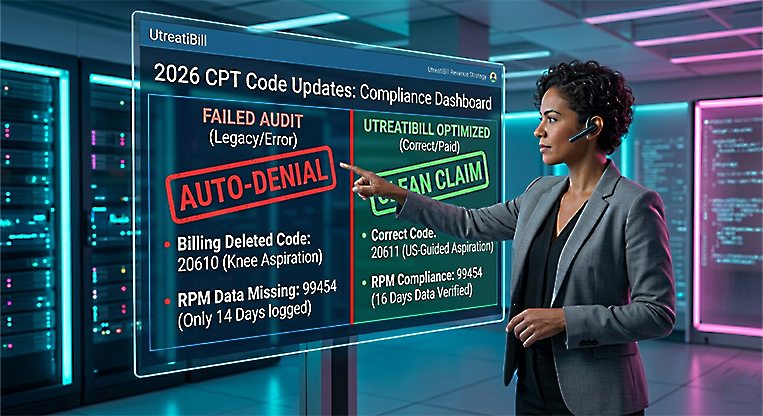
The biggest error UtreatiBill sees in Q1 2026 will be legacy code usage. Payers like Medicare and UnitedHealthcare will auto-deny any claim containing a deleted CPT code after January 31, 2026.
2. New CPT Codes for 2026: Evaluation & Management (E/M) Expansions
Under the 2026 CPT Code Updates, E/M coding for outpatient services (99202-99215) remains structurally similar, but six new add-on codes for complex care management have been approved.
Key Additions:
- 99340– Prolonged care coordination for patients with 3+ chronic conditions (billed with 99214).
- 99341– Interprofessional telephone/internet assessment for high-risk pregnancy.
- +XXXX(New Category III) – Remote therapeutic monitoring (RTM) for musculoskeletal response.
Additionally, inpatient consultation codes (99252-99255) now require medically appropriate history AND exam—the “or” option has been removed. This is a hard revision that will trip up legacy billers.
Why This Matters for Revenue
If you fail to capture 99340 for your complex chronic disease patients, you are leaving 62–62–89 per encounter on the table. UtreatiBill recommends auditing your top 50 chronic care patients in January 2026 to identify missed add-on opportunities.
3. Deleted and Revised Codes: The “Danger List” for Claims
The Medical Billing Code Changes delete several workhorses of surgical coding. Using any of the following after March 1, 2026 will result in an immediate RTP (Return to Provider) denial.
Deleted Codes (Partial List):
- 20610– Arthrocentesis, major joint/bursa (Now split into 20611 for US-guided and 20612 for non-US-guided).
- 93000– Routine ECG with interpretation (Replaced by 93005 + 93006 for split technical/professional components).
- 99241– Office consultation (Level 1) – Deleted; use 99202 instead.
- G0296– CT colonography screening (Deleted; use 74263 with modifier TC).
Revised Codes with New Rules:
- 99495 & 99496 (Transitional care management): Now require face-to-face contact within 48 hours of discharge (was 7 days).
- 90716 (Varicella vaccine): Administration code changed to require a separate nurse visit—no longer bundled with the vaccine product.
Internal link: Check our guide on cpt codes 99202-99205.
The 9 Common Errors to Avoid
Based on early payer bulletins, here are the 9 errors UtreatiBill’s auditors are tracking:
- Billing deleted code 20610 for knee aspiration.
- Missing the new time threshold for 99495 (48-hour rule).
- Failing to document “medical necessity” for new E/M add-ons.
- Using telehealth modifiers for in-person RPM services.
- Omitting the required patient consent form for new Category III codes.
- Reporting old vaccine administration codes for RSV immunizations.
- Misusing modifier 95 for audio-only telephone calls (no longer allowed in 2026 for Medicare).
- Forgetting the “direct supervision” requirement for new AI-assisted dermatology codes.
- Submitting 2025 paper forms after the electronic cutover date.
4. Documentation Requirements for New Codes (High Risk)
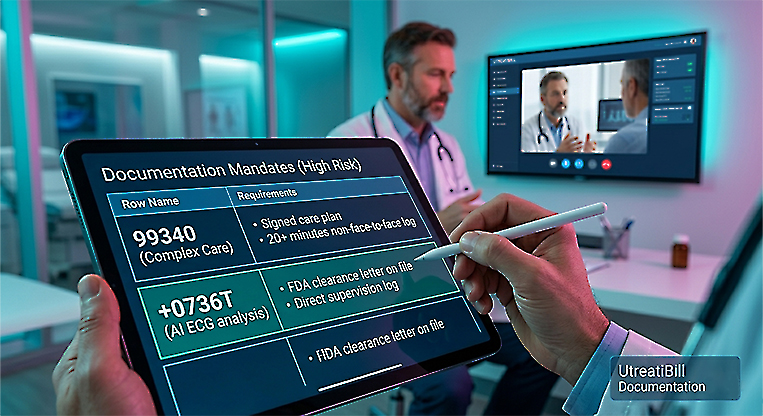
The Revenue Cycle Compliance Updates introduce stricter Documentation Requirements for New Codes, particularly in the digital health space. Payers are now auditing for four specific elements.
What You Must Now Record:
| New Code | Documentation Mandate |
| 99340 (Complex care) | Signed care plan; 20+ minutes of non-face-to-face time log. |
| 98991 (RPM setup) | Patient’s verbal consent + device calibration log. |
| +0736T (AI ECG analysis) | Copy of the algorithm’s FDA clearance letter on file. |
| G2212 (Prolonged service) | Start/stop timestamp for every 15-minute increment. |
UtreatiBill Pro Tip: For any code with “time-based” descriptors (common in the 2026 CPT Code Updates for mental health), use a time tracking template inside your EHR. Retrospective time estimation is no longer accepted by Noridian or NGS Medicare.
External Resource: CMS’s 2026 Documentation Guidelines are available here
5. Telehealth CPT and RPM Changes Updates: The Digital Shift
Perhaps the most anticipated section of the 2026 CPT Code Updates concerns Telehealth & RPM Coding Updates. The public health emergency waivers are fully expired, and permanent rules are now in effect.
Telehealth (Medicare) – 2026 Final Rules:
- Audio-video required for 98000-98007 (Remote E/M). No more telephone-only visits for established patients.
- Originating site restrictions are gone. Patients can receive telehealth at home.
- Modifier 93 (Synchronous telemedicine) is now required for all commercial telehealth claims.
RPM coding changes 2026:
- 99453 (RPM device setup): Now only billable once per patient per lifetime.
- 99454 (Device supply & daily recording): Requires 16 days of data per 30-day period (was 14 days).
- New code 99455– Remote monitoring of therapeutic response (e.g., PT/INR for warfarin patients).
The Compliance Trap
If your practice bills 99454 without verifying the 16-day data threshold, you face a 100% clawback risk. UtreatiBill recommends running a weekly RPM data compliance report starting January 15, 2026.
These revenue cycle compliance updates require stricter documentation standards.
6. How UtreatiBill Helps You Navigate the 2026 CPT Code Updates
At UtreatiBill, we don’t just update our software—we update your revenue strategy. Our team has already mapped the 2026 CPT Code Updates to payer-specific LCDs (Local Coverage Determinations).
Here is what UtreatiBill clients receive automatically:
- Code Crosswalk Reports: A spreadsheet mapping every deleted 2025 code to its 2026 replacement.
- Telehealth Audit Tool: A one-click verification system to ensure modifier 93 is applied correctly.
- RPM Documentation Templates: Pre-built, CMS-compliant time logs for 99453-99455.
- Regression Testing: We resubmit your top 25 claim types to virtual payers to catch denials before you bill.
Internal link: Schedule your 2026 CPT Code Updates audit with UtreatiBill here.
7. Final Checklist for Billers
To survive the transition to the 2026 CPT Code Updates, complete these five tasks before January 1, 2026:
- Update your PM system with the new Category I and III codes.
- Delete all 92 obsolete codes from your charge master.
- Retrain front desk staff on the new 48-hour TCM rule (99495/99496).
- Add the “audio-video required” clause to your telehealth consent forms.
- Run a test claim batch with UtreatiBill’s scrubber to check for 2026 syntax errors.
The Bottom Line
CPT coding updates 2026 introduce stricter telehealth requirements. Whether you are a solo practitioner or a 50-provider group, failing to adopt these changes will result in a 15–20% denial spike in Q1 2026. Do not wait for your first rejection letter.
UtreatiBill keeps your revenue cycle compliant, optimized, and profitable. From RPM documentation to deleted code crosswalks, we turn complex regulation into clean claims.