The medical coding landscape is shifting faster than ever. For revenue cycle managers, billers, and clinicians, staying compliant means mastering both the ICD-10 updates and preparing for the future ICD-11 transition. At UtreatiBill, we’ve seen how these changes impact claim acceptance rates, reimbursement cycles, and clinical documentation integrity.
In this guide, we’ll break down the annual ICD-10 changes, the expected ICD-11 adoption timeline, rising coding specificity requirements, and major expansions in behavioral health and chronic disease coding. Plus, we’ll explain why the industry is moving toward higher specificity and AI-supported coding—and how UtreatiBill helps you bridge the gap.
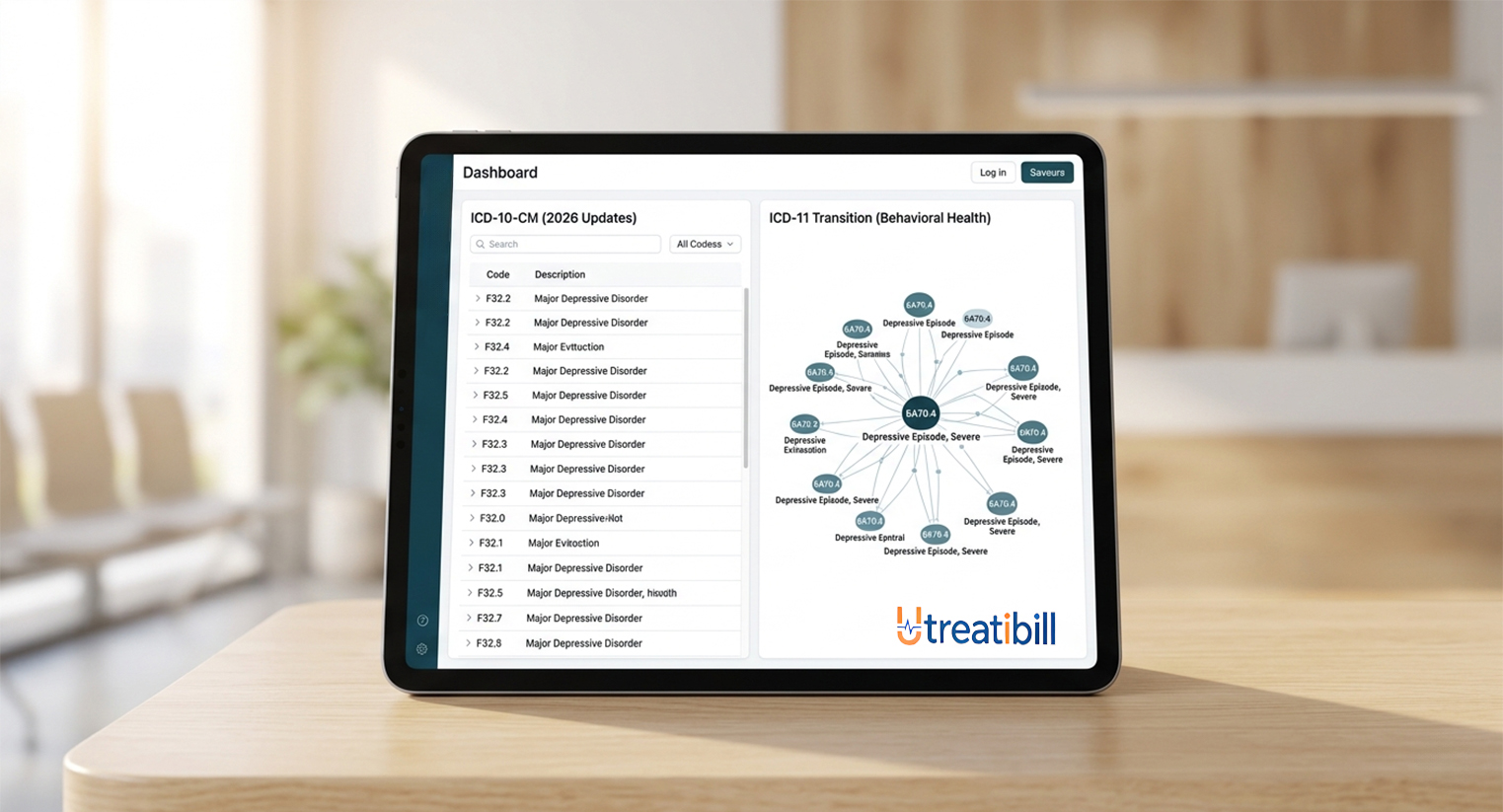
Table of Contents
- Why ICD-10 Updates Matter More Than Ever
- Annual ICD-10 Updates: What Changed in 2025–2026
- Expected ICD-11 Adoption Timeline: When to Act
- Coding Specificity Requirements Are Rising
- Behavioral Health Expansions in ICD-10 and ICD-11
- Chronic Disease Coding: New Layers of Complexity
- Industry Shift: Higher Specificity + AI-Supported Coding
- How UtreatiBill Simplifies the Transition
- Common Errors to Avoid (9 Critical Mistakes)
- Final Thoughts & Next Steps
- Why ICD-10 Updates Matter More Than Ever
The ICD-10 updates are no longer minor annual administrative tasks. They directly affect:
- Medical necessity determinations
- Prior authorization approvals
- Risk adjustment scores (especially in Medicare Advantage)
- Denial management and appeals
With the future ICD-11 transition on the horizon, every update now serves as a stepping stone toward a more granular, digital-first classification system. Ignoring these changes leads to revenue leakage and compliance risks.
- Annual ICD-10 Updates: What Changed in 2025–2026
CMS and WHO release new ICD-10-CM and ICD-10-PCS codes every October 1st. The 2025–2026 cycle introduced:
- 283 new codes (primarily in behavioral health, adverse effects, and social determinants of health)
- 51 revised code descriptors (not just titles but clinical definitions)
- 23 invalidated codes (requiring record reclassification)
Key areas affected include:
- Chapter 5 (Mental disorders): New specifiers for substance-induced mood disorders
- Chapter 18 (Symptoms/signs): Expanded codes for chronic pain with psychological factors
- Chapter 21 (SDOH): Housing instability and food insecurity codes now require documentation of duration (acute vs. chronic)
Pro tip from UtreatiBill: Don’t just update your billing software. Update your encounter templates, clinical decision support rules, and denial management logic.
- Expected ICD-11 Adoption Timeline: When to Act
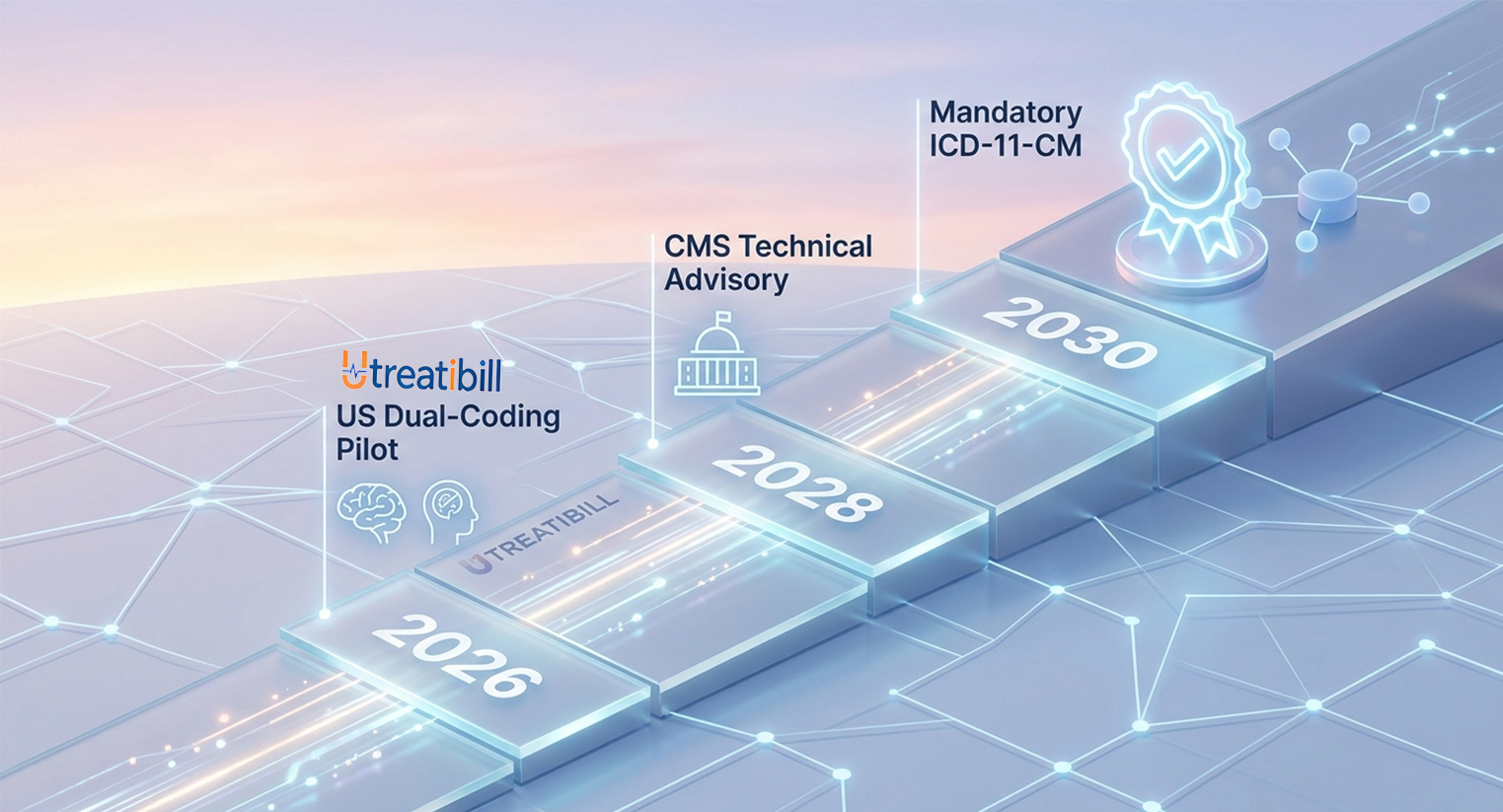
The future ICD-11 transition is not a single event but a phased migration. Here is the realistic adoption timeline:
| Year | Milestone |
| 2022 | WHO member states encouraged to prepare |
| 2024–2025 | Pilot implementations (Germany, UK, Canada) |
| 2026 | US dual-coding pilot (ICD-10 + ICD-11 for select payers) |
| 2027–2028 | CMS technical advisory; Medicare transition planning |
| 2029 | Earliest projected mandatory ICD-11-CM implementation for US hospitals |
| 2030+ | Full adoption with ICD-11-PCS for inpatient procedures |
Key insight: ICD-11 is not just an expansion—it is a fundamentally different architecture. It uses a foundation component (ontology) and linearizations (e.g., mortality, primary care). Codes are alphanumeric (e.g., 6B40.Z for dementia) and support post-coordination (combining multiple concepts into one code).
External dofollow resource: WHO ICD-11 Implementation Toolkit – official roadmap and training materials.
- Coding Specificity Requirements Are Rising
Payers are aggressively denying claims for lack of specificity. The ICD-10 updates and future ICD-11 transition both demand:
- Laterality (left/right/bilateral) – now required for over 400 codes
- Episode of care (initial, subsequent, sequela)
- Severity scales (mild, moderate, severe, without/with psychotic features)
- Temporal patterns (first episode, recurrent, in remission)
Example from behavioral health:
Under current ICD-10, F32.2 (major depressive disorder, single episode, severe without psychotic features) is acceptable.
Under future ICD-11 transition, you will need to specify:
6A70.4 – Depressive episode, severe, with psychotic symptoms, current episode less than 2 months.
Internal link suggestion: Read our related article – How to Avoid Denials Through Specificity Mapping (add your actual internal URL).
- Behavioral Health Expansions in ICD-10 and ICD-11
Behavioral health is the most rapidly growing section of both the ICD-10 updates and the future ICD-11 transition. Key expansions include:
Current ICD-10 Updates (2025–2026)
- Gaming disorder (F63.0) – now with specifiers for online vs. offline
- Prolonged grief disorder (F43.8) – distinct from major depression
- Non-suicidal self-injury (Z91.5-) – new seventh character for frequency
- Suicidal behavior (Z91.5-) – separate from ideation codes
Future ICD-11 Transition – Behavioral Health Highlights
| ICD-11 Code | Condition | Improvement over ICD-10 |
| 6D72 | Body-focused repetitive behavior disorder | New category (hair pulling, skin picking) |
| 6C4G | Complex post-traumatic stress disorder | Separate from simple PTSD |
| 8A20 | Catatonia | Moved from symptom to independent disorder |
| MB23.3 | Functional neurological disorder | Integrated with psychological factors |
Why this matters for UtreatiBill users: Our AI-supported coding engine already recognizes these ICD-11 precursors, helping you future-proof your billing today.
- Chronic Disease Coding: New Layers of Complexity
Chronic diseases now require etiology + manifestation + severity + management history. The ICD-10 updates added combination codes for:
- Diabetes + chronic kidney disease (E11.22 with specific stage of CKD)
- COPD with acute exacerbation (J44.1 – now requires inpatient/outpatient qualifier)
- Heart failure with preserved ejection fraction (I50.3 – previously lacked specificity)
Under the future ICD-11 transition, chronic diseases will use cluster coding via post-coordination. For example, type 2 diabetes with nephropathy would combine:
- 5A10(Type 2 diabetes mellitus)
- MF94(Diabetic nephropathy)
- XT9D(Poorly controlled)
External dofollow resource: CMS 2026 ICD-10-CM Coding Guidelines – official updates.
- Industry Shift: Higher Specificity + AI-Supported Coding
The industry is moving toward higher specificity and AI-supported coding for three reasons:
- Value-based care– Risk adjustment requires precise severity capture.
- Clinical decision support– Specific codes enable better algorithms.
- Denial prevention– AI can flag non-specific codes before claim submission.
How UtreatiBill leverages AI for ICD-10 updates and future ICD-11 transition:
- Natural language processing (NLP) to extract laterality, acuity, and episode from clinical notes
- Real-time crosswalk from ICD-10 to ICD-11 provisional codes
- Automated specificity scoring (0–100%) with denial risk alerts
- Historical code usage analytics for annual update impact forecasting
*“Systems that ignore AI-supported coding will see a 15–20% increase in claim denials by 2028.”* – HFMA 2025 Revenue Cycle Report

- How UtreatiBill Simplifies the Transition
UtreatiBill is not just another billing software. We built our platform specifically for:
- Behavioral health and primary care (most affected by ICD-11 changes)
- Dual-coding environments (run ICD-10 and ICD-11 in parallel during transition)
- Real-time update integration– Our system updates ICD-10 codes on October 1st automatically, with no manual patching.
Key features:
- ICD-11 test environment– Practice with ICD-11 codes without affecting live claims
- Specificity auditor– Highlights insufficiently specific codes before billing
- Chronic disease registry– Tracks linked codes across patient episodes
- Denial pattern analyzer– Maps denials to specific ICD-10 updates
- 9 Critical Errors to Avoid (And How UtreatiBill Prevents Them)
Even experienced billers make these mistakes when adapting to ICD-10 updates and preparing for the future ICD-11 transition:
| Error | Consequence | UtreatiBill Solution |
| 1. Using deleted codes after October 1 | Automatic denial | Live code validation |
| 2. Missing laterality on chronic disease | Downcoding to less specific, lower reimbursement | Laterality prompt in note review |
| 3. Failing to update encounter templates | Clinicians default to old codes | Template sync with annual updates |
| 4. Ignoring SDOH codes | Lost risk adjustment revenue | SDOH capture wizard |
| 5. Using ICD-10 codes that map to multiple ICD-11 codes | Incorrect reimbursement in dual-coding pilots | One-click ICD-11 crosswalk |
| 6. No severity scaling for behavioral health | Medical necessity denial | Severity dropdown linked to documentation |
| 7. Mixing acute and chronic episode qualifiers | Claim scrubbing failure | Episode-of-care validation |
| 8. Manual code entry without AI support | 30% slower billing cycle | Auto-suggest from clinical text |
| 9. No training on annual updates | Employee errors peak in October–November | Built-in update tutorials |
- Final Thoughts & Next Steps
The ICD-10 updates will continue annually until at least 2029, but the future ICD-11 transition is already reshaping coding logic, specificity requirements, and clinical documentation standards. Behavioral health and chronic disease expansions are leading the charge.
UtreatiBill gives you a single platform to:
- Stay current with annual ICD-10 updates
- Pilot ICD-11 codes without disruption
- Use AI-supported coding to improve specificity
- Reduce denials related to code granularity
Ready to future-proof your revenue cycle?
👉 Click to Request a demo