
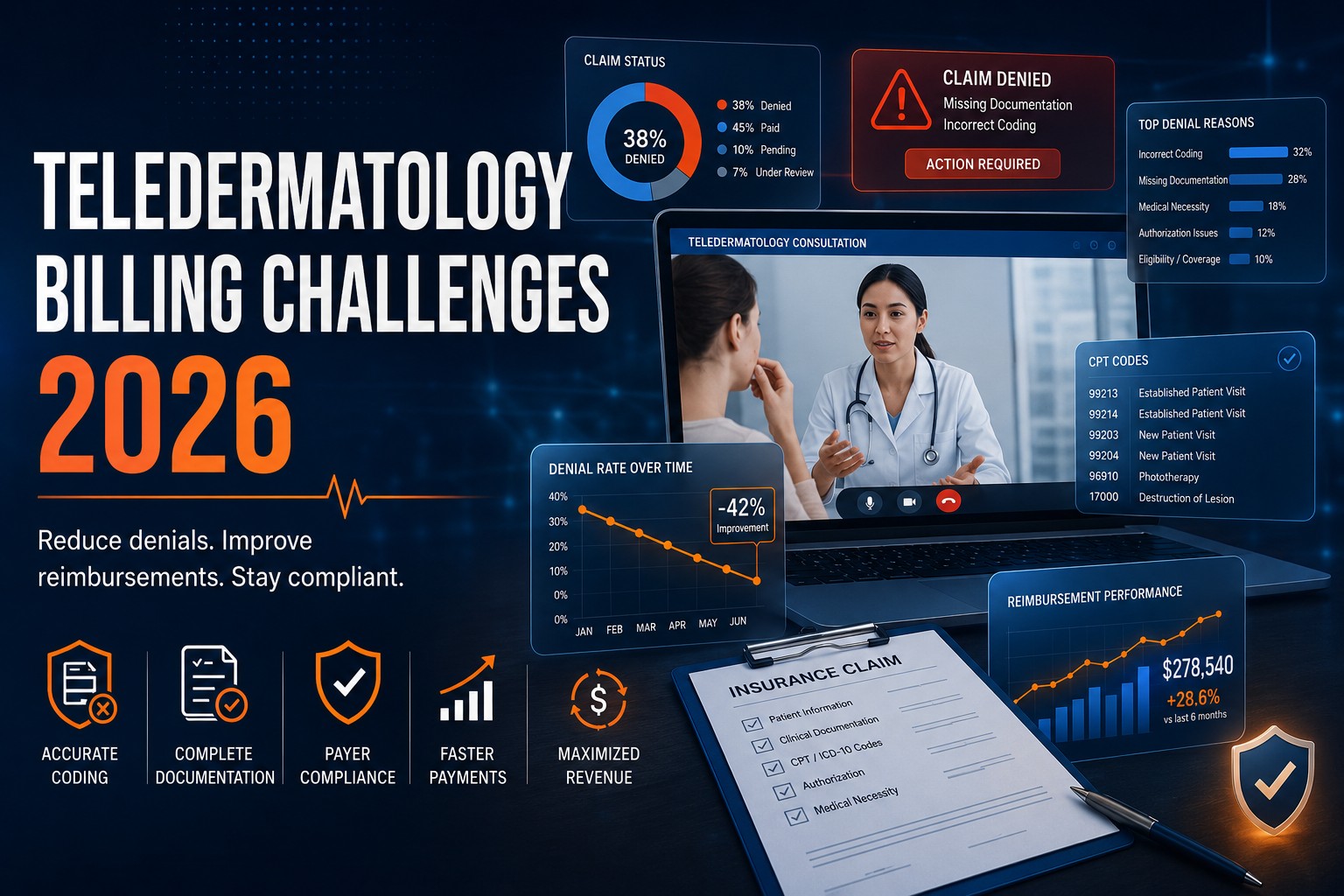
Virtual care is no longer a pandemic workaround. For dermatology practices across the United States, it has become a permanent part of how patient care gets delivered — and for good reason. Patients appreciate the convenience. Providers appreciate the flexibility. But anyone who has spent time managing the billing side of a teledermatology practice knows that the convenience stops at the clinical door.
Behind every virtual visit is a billing process that has gotten significantly more complicated. Payer rules keep shifting. Documentation requirements keep growing. And claim denial rates? They keep climbing.
In 2026, dermatology practices that are not actively managing these challenges are losing revenue they should be collecting. This guide explores the biggest teledermatology billing challenges 2026 has created for U.S. dermatology practices and what providers can do to reduce claim denials and improve reimbursement.
Why Teledermatology Keeps Growing — And Why Billing Hasn’t Caught Up
The growth of teledermatology did not slow down after the pandemic. If anything, it accelerated. Patient expectations shifted permanently, and providers who adapted early built real competitive advantages in their markets. Accurate telehealth dermatology billing processes are now essential for practice profitability.According to the American Academy of Dermatology, virtual visits are now a standard part of how practices handle follow-up care, chronic condition management, medication monitoring, and serving patients in areas where specialist access has always been limited.
People are booking online consultations for everything from acne and rosacea to psoriasis flare-ups and eczema management. Medication follow-ups that once required an in-person visit are now handled efficiently over video. That is genuinely good for patients.
The problem is that billing for these visits is nothing like billing for an in-office appointment. Different modifiers, different documentation standards, different payer rules — sometimes different rules for the same payer depending on the state. Many practices built their billing workflows around in-office care and then tried to stretch them to cover telehealth. That is where the cracks start to show.

Biggest Teledermatology Billing Challenges 2026 Practices face
Let us get specific. These are the issues we see most consistently affecting practices in 2026.
Payer Rules That Will Not Stop Changing
If there is one thing that frustrates insurance billing for teledermatology teams more than anything else, it is the pace at which payer rules change. Medicare revises its telehealth coverage guidelines. Private insurers follow with their own updates. State regulations layer on top of that. And somewhere in the middle, practices are trying to submit clean claims without a clear, stable target to aim at.
The most common pain points we hear about:
- Place-of-service coding errors that trigger automatic denials
- Modifier misuse because payer requirements were not checked before submission
- Documentation that meets clinical standards but falls short of what payers actually want
- Billing teams working off guidelines that were updated months ago
The Centers for Medicare & Medicaid Services updates its telehealth reimbursement rules regularly, and staying compliant means treating that as an ongoing responsibility — not something you handle once and move on from. Even minor coding mistakes can set off a chain of delays and denials that takes weeks to untangle.
Modifier Errors — Still One of the Biggest Problems
Modifier errors have been a leading cause For many practices, modifier misuse remains one of the most expensive teledermatology billing challenges 2026 continues to create.
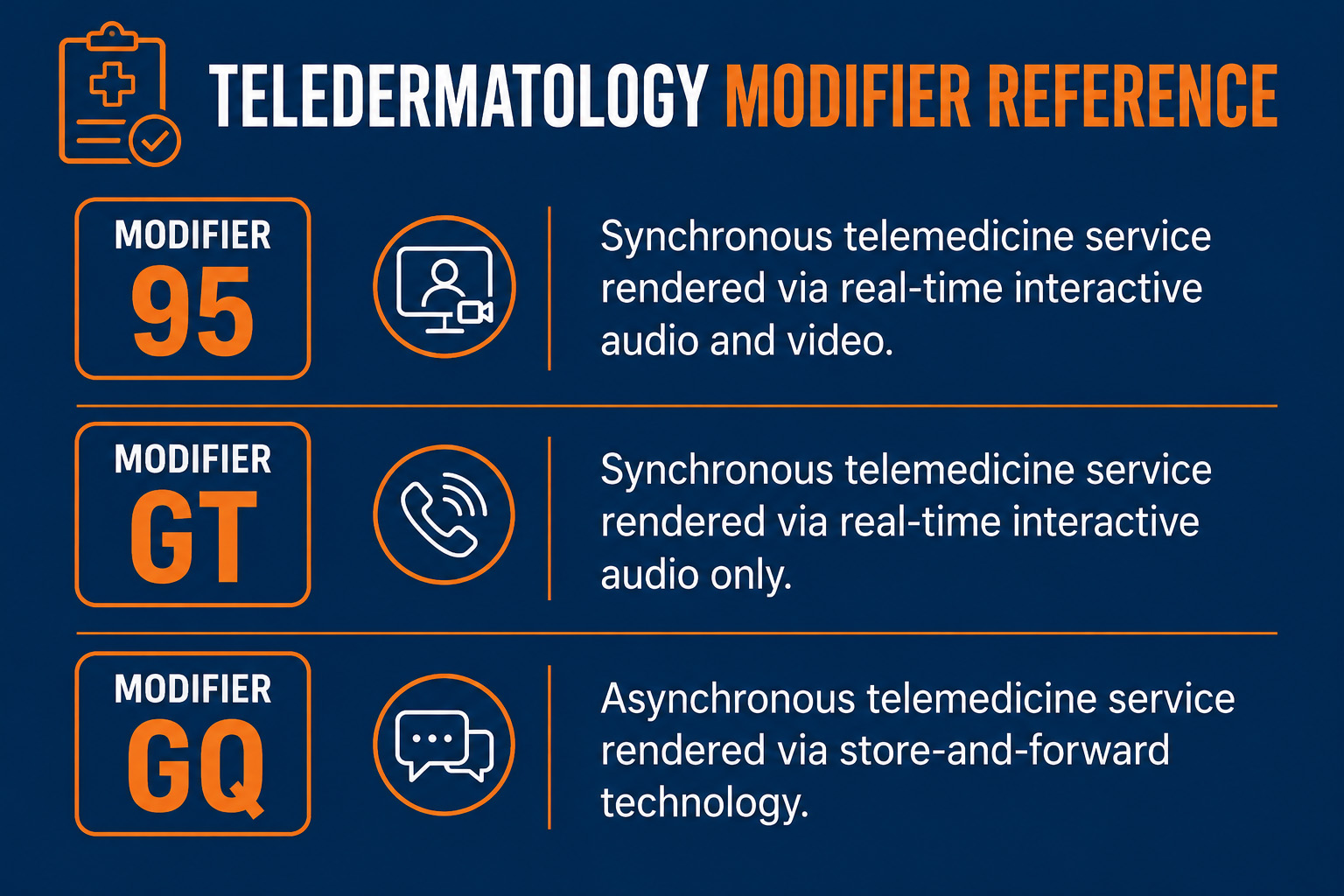
The three modifiers practices deal with most often in teledermatology are Modifier 95, Modifier GT, and Modifier GQ. On the surface, this seems manageable. In practice, it is more complicated than it looks — because the rules around which modifier to use are not consistent across payers.
Some commercial insurers require Modifier 95 for synchronous video visits. Others have their own requirements entirely. Applying the wrong modifier, or combining modifiers incorrectly, results in automatic claim rejection. No human review. Just a denial.
The fix is not complicated — it requires checking payer-specific requirements before every submission, not assuming last month’s rules still apply. But that takes time and discipline, and in busy practices it is easy for this step to get skipped.
Dermatology CPT Codes 2026 Mistakes That Cost Practices Revenue
Keeping up with dermatology CPT code updates in 2026 is genuinely difficult. Telehealth coding changes keep affecting evaluation and management services, follow-up consultations, and procedural billing — and mistakes in these areas happen more often than most billing teams would like to admit.
Three areas where we see the most problems:
Evaluation and Management Visits — Choosing the wrong E/M code level is more consequential than it might seem. Underbilling means leaving money on the table. Overbilling without supporting documentation means compliance exposure. The clinical notes need to clearly justify whatever code level was selected.
Skin Lesion Evaluations — Telehealth consultations involving suspicious lesions require more documentation than a routine follow-up. Payers want to see notes on image quality, the clinical reasoning behind any decisions made, and what the follow-up plan looks like.
Chronic Condition Management — Patients with psoriasis, eczema, or other ongoing conditions often need regular medication monitoring. That monitoring needs to be documented in a way that makes the medical necessity clear to payers — otherwise reimbursement eligibility gets questioned.
The American Medical Association CPT Resources are worth bookmarking for anyone managing dermatology billing.
Documentation: The Area Where Most Practices Are Falling Short
We will be direct about this — documentation problems are behind Incomplete records remain one of the most overlooked teledermatology billing challenges 2026 billing teams face.
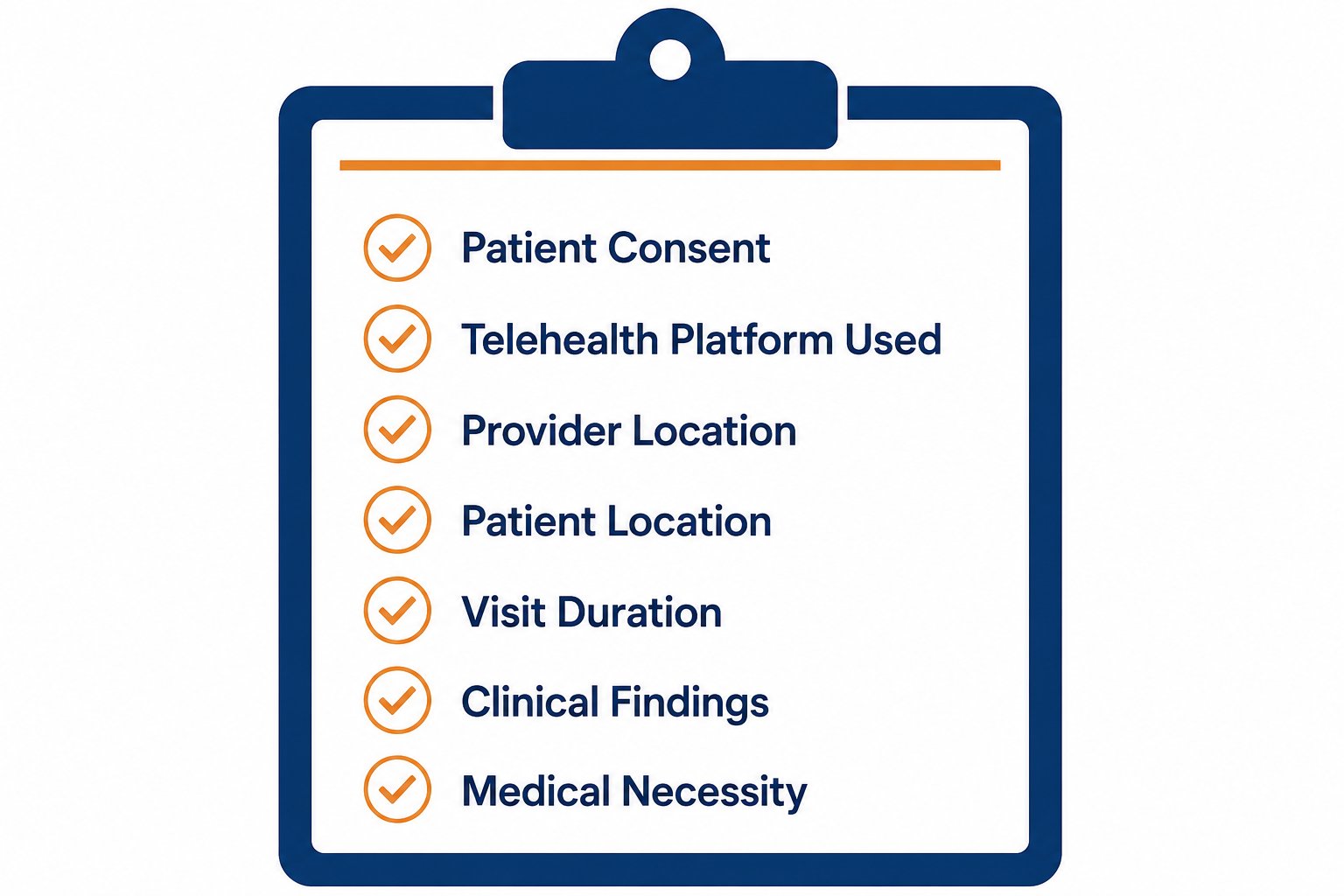
Every telehealth visit should have documentation covering:
- Patient consent for the virtual visit
- The technology platform that was used
- Location of both provider and patient
- How long the visit lasted
- Clinical findings
- Treatment recommendations
- Medical necessity
Payers are not being lenient about this. Incomplete documentation gets claims denied, invites audits, and slows reimbursements across the board. The practices that treat documentation as a clinical and billing priority — not just a regulatory formality — consistently see better outcomes on both fronts.
Prior Authorization Is Getting More Complicated
Prior authorization has always been time-consuming. In 2026, it has become a more significant operational challenge, particularly for practices prescribing biologics, specialty medications, or advanced dermatological treatments.
Delays happen for predictable reasons: incomplete telehealth documentation, missing clinical notes, insurance eligibility that was never verified, coding inconsistencies that trigger additional review. Each of those delays hits cash flow directly. Patients feel it too when their treatment gets pushed back while authorizations are sorted out.
Practices that build proactive prior authorization workflows — rather than reacting to each request as it comes — manage this much more effectively.
What Denied Claims Are Really Costing Your Practice
Many providers are actively searching for ways on how to reduce teledermatology claim denials in 2026 as payer scrutiny increases. Rising dermatology claim denials continue affecting practices nationwide.
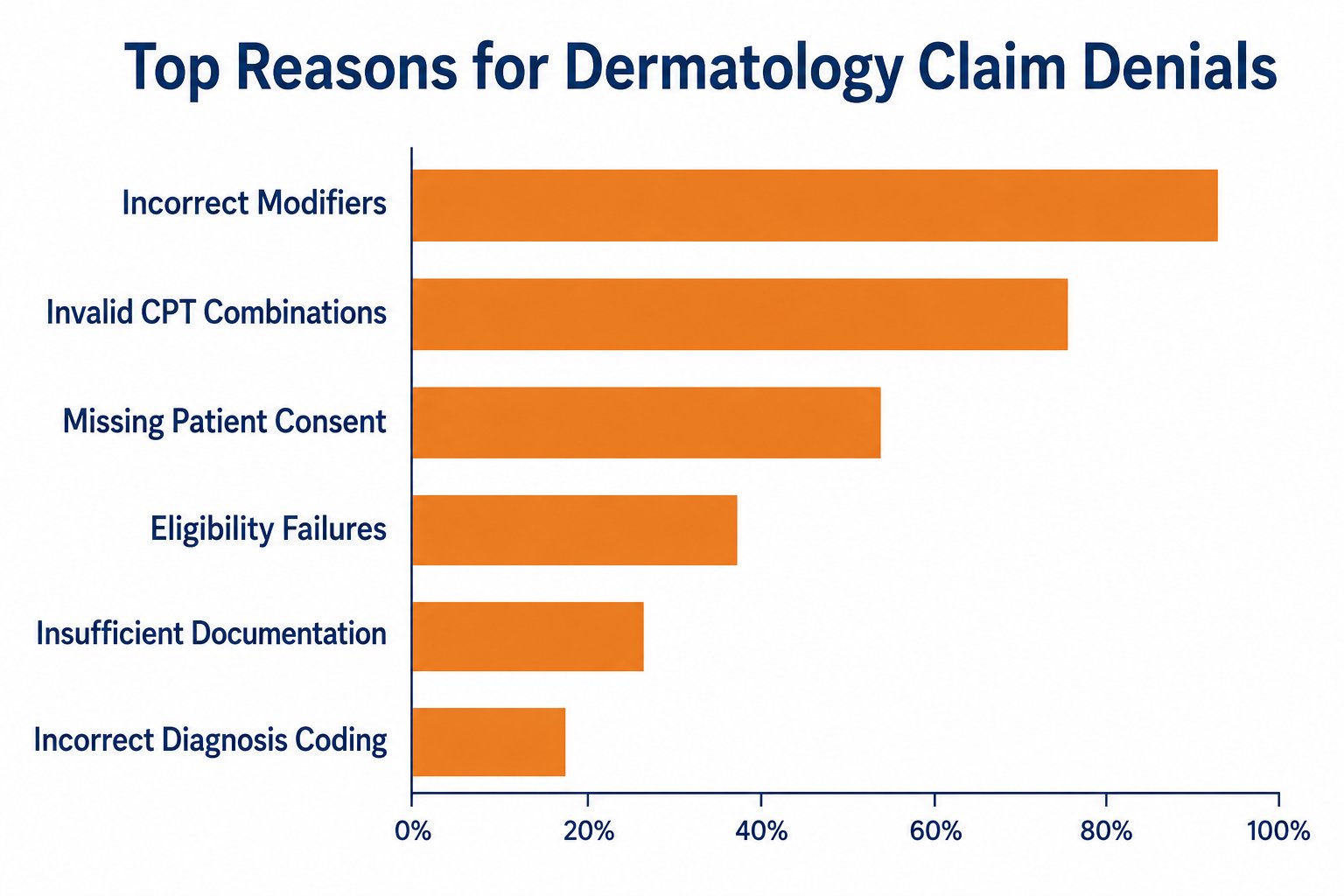
The most common reasons dermatology claims get denied include incorrect modifiers, invalid CPT combinations, missing patient consent, eligibility verification failures, insufficient documentation, and incorrect diagnosis coding. None of those are exotic problems. They are all routine billing errors — which makes it all the more frustrating when they keep happening.
When denial rates climb, billing staff end up spending their time reworking rejected claims instead of keeping the revenue cycle moving. That is why a growing number of practices are working with specialized Dermatology Billing Services USA providers who have the systems and expertise to manage telehealth reimbursement complexity at scale.
Practical Ways to Bring Denial Rates Down
There is no single fix for claim denials — it takes a combination of cleaner processes, better documentation habits, and consistent attention to payer rules. Here is what actually makes a difference.
Check Eligibility Before Every Visit
Telehealth coverage varies more than most patients or providers expect. A patient with active insurance is not automatically covered for a virtual dermatology visit. Confirming eligibility before the appointment happens is the single most reliable way to prevent billing surprises.
What to verify: telehealth coverage eligibility, copay responsibilities, which telehealth services are approved, and whether prior authorization is required. This one step, done consistently, reduces denials significantly.
Keep Up With Billing Rule Changes
Telehealth regulations move fast. Practices need to actively monitor CMS updates, state telemedicine regulations, commercial payer policy changes, and coding revisions — not catch up with them after denials start rolling in. The American Telemedicine Association publishes reliable updates and policy insights worth following.
Invest in Staff Training
Virtual dermatology billing has its own rules, and billing staff who were trained primarily on in-office coding will have gaps. Ongoing training that addresses modifier requirements, diagnosis coding, documentation standards, and payer-specific requirements reduces the errors that lead to denials. Experienced dermatology coding specialists make a measurable impact on clean claim rates.
Make Documentation a Team Priority
Providers should approach telehealth documentation with the same attention they give to any clinical note that affects patient care — because in billing terms, it absolutely does. Complete, payer-compliant documentation supports medical necessity, correct E/M coding, audit protection, and faster reimbursement. The quality of what gets documented has a direct effect on what gets paid.
Revenue Cycle Management in a Teledermatology Practice
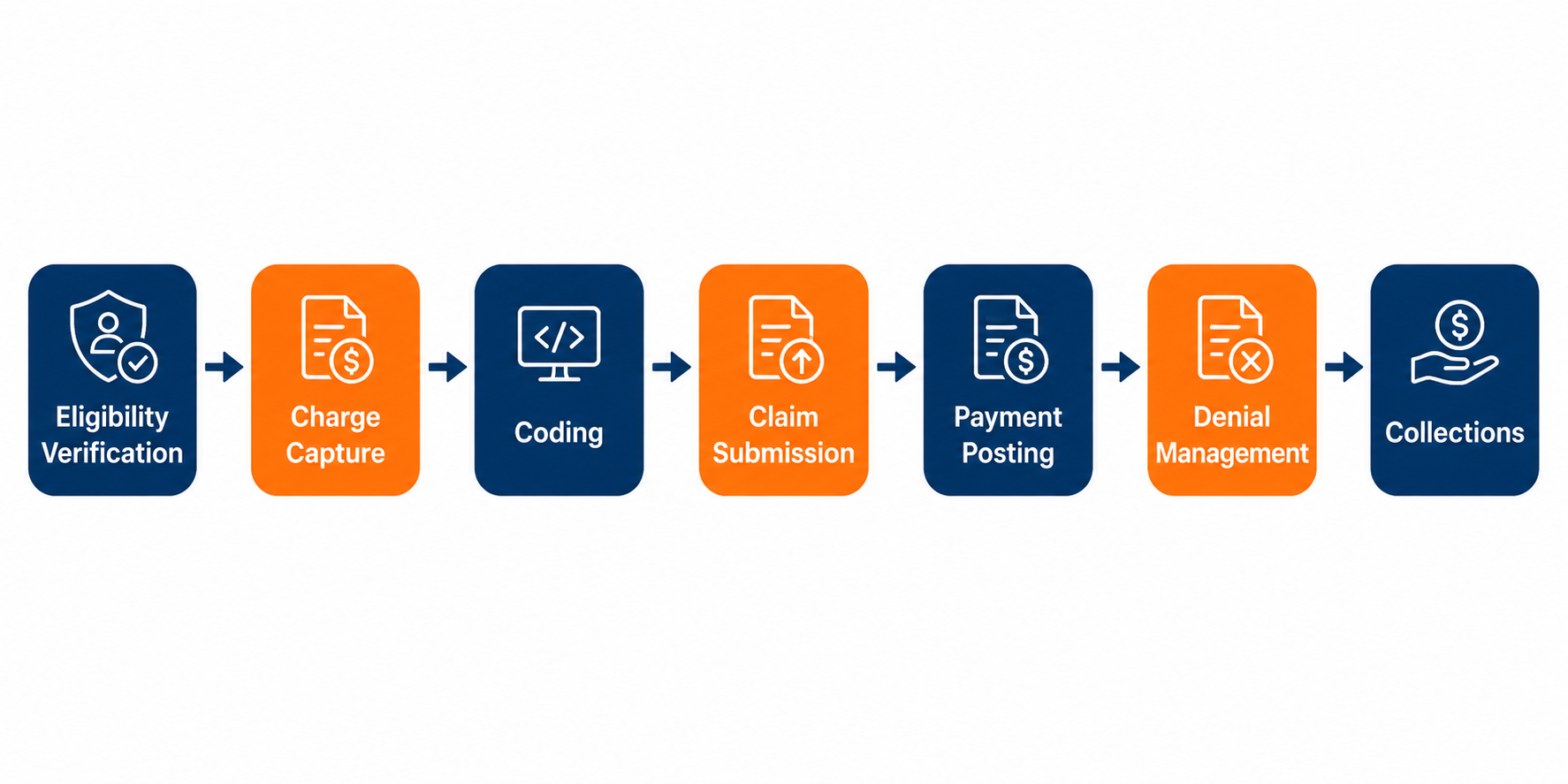
Strong dermatology revenue cycle management helps practices reduce delayed reimbursements and administrative inefficiencies. Patient eligibility verification, charge capture, coding accuracy, claim submission, payment posting, denial management, patient collections — each of these requires attention, and virtual care introduces new variables into all of them.
Practices without optimized workflows start seeing accounts receivable climb, reimbursements slow down, and profitability erode. It is rarely one catastrophic problem. It is usually a series of small inefficiencies that compound over time.
Why Outsourcing Medical Billing for Dermatologists Makes Sense for Many Practices
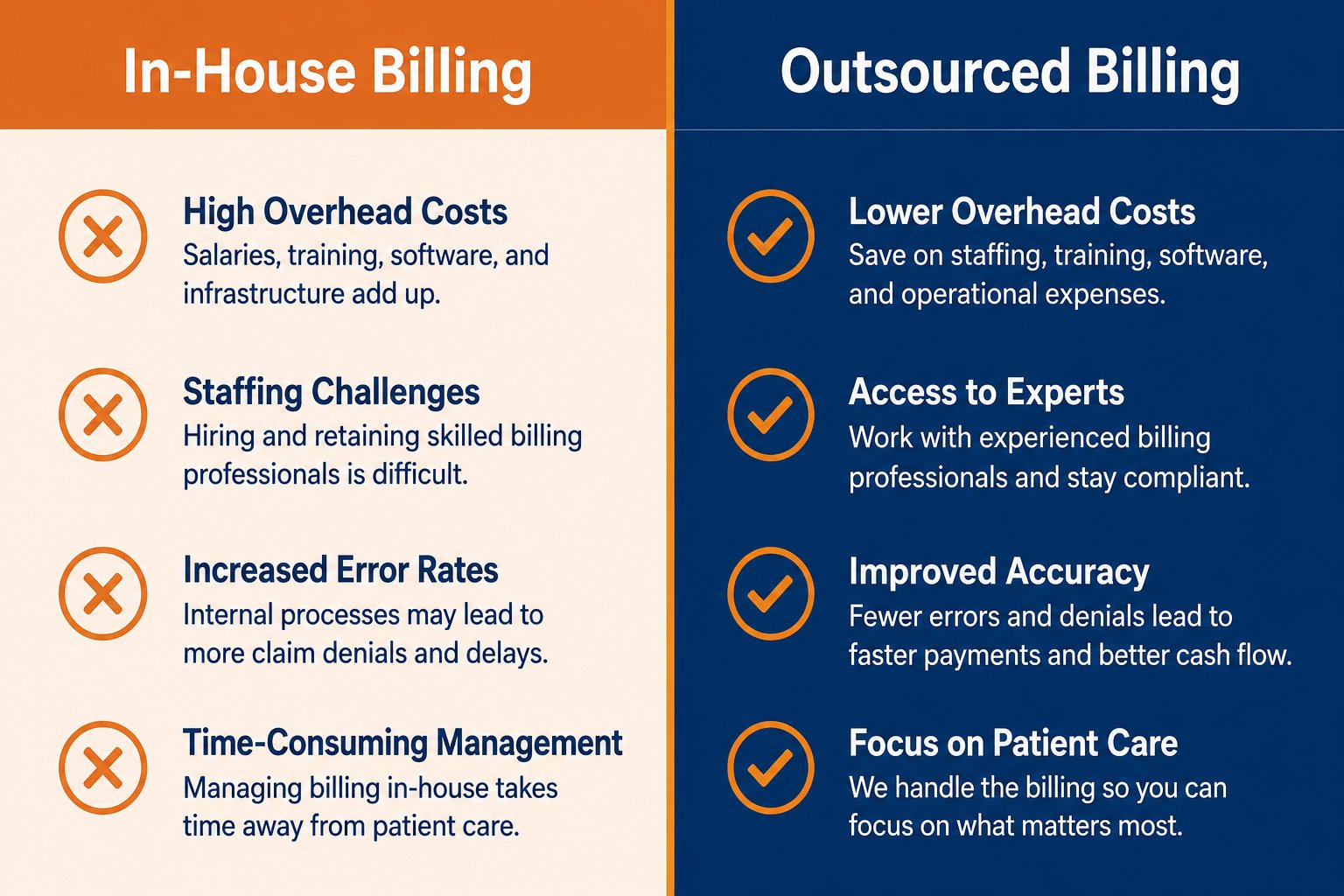
As telehealth billing has grown more complex, more practices have made the decision to stop managing it entirely in-house. It is a practical call, and for many clinics it has made a significant difference in both financial performance and day-to-day operational stress.
Outsourced billing teams keep current on payer changes, apply telehealth modifiers correctly, manage appeals, and bring coding accuracy that is hard to maintain internally when your billing staff is also handling a dozen other responsibilities. Many practices rely on Dermatology Billing Services USA companies for exactly this reason — the administrative demands of virtual care billing have simply grown beyond what most in-house teams were built to handle.
Choosing the best dermatology billing services USA for telehealth practices can significantly improve clean claim rates and when billing is handled well by a team that specializes in it, physicians get to spend more of their time doing what they actually went into medicine for.
For practices looking to get telehealth reimbursement under better control, working with a billing partner who understands dermatology specifically — not just general medical billing — is worth a serious look. You can learn more about professional Dermatology Billing Services USA solutions built for dermatology practices.
How Reimbursement Varies Across Insurance Payers
One of the more frustrating realities of teledermatology billing is that the rules are not consistent. Commercial insurers, Medicare Advantage plans, and Medicaid programs all operate under different policies — and differences can be significant.
Some payers restrict which telehealth services are reimbursable, which provider types qualify, which platforms are acceptable, and whether audio-only visits are covered at all. Geographic restrictions add another layer. Assuming that what works with one payer will work with another is a reliable way to generate denials.
Verifying payer-specific policies before submitting claims is not optional — it is a fundamental part of managing telehealth billing correctly.
Compliance Risks That Practices Cannot Afford to Ignore
Telehealth audits are becoming more frequent, and the compliance stakes that come with them are higher than they used to be. Practices need to maintain compliance with HIPAA regulations, state licensing requirements, telehealth consent policies, coding standards, and medical necessity documentation — all at once.
The U.S. Department of Health & Human Services provides compliance guidance for healthcare organizations navigating telehealth requirements, and it is worth staying current on what they publish.
Non-compliance is not just a financial risk. Audits, repayment demands, and reputational damage can follow from billing practices that fall short of regulatory standards — and recovering from that kind of exposure is significantly harder than preventing it.
What AI Is Actually Doing for Teledermatology Billing
Artificial intelligence has started making a real difference in healthcare revenue cycle operations, and teledermatology billing is no exception. AI-powered tools are helping practices with coding recommendations, denial prediction, eligibility verification, claim scrubbing, and payment trend analysis.
That said, AI works best as a support layer, not a replacement for experienced billing professionals. Complex dermatology reimbursement scenarios still require human judgment — particularly when payer rules are ambiguous or claims require nuanced documentation to support. The most effective billing operations use AI to improve efficiency while keeping experienced people in charge of decisions that actually matter.
Choosing the Right Dermatology Billing Partner
Not all billing companies are built the same, and for dermatology practices managing significant telehealth volumes, the difference between a general medical biller and a specialty-specific partner is meaningful.
The best Dermatology Billing Services USA providers bring specialty-specific coding expertise, a real understanding of telehealth billing rules, denial management support, HIPAA-compliant workflows, real-time reporting, and credentialed billing professionals who know dermatology. Practices are better served by working with companies that have hands-on dermatology experience rather than firms that apply the same generic approach to every specialty.
The Real Patient Access Benefits of Teledermatology
Despite its billing complexities, teledermatology is delivering genuine value — and that deserves to be acknowledged.
Faster access to specialist care, less travel for patients, improved healthcare access in rural communities, better chronic disease management, greater convenience overall. According to the National Library of Medicine, teledermatology is making a measurable difference in healthcare accessibility and treatment outcomes for underserved populations.
As demand grows, the challenge for practices is building a billing operation that can support that growth without becoming a bottleneck.
Billing Mistakes That Are More Common Than They Should Be
Most billing problems come from routine workflow gaps, not complex scenarios. These are the mistakes we see most often:
Not Verifying Telehealth Coverage — Coverage rules differ between payers. Assuming a patient is covered without confirming it leads to predictable problems.
Wrong Place-of-Service Codes — Incorrect POS coding can trigger an automatic denial before a human ever reviews the claim.
Weak Documentation — Incomplete visit notes are both an audit risk and a frequent cause of denied reimbursements.
Late Claim Submissions — Missing filing deadlines makes reimbursement impossible regardless of how accurate the claim is.
Not Reviewing Denial Patterns — If your team is not regularly analyzing why claims are getting denied, the same problems will keep repeating.
Catching these early makes a significant difference in long-term revenue performance.
Where Teledermatology Billing Is Headed
The billing landscape for virtual dermatology reimbursement is going to keep evolving, and practices that plan ahead will handle the transitions better than those who wait to react.
Expect expanded AI automation across billing workflows, more frequent payer audits, increasingly complex reimbursement models, greater interoperability requirements, value-based care integration, and more sophisticated revenue analytics. None of these are distant possibilities — most are already taking shape. Practices investing in education and optimized billing systems now will be better positioned when these changes hit in full.
The Eligibility Verification Step Most Practices Are Rushing Through
Insurance eligibility verification might be the most underestimated part of successful telehealth billing. The assumption that active insurance means covered telehealth services is one of the most common — and costly — mistakes practices make.
Insurance companies update their telehealth policies frequently, particularly around which dermatology services are covered, which provider types qualify, which platforms are accepted, state-specific restrictions, audio-only visit limitations, and copayment structures.
Confirming coverage before a virtual appointment is scheduled takes a few minutes. Dealing with a denied claim and an unhappy patient afterward takes much longer. Practices with strong eligibility verification workflows see faster reimbursements, fewer denied claims, fewer billing disputes, and better revenue cycle efficiency as a direct result.
Why Your Telehealth Platform Choice Affects Billing More Than You Think
The platform a practice uses for telehealth has a bigger impact on billing accuracy than most providers realize when they are selecting software. Clinical functionality gets most of the attention. Billing compatibility often gets treated as an afterthought — and that shows up later in missing documentation, incomplete coding information, and delayed claim submissions.
A solid telehealth platform should support HIPAA-compliant communication, integrated documentation workflows, EHR compatibility, automated coding support, accurate encounter tracking, and secure image sharing. When these elements are not in place, billing teams spend their time chasing information that should have been captured automatically.
Technology gaps also create compliance exposure. The Office for Civil Rights HIPAA Guidance outlines the security and privacy standards healthcare organizations need to follow when using telehealth technologies — and platform selection plays a direct role in meeting those standards.
Serving Rural Patients — And Getting Reimbursed for It
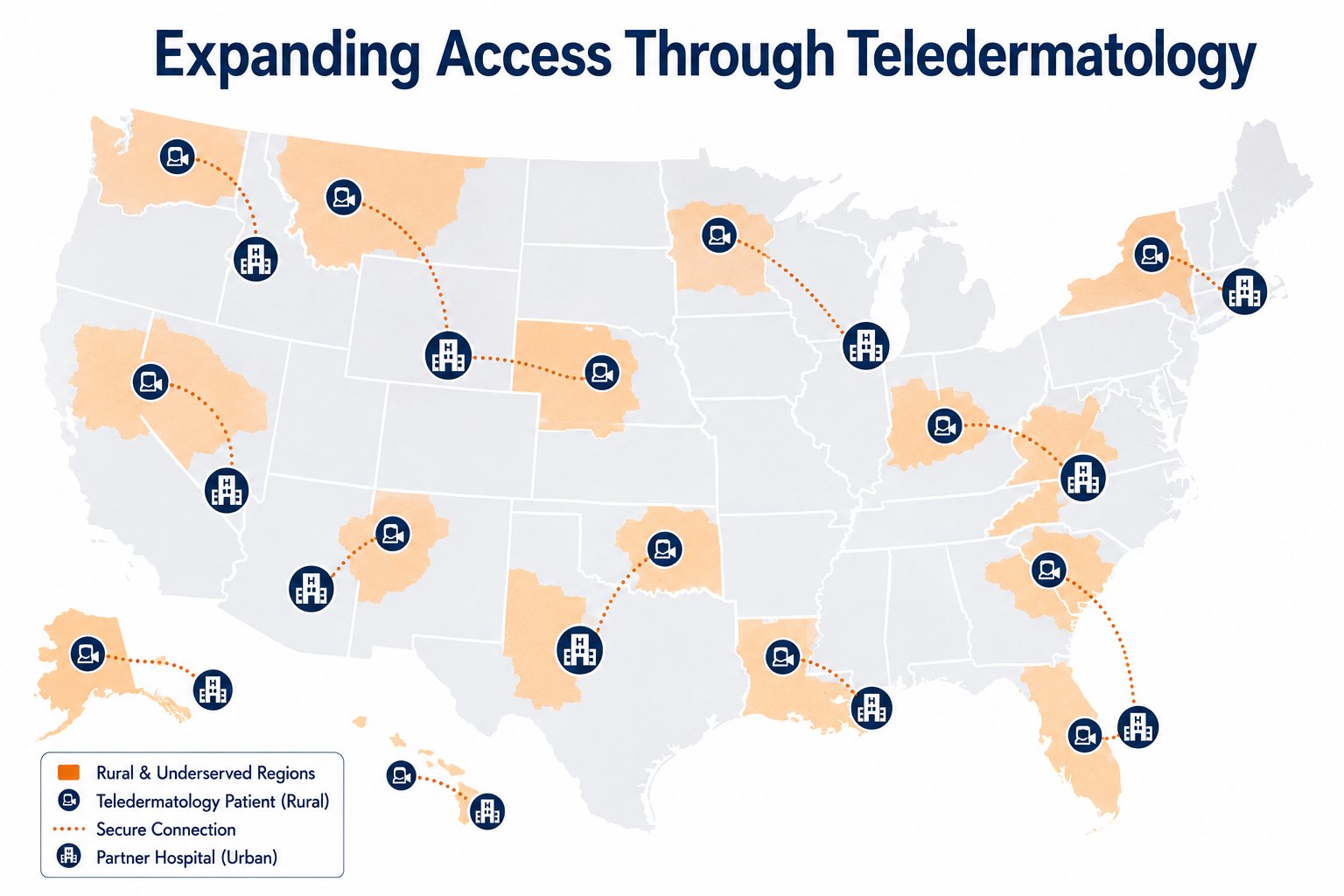
Teledermatology has become genuinely important for patients in rural and underserved areas where dermatology specialists have always been hard to access. Without virtual care, those patients deal with long drives, weeks-long wait times, limited local provider availability, and delayed treatment that compounds their conditions.
Virtual visits solve a real problem for these patients. But rural telehealth reimbursement comes with its own set of payer policies and state Medicaid requirements that differ from urban markets. Billing specialists serving rural patient populations need to understand those regional differences — overlooking them leads to costly mistakes that could have been avoided.
The Administrative Load Is Real — And It Is Growing
The administrative burden of teledermatology billing has gotten heavier in 2026. Insurance verification, claim submission tracking, appeals management, prior authorization requests, coding reviews, payment posting, denial follow-ups — for smaller practices, managing all of this internally stretches staff thin and increases error rates.
This is a large part of why outsourcing medical billing for dermatologists has become increasingly common. Specialized billing providers bring the systems, the expertise, and the dedicated capacity to keep everything running without overwhelming the people who work at your front desk and in your billing department. When the administrative side is handled well externally, providers get their time back.
What Unmanaged Denials Do to Practice Profitability Over Time
Denied claims are not a temporary inconvenience. Left unaddressed, they become a slow and quiet drain on practice revenue.
The financial impact accumulates in real ways — higher administrative costs from reworking claims, delayed cash flow, growing accounts receivable balances, permanently lost reimbursement on appeals that never get filed, and reduced operational efficiency across the board. A significant portion of denied claims are never successfully appealed. That revenue is simply gone, often due to errors that were entirely preventable.
Managing denials effectively means Practices that ignore these teledermatology billing challenges 2026 trends often experience worsening reimbursement delays. It requires root cause analysis, staff training based on what is going wrong, regular coding audits, timely appeals, and consistent tracking of payer communication. Practices that do this proactively catch recurring problems before they become expensive habits.
Why Regular Coding Audits Are Worth the Effort
Coding audits are one of the most reliable tools a practice has for catching billing problems before they escalate. They surface incorrect CPT usage, modifier errors, documentation deficiencies, compliance risks, and instances of underbilling that might otherwise go unnoticed.
As telehealth volumes grow, the importance of audits grows with them. Billing errors multiply when workflows scale, and catching them early through regular reviews costs far less than dealing with them after payer scrutiny begins. Practices that invest in Dermatology Coding Specialists consistently better positioned for long-term financial stability.
Billing Clarity Is Part of the Patient Experience
Billing efficiency is not just a back-office concern. It shapes how patients feel about their overall care experience in ways that are easy to underestimate.
Even when a virtual visit goes well clinically, a confusing bill or an unexpected denied claim leaves a lasting impression. Patients today expect transparent billing, accurate insurance processing, clear communication about their financial responsibility, and quick resolution when problems come up.
Practices that educate patients upfront about telehealth coverage limitations, copay expectations, out-of-pocket costs, and prior authorization requirements have significantly fewer billing disputes — and significantly higher patient retention.
General Billers vs. Dermatology Specialists — The Difference Is Significant
General medical billing companies often lack the specialized knowledge that dermatology telehealth reimbursement actually requires. Dermatology billing involves complexities that generalists frequently miss — biopsy coding, lesion destruction procedures, the distinction between cosmetic and medically necessary treatments, telehealth modifier rules specific to dermatology, and procedure bundling edits.
Experienced Dermatology Billing Services USA providers understand these challenges because they work with them every day. They know what payers expect and how to structure claims in a way that gets them through clean. That expertise directly affects collections and compliance outcomes.
Getting Ready for Value-Based Care
Healthcare reimbursement is steadily moving toward value-based models, and dermatology practices should be thinking about what that means for how they bill.
Value-based care rewards patient outcomes, cost efficiency, preventive care, quality reporting, and care coordination. Teledermatology is actually well-positioned for this shift — better follow-up care, improved chronic disease management, and broader access to treatment all align with what value-based models are designed to incentivize. But practices may face additional reporting requirements tied to reimbursement incentives as these models expand.
Getting familiar with that landscape now, rather than scrambling to adapt later, puts practices in a much stronger position.
The Numbers Every Practice Should Be Watching
If you are not tracking billing performance metrics, you are missing your clearest window into where revenue is leaking and where processes need work. The KPIs that matter most for teledermatology practices:
Clean Claim Rate — How many claims are accepted on the first submission without correction. This number tells you a lot about the overall health of your billing process.
Denial Rate — The percentage of submitted claims that get rejected. Rising denial rates are a signal that something in the workflow needs attention.
Days in Accounts Receivable — How quickly the practice is actually collecting what it is owed. A rising AR balance is often a sign of billing bottlenecks that have gone unaddressed.
Collection Rate — The percentage of collectible revenue that is actually being received. Gaps here usually point to specific payer or coding issues.
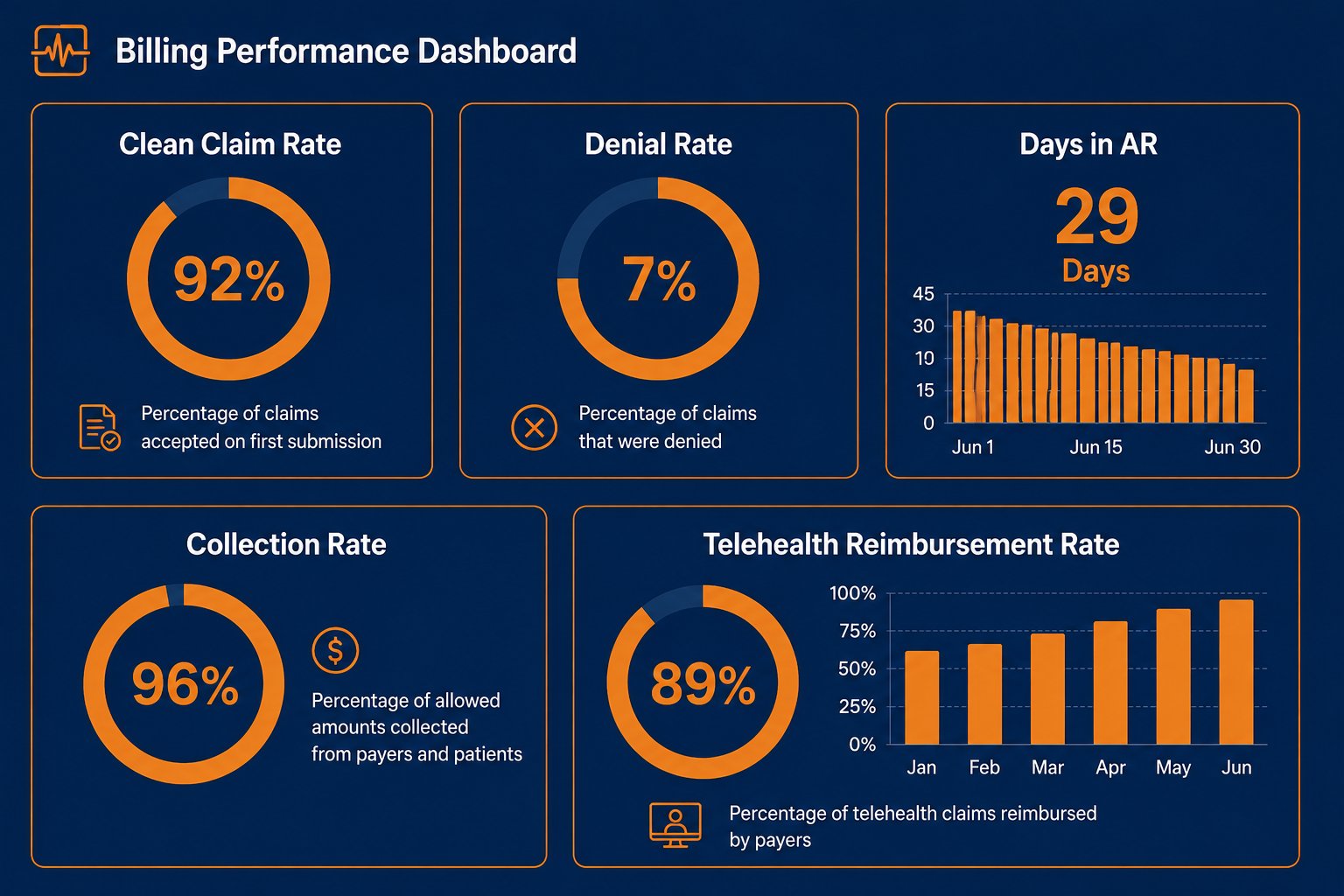
Telehealth Reimbursement Rate — How well payers are performing on virtual visit claims specifically. This metric helps identify which payer relationships need attention.
Reviewing these consistently gives practices the visibility they need to act on problems before they grow.
Training Is Not Optional — It Is Ongoing
Telehealth billing rules are a moving target. Billing teams that do not keep up with changes will make mistakes that cost the practice real money.
Good training programs cover updated telehealth coding rules, modifier changes, documentation standards, compliance regulations, and payer-specific requirements. Well-trained staff submit cleaner claims, catch errors before they go out the door, and handle denials more effectively when they do occur.
Many practices partner with experienced Dermatology Billing Services USA providers partly for this reason — specialized billing teams treat continuous education as a core part of what they do, not an occasional event.
Final Thoughts
Teledermatology is not going anywhere. Virtual care has become a permanent fixture of how dermatology practices operate, and the practices that manage the business side of it well are going to have a real advantage over those that do not.
The teledermatology billing challenges 2026 has introduced are real, but practices that improve workflows and coding accuracy can stay financially stable. — shifting payer rules, modifier complexity, documentation demands, rising denial rates. But none of them are insurmountable. They respond to the right processes, the right expertise, and a genuine commitment to staying current as the landscape continues to change.Many providers are partnering with specialized Dermatology Billing Services USA companies to improve telehealth reimbursement performance.
Strong coding accuracy, thorough documentation, proactive denial management, and a well-optimized revenue cycle are not nice-to-haves. They are what keeps a practice financially sustainable while delivering the quality of care patients expect from a virtual visit.
For many practices, partnering with experienced Dermatology Billing Services USA providers has been the most practical path to getting telehealth reimbursement under control without burning out internal staff. If that is a conversation worth having for your practice, we are here for it.
As virtual care keeps expanding, the practices that invest in the right billing infrastructure today will be the ones growing with confidence tomorrow.