
Orthopedic practices deliver some of the most complex, high-value care in medicine — yet they also face some of the highest claim denial rates in the industry. If your team is submitting clean claims and still watching rejections pile up, you’re not alone. The problem usually isn’t effort; it’s process. Understanding exactly why orthopedic claim denials happen — and building systems to prevent them — is the difference between a thriving practice and one that’s constantly chasing reimbursements.
Our team at UtreatiBill works exclusively with orthopedic and musculoskeletal practices through our orthopedic billing services, and we’ve seen firsthand how fixable most of these denials actually are. For context, the American Academy of Orthopaedic Surgeons (AAOS) reports that billing and coding complexity is consistently among the top administrative challenges facing orthopedic providers today. This post breaks down the most common causes of orthopedic billing denials and gives you a practical roadmap to fix them.
The Real Cost of Orthopedic Claim Denials
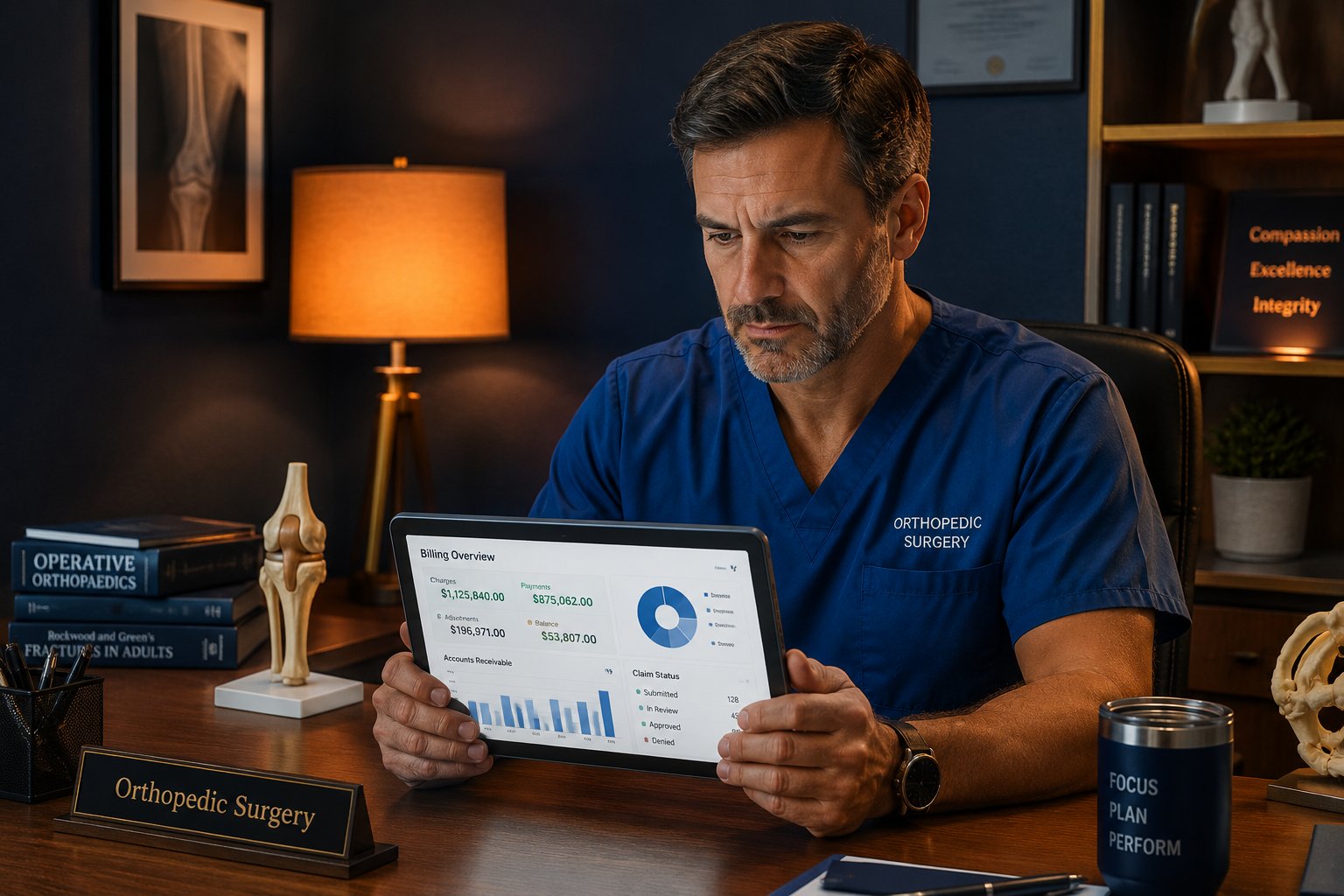
A denied claim isn’t just a billing headache — it’s a direct hit to your revenue cycle. On average, denied claims cost a practice significantly more to rework than to get right the first time. Staff time, appeals preparation, delayed payments, and write-offs add up fast.
For orthopedic practices specifically, the financial exposure is amplified. Procedures like total joint replacements, spinal fusions, and fracture repairs often carry high reimbursement values. A single denied claim on a complex surgical case can represent thousands of dollars sitting in limbo. Multiply that across a busy practice and the impact on orthopedic revenue cycle management becomes critical.
What’s more, payers are getting smarter. Pre-payment audits, automated claim edits, and tightened prior authorization requirements mean that orthopedic insurance claim rejection rates have climbed in recent years. The days of submitting a claim and assuming it’ll go through are long gone.
The good news? Most denials are preventable. Research from the American Medical Association (AMA) consistently shows that roughly 90% of claim denials are avoidable with proper coding, documentation, and verification workflows in place.

Top Reasons Why Orthopedic Claims Get Denied
Coding Errors: CPT, ICD-10, and Modifiers
Coding errors are the single most common trigger for orthopedic billing denials. Orthopedic procedures are notoriously complex to code — a rotator cuff repair, for instance, may involve multiple CPT codes for the open repair, arthroscopy, and additional work on surrounding structures. Miss one code, sequence them incorrectly, or apply the wrong modifier, and you’ve handed the payer an easy reason to deny.
CPT coding for orthopedic procedures requires precise specificity. Bundling errors — where separately billable services get grouped into a single code — and unbundling violations — where procedures that should be combined are billed separately — are frequent targets of payer edits. ICD-10 codes for orthopedics also demand careful selection. Using an unspecified fracture code when laterality and type are documented in the chart is a coding gap that will cost you.
Medical billing modifier errors are equally damaging. Modifiers like -59 (distinct procedural service), -51 (multiple procedures), and -LT/-RT (laterality) must be applied accurately and consistently. An incorrect or missing modifier can trigger an automatic denial or a reduced payment that looks like a full approval until someone runs an audit.
Prior Authorization Failures
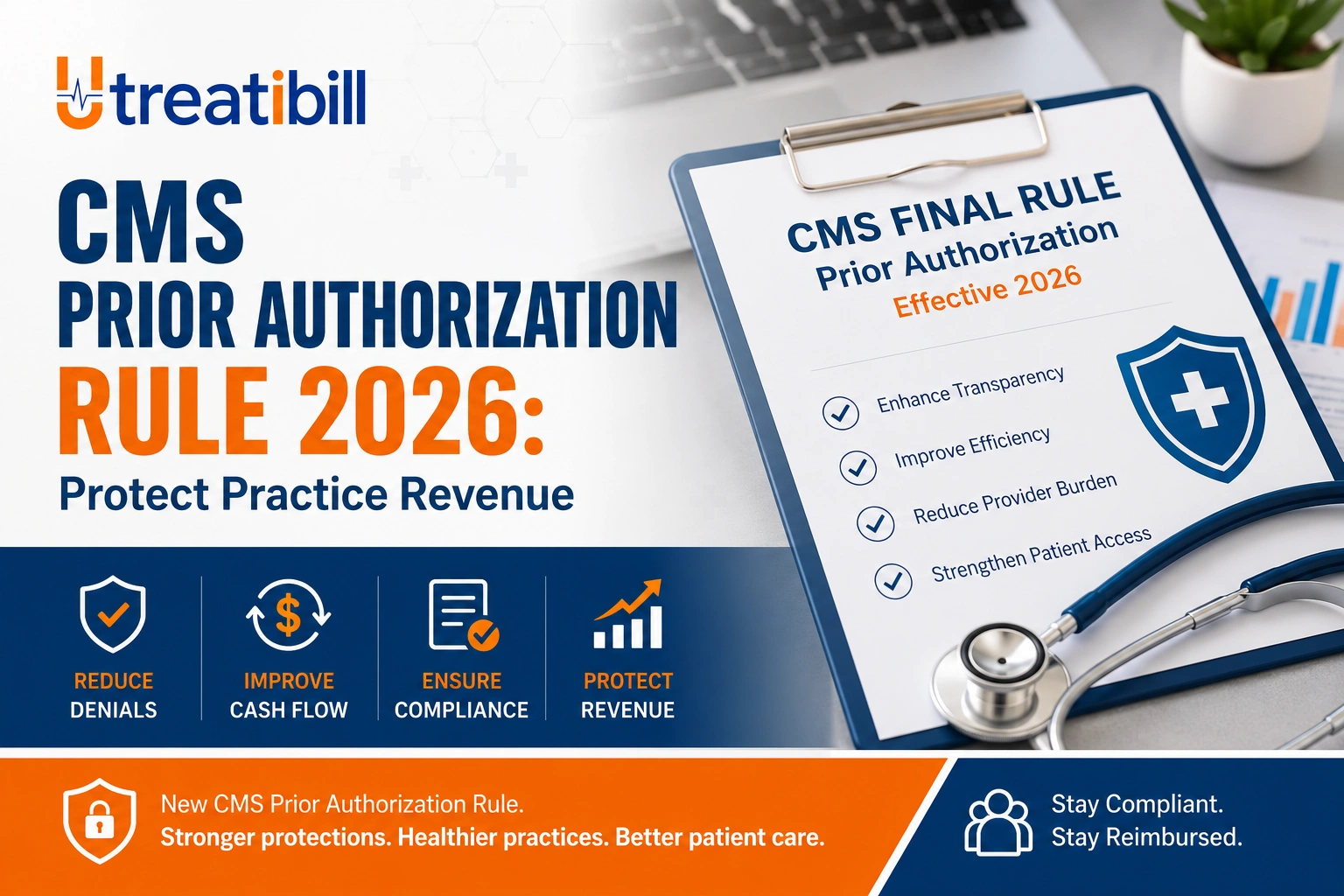
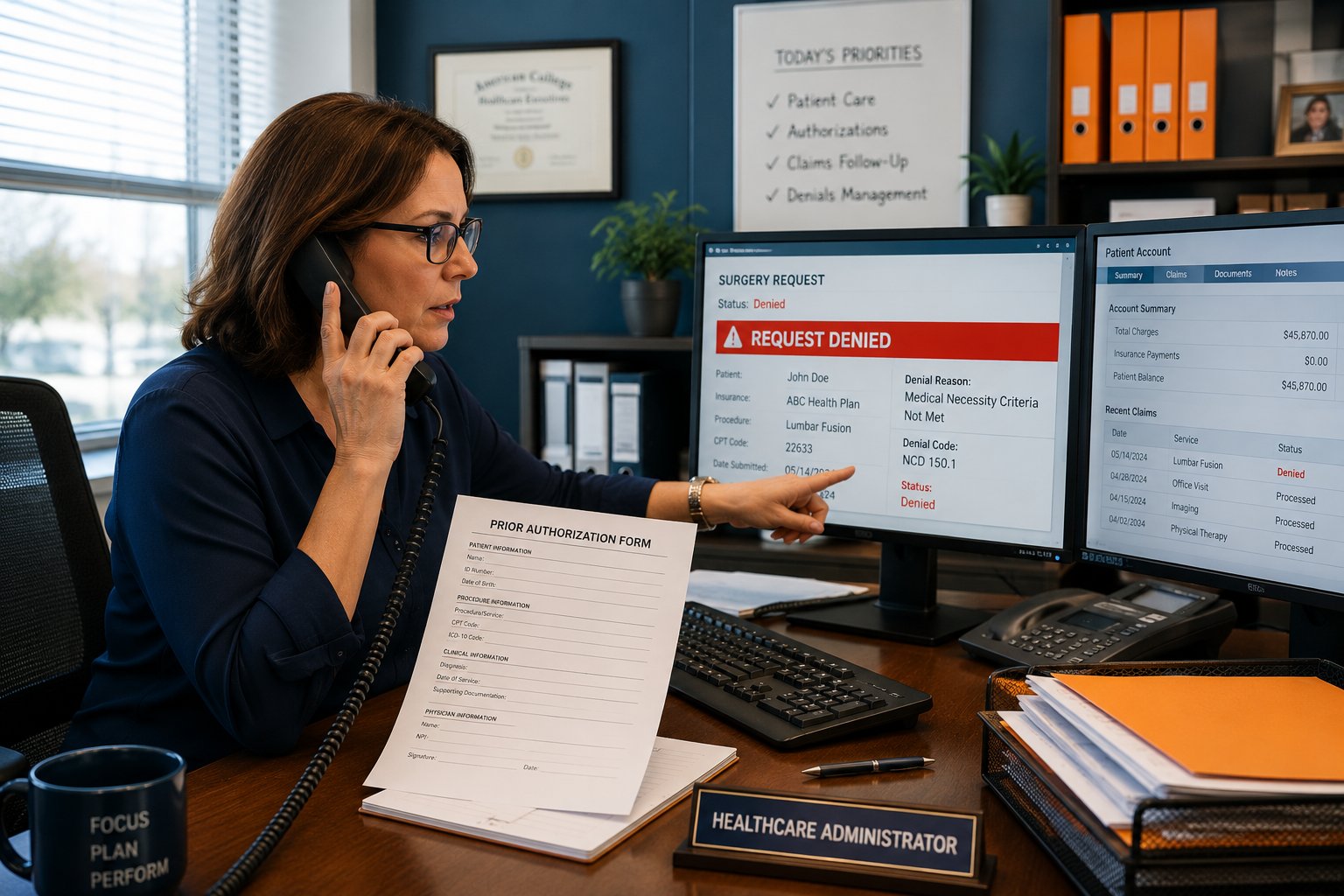
Few things derail orthopedic revenue cycle management faster than prior authorization issues. Surgical procedures, imaging, physical therapy, and injections often all require pre-approval — and the rules change constantly by payer, plan, and procedure type.
Prior authorization denial reasons for orthopedic surgery usually fall into a few buckets: the authorization wasn’t obtained at all, it was obtained for the wrong procedure or level, or documentation submitted during the auth request didn’t clearly establish medical necessity. Sometimes a surgeon changes their surgical plan in the OR and the performed procedure no longer matches the authorized one.
Building a prior authorization workflow that tracks every request, confirms approval details before scheduling, and flags any discrepancies between what’s authorized and what’s planned is non-negotiable for any practice trying to reduce orthopedic insurance claim rejection.
Insurance Verification Gaps
Orthopedic insurance verification is a step many practices underestimate — until the denials start rolling in. Coverage changes. Plans have different benefit structures for surgical vs. non-surgical care. Patients switch insurance mid-treatment, hit their deductible limits, or have coordination of benefits issues with secondary payers.
Verifying eligibility once at intake and never again is a setup for denials. A best-practice orthopedic insurance verification process confirms active coverage, plan benefits, deductible and out-of-pocket status, and authorization requirements before every encounter — not just at the initial visit.
Documentation Issues
Even when coding and authorization are handled correctly, poor documentation can sink a claim. Payers reviewing for medical necessity want to see a clear clinical picture: the patient’s diagnosis, why the selected treatment was appropriate, what conservative measures were tried first, and the expected outcome.
Vague notes, templated progress notes that don’t reflect the actual visit, and missing operative reports are all common documentation failures in orthopedic medical billing errors. And with more payers conducting retrospective audits, documentation gaps that seemed harmless at claim submission can resurface months later as demand letters or take-backs.
Common Orthopedic Billing Mistakes That Cause Denials
Beyond the major categories above, there’s a longer list of common orthopedic billing mistakes that cause denials — the kind of errors that don’t show up dramatically but quietly erode your clean claim rate over time.
Billing the wrong place of service code is one. A procedure performed in an ambulatory surgery center billed as an office visit will deny. Failing to link the diagnosis code to the specific procedure billed is another — payers want to see that the ICD-10 code logically supports the CPT code on that line. Submitting claims with duplicate service dates, outdated fee schedules, or missing taxonomy codes are all part of the orthopedic billing denials pattern that frustrates practices daily.
One often-overlooked area is coordination of benefits. When a patient has both primary and secondary insurance, claims must be submitted in the correct sequence with the correct payment amounts from each payer properly reflected. Getting this wrong creates a cascade of orthopedic billing denials that can take weeks to untangle.
Musculoskeletal billing compliance is also increasingly scrutinized. Payers watch for patterns — a practice that bills modifier -25 (significant, separately identifiable E&M service) on a high percentage of procedure days, for instance, may trigger a focused audit. Knowing where your practice stands relative to payer benchmarks matters.

How to Fix Orthopedic Claim Denials Before They Happen
The best denial is the one that never happens. That requires a proactive approach built around three core activities.
Orthopedic Claim Scrubbing
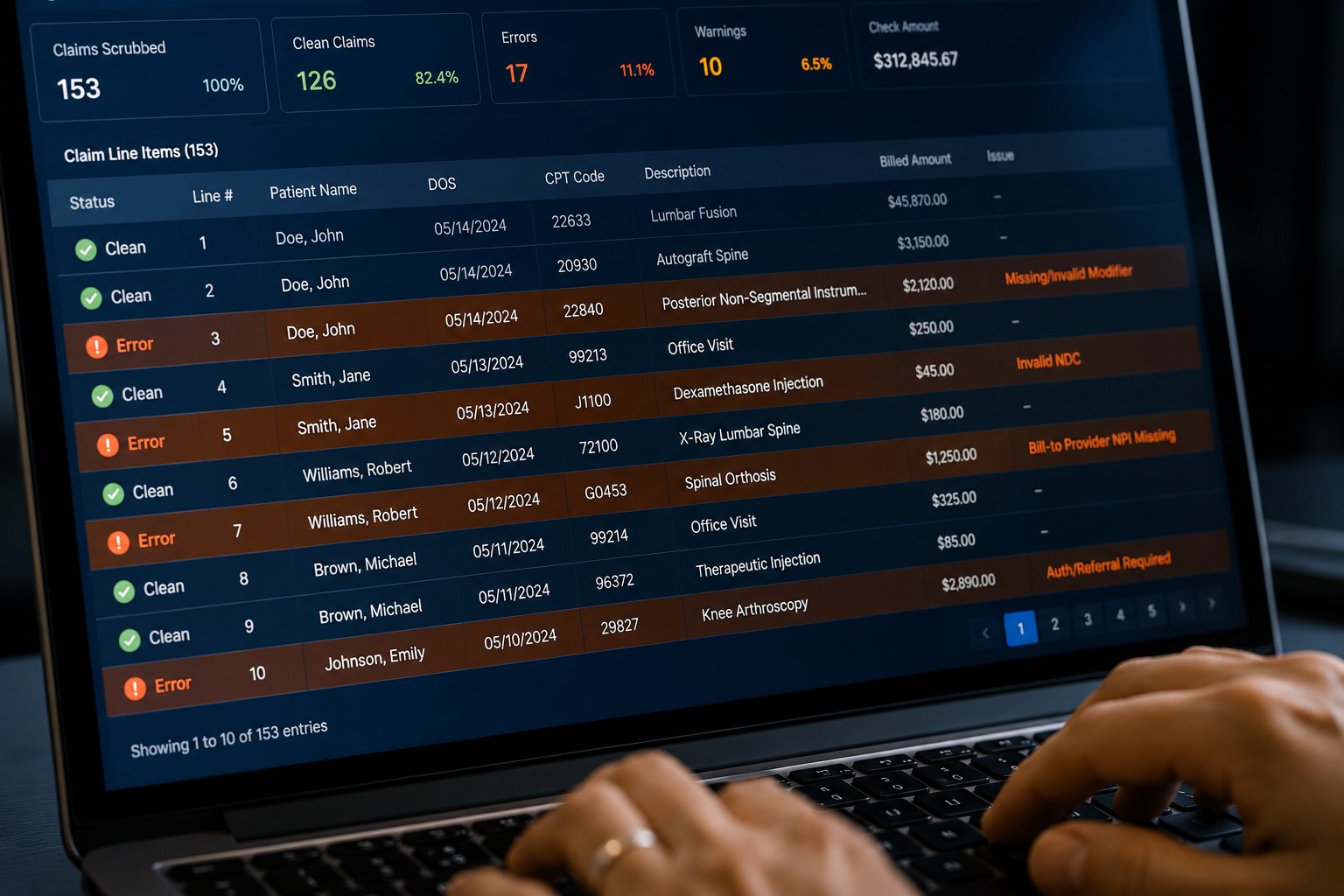
Orthopedic claim scrubbing is the process of reviewing claims for errors before they’re submitted to the payer. A robust scrubbing workflow checks for correct CPT and ICD-10 pairings, modifier accuracy, place of service codes, duplicate billing, and prior authorization numbers.
Modern billing software can automate much of this — but automation only catches what it’s programmed to look for. Experienced human reviewers are still essential, especially for complex surgical cases with multiple line items. A claim that passes automated scrubbing can still deny if the clinical documentation doesn’t support the codes billed.
Orthopedic claim scrubbing should be treated as a front-end quality control step, not an afterthought. Practices that invest in this process see measurable improvements in their first-pass acceptance rates within the first billing cycle.
AR Follow-Up Best Practices
AR follow-up in orthopedic billing is where revenue either gets recovered or quietly written off. A denial that sits unworked past the payer’s timely filing deadline for appeals is revenue gone forever. Yet many practices let AR age because they don’t have a structured workflow.
Effective AR follow-up for orthopedic billing means setting clear timelines for when denials are worked (typically within 24–48 hours of receipt), prioritizing by dollar value and denial type, and tracking root causes so they can be addressed upstream. If you’re seeing repeated denials for the same reason — say, a specific payer keeps rejecting a particular modifier combination — that pattern needs to be caught and fixed at the billing level, not just reworked case by case.
Denial Management Workflow
A structured orthopedic denial management workflow closes the loop between denials received and process improvements made. It starts with categorizing every denial by reason code, payer, provider, and procedure type. From there, the team can identify which denials are best appealed, which require clinical input, and which point to upstream process failures.
This is where orthopedic revenue cycle management becomes strategic rather than reactive. Instead of just working denials as they come in, a well-run practice uses denial data to improve coding accuracy, tighten authorization processes, and prioritize staff training where gaps are largest.
How to Appeal Denied Orthopedic Insurance Claims
When denials do happen, knowing how to appeal denied orthopedic insurance claims effectively is a critical skill. An appeal is not just a resubmission — it’s a documented argument that the payer’s denial was incorrect, supported by clinical evidence.
Start with the denial reason code. Understanding exactly what the payer is objecting to shapes the entire appeal strategy. A medical necessity denial requires different supporting documentation than a coding dispute or a prior authorization mismatch.
For medical necessity appeals, the clinical record should directly address the payer’s criteria. If a payer denies a spinal surgery as not medically necessary, the appeal should include the operative report, pre-operative imaging, a history of failed conservative treatment, and any clinical guidelines — such as those from the AAOS — that support the decision to operate.
For coding disputes, the appeal should reference the relevant CPT codebook guidance, CMS National Correct Coding Initiative (NCCI) edits, and any payer-specific policies that support the codes as billed. A letter of medical necessity from the treating physician strengthens almost any appeal.
Timelines matter enormously. Most payers give 90–180 days from the denial date to file a first-level appeal, but those windows vary. Missing a deadline forfeits the appeal right entirely, which is why AR follow-up for orthopedic billing can’t afford to be slow.
Orthopedic Billing Best Practices for Long-Term Revenue Health
Building a denial-resistant practice takes more than reacting to problems. Sustainable orthopedic billing best practices require embedding quality at every stage of the revenue cycle.
Start with staff training. Coding guidelines for CPT coding for orthopedic procedures change annually, and ICD-10 codes for orthopedics are updated each October. A team that isn’t keeping pace with those changes will gradually drift toward higher denial rates without anyone fully understanding why.
Build payer-specific knowledge into your workflows. The rules for Medicare differ from those for commercial payers, and large insurers like Aetna, UnitedHealthcare, and Cigna all have their own local coverage determinations and prior authorization policies. Knowing those specifics — and updating them when they change — is a core part of orthopedic billing best practices.
Consider whether your in-house team has the bandwidth and expertise to manage orthopedic billing denials at scale. For many practices, especially those growing quickly or dealing with high surgical volume, the complexity of orthopedic billing outsourcing starts to make sense. A specialized billing partner brings dedicated coders, denial management expertise, and continuous compliance monitoring that’s hard to replicate with a generalist in-house billing team.
Regular internal audits are also essential for musculoskeletal billing compliance. Quarterly chart-to-claim audits help catch coding drift before it becomes a payer audit, and they give providers the feedback they need to improve documentation quality. The Centers for Medicare & Medicaid Services (CMS) regularly publishes guidance on orthopedic billing compliance targets — reviewing those resources annually keeps your practice aligned with federal standards.

Your Revenue Deserves Better Than Preventable Denials
Orthopedic claim denials are frustrating — but they’re not inevitable. With the right coding expertise, verification workflows, and denial management processes in place, most practices can dramatically reduce their denial rates and recover faster when rejections do occur.
If your practice is spending more time fighting denials than focusing on patient care, that’s a sign your revenue cycle needs attention. Our team at UtreatiBill specializes in exactly this — from proactive claim scrubbing and prior authorization management to complex denial appeals and AR follow-up. We’ve helped orthopedic practices across the country stop leaving money on the table and build billing processes that work reliably.
Ready to see what’s possible? Visit our orthopedic billing services page to learn more, or reach out to book a free consultation with our orthopedic RCM solutions team. Let’s fix your denials — before they cost you another dollar.