
Internal Medicine Billing Solutions Every Practice Manager Should Know in 2026
Managing an internal medicine practice in 2026 means navigating one of the most demanding billing environments in all of healthcare. Claim denials, shifting payer rules, chronic care coding gaps, and documentation requirements are eating into revenue that your physicians have already earned. Whether your team is handling billing in-house or considering a change, the right Internal Medicine Medical Billing Services can transform your cash flow, reduce administrative burden, and give your practice the financial stability it deserves.
This guide covers the most effective internal medicine billing solutions available in 2026 — practical, proven strategies that practice managers can act on today.
Why Internal Medicine Billing Is More Complex Than Ever in 2026
Internal medicine is one of the most billing-intensive specialties in healthcare, and 2026 hasn’t made things simpler. Your physicians are managing patients with multiple overlapping chronic conditions, coordinating referrals, providing preventive care, and handling a growing volume of transitional and chronic care management services. Each encounter generates a complex mix of codes, documentation requirements, and payer-specific rules.
The CMS billing guidelines for 2026 continue to evolve around value-based care, telehealth expansion, and prior authorization reform. At the same time, the American Medical Association’s updated E/M documentation guidelines — which shifted how office visit levels are selected based on medical decision-making or total time — remain a source of coding errors for practices that haven’t fully trained their teams.
Add to that the ongoing pressure around medical billing compliance 2026, payer-specific coverage policies, and the persistent challenge of claim denials, and it’s clear: medical billing for internal medicine practices demands specialty expertise, not just general billing knowledge.
If your internal medicine revenue cycle management isn’t backed by consistent processes, trained staff, and real-time data, revenue is quietly leaking every single month.
Core Internal Medicine Billing Solutions That Drive Revenue
Let’s get specific. Here are the five billing areas that have the biggest impact on your practice’s financial performance.
1. Accurate E/M Coding for Office and Hospital Visits
E/M coding internal medicine practices rely on is the single largest driver of revenue — and the single largest source of errors. Evaluation and Management codes cover the bulk of your claim volume, and the updated guidelines give physicians flexibility to select visit levels based on either medical decision-making or total time. That flexibility is only valuable when your coders understand how to apply it.

A provider spending 45 minutes managing a patient with uncontrolled hypertension, type 2 diabetes, and chronic kidney disease should consistently be capturing a level-four or level-five visit. Defaulting to level three out of habit — or out of fear — is a form of self-imposed revenue loss called downcoding. On the flip side, upcoding without proper documentation creates audit exposure that can be costly to resolve.
What to do: Run quarterly E/M distribution reports by provider and compare them against national specialty benchmarks. If your coding clusters tightly around one or two levels regardless of visit complexity, that’s a red flag worth investigating.
2. ICD-10 and CPT Code Accuracy for Internal Medicine
The ICD-10 codes internal medicine specialists use span an enormous range — combination codes for comorbid conditions, specificity requirements for chronic disease staging, Z codes for preventive care, and everything in between. CPT codes for internal medicine are equally varied, covering wellness visits, prolonged services, hospital observation, and dozens of other encounter types.
Mismatched code pairs, missing specificity, and diagnosis codes that don’t support medical necessity are among the leading causes of first-pass denials. These aren’t just billing mistakes — they’re incomplete clinical records that can complicate continuity of care.
What to do:
- Build diagnosis code templates for your highest-volume visit types
- Review Correct Coding Initiative (CCI) edits regularly with your billing team
- Validate that every CPT code is supported by a matching, specific ICD-10 code before submission
- Audit your top-denial codes quarterly to identify patterns
Medical coding accuracy directly determines your clean claim rate. Improving it upstream is far cheaper than chasing denials downstream.

3. Chronic Care Management (CCM) Billing
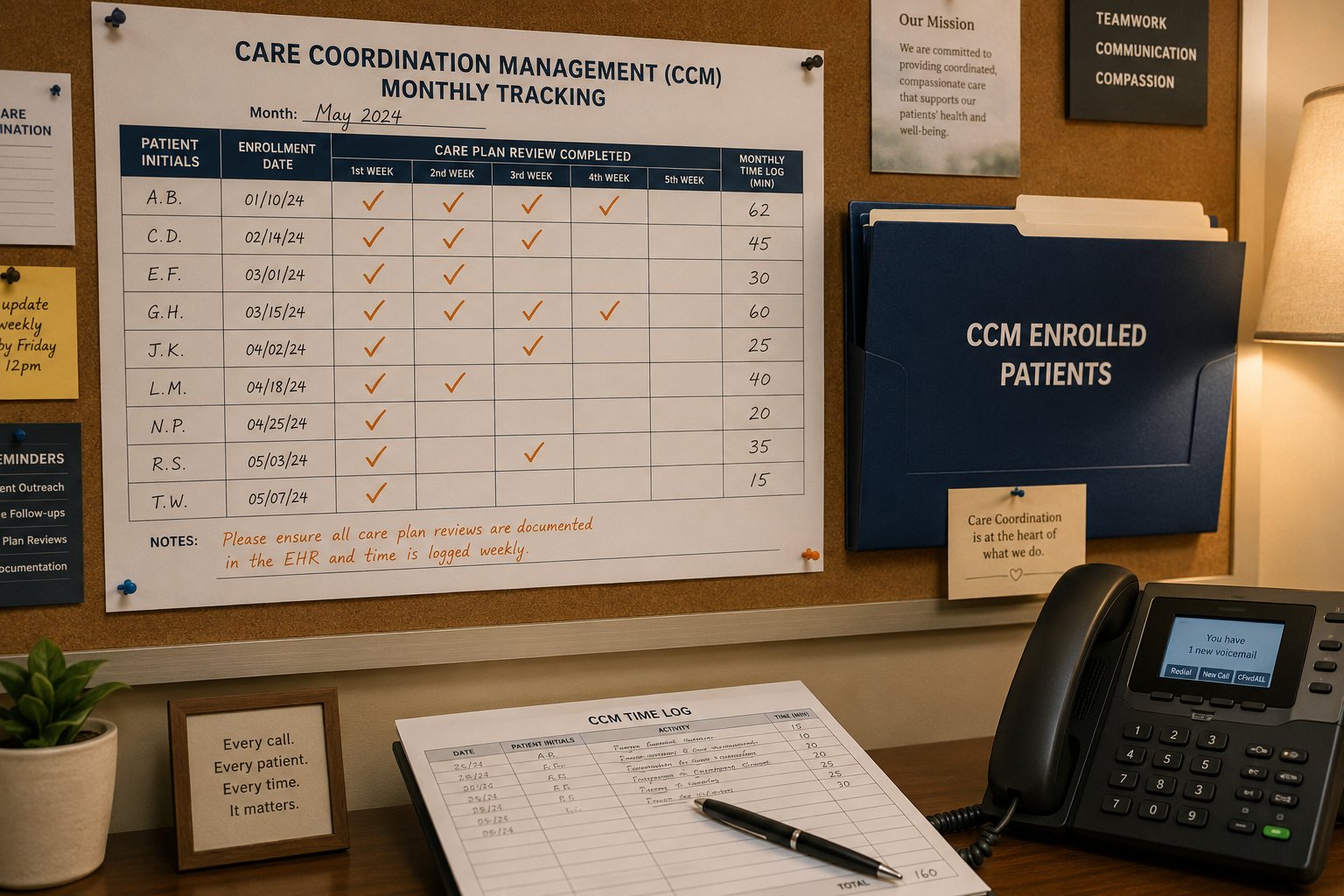
If there’s one billing opportunity that most internal medicine practices are leaving on the table, it’s chronic care management billing. Patients with two or more chronic conditions — the majority of a typical internal medicine panel — may qualify for monthly CCM services billed under CPT codes 99490, 99439, 99487, and 99489.
These codes compensate your practice for the clinical staff time spent coordinating care between visits: developing and maintaining care plans, coordinating with specialists, monitoring medication adherence, and checking in with patients managing complex conditions. For a practice with a large chronic disease panel, CCM billing can generate significant additional revenue from work your team is already doing — just not capturing.
Getting CCM billing right requires:
- Documenting informed patient consent at enrollment
- Assigning dedicated clinical staff to coordinate and track time monthly
- Using practice management software billing tools to automate time logging and monthly billing triggers
- Conducting regular audits to confirm documentation meets payer requirements
4. Prior Authorization Management
Prior authorization management has become one of the heaviest administrative burdens in internal medicine. Payers require authorizations for a growing list of services — specialist referrals, imaging studies, specialty medications, and certain procedures — and the process is notoriously slow and unpredictable.
When prior auths aren’t tracked proactively, the fallout is real: delayed care, disrupted cash flow, billing gaps, and frustrated patients. Effective prior authorization management means staying ahead of payer requirements, submitting requests early, following up consistently, and appealing denials when the clinical documentation supports medical necessity.
Healthcare revenue cycle optimization in 2026 increasingly depends on removing these bottlenecks, because delayed authorizations cascade into delayed billing, revenue gaps, and unnecessary staff rework.
5. Denial Management and Appeals
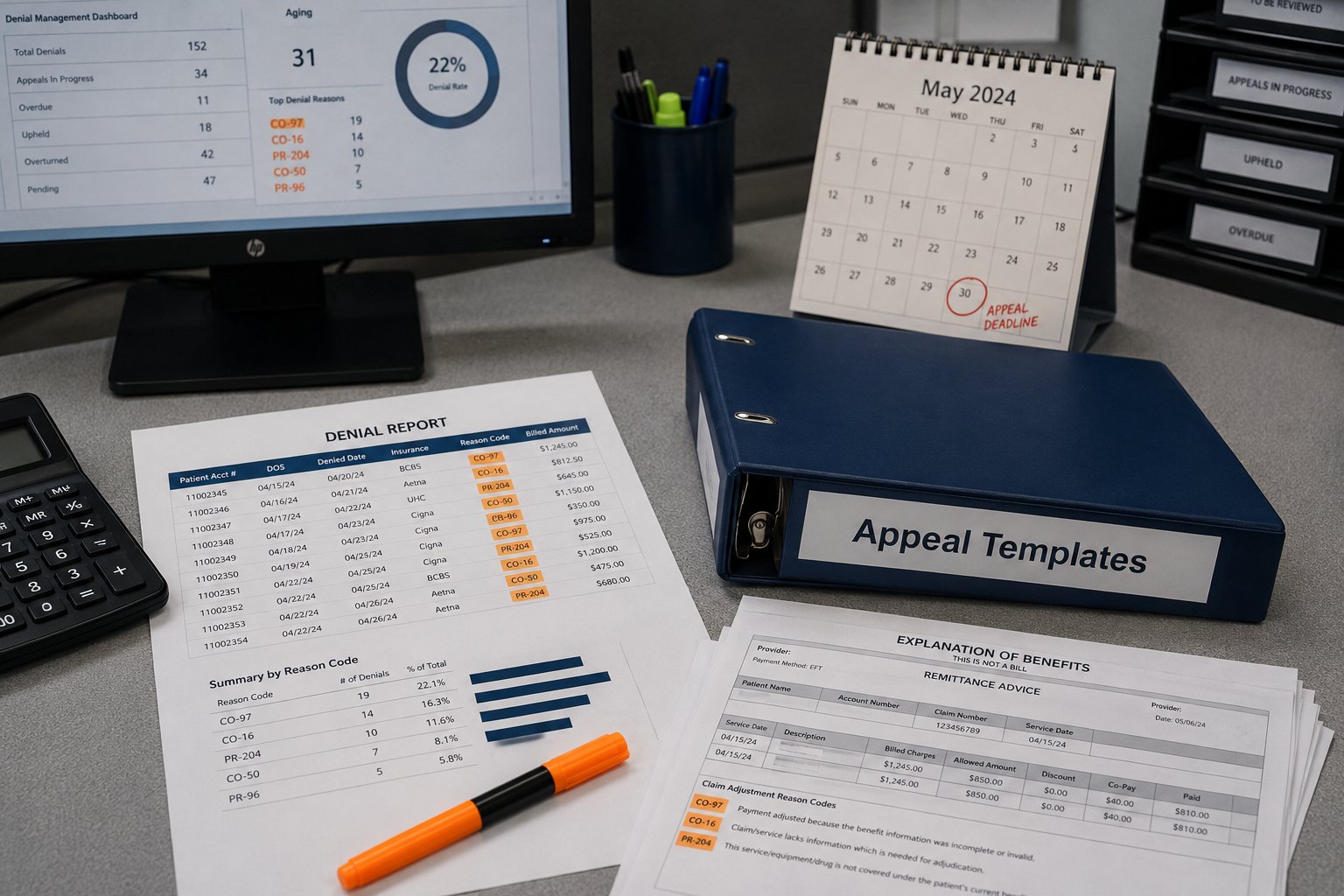
Internal medicine claim denial management is where practices lose some of their most recoverable revenue. Industry data from MGMA’s revenue cycle benchmarks suggests that average denial rates in medical billing range from 5–10%. For a practice billing $2 million annually, that’s potentially $100,000–$200,000 in claims that could be recovered — but won’t be without a structured process.
A strong denial management program includes:
- Daily or weekly denial tracking organized by payer, reason code, and provider
- Template-driven appeals with supporting clinical documentation
- Root cause analysis to trace denials back to upstream coding or documentation errors
- Clear ownership — someone on your team is responsible for the denial queue every day, not occasionally
Treating denials as a routine metric rather than an emergency response is what separates high-performing practices from those constantly chasing past-due claims.
How to Improve Internal Medicine Billing Efficiency in 2026
Understanding how to improve internal medicine billing efficiency in 2026 starts with an honest look at where your current process is breaking down. Three areas consistently deliver the highest return on attention.
Leverage Practice Management Software Billing
Modern practice management software billing platforms do far more than manage appointments. The best systems integrate real-time eligibility verification, charge capture, claim scrubbing, denial dashboards, and analytics into a unified workflow.
If your team is still manually checking eligibility, entering charges from paper superbills, or tracking denials in spreadsheets, you’re creating unnecessary errors and delays at every step. The right platform doesn’t just speed things up — it catches mistakes before they become denials.
Key features to look for:
- Automated real-time eligibility checks before each appointment
- Integrated claim scrubbing with payer-specific edits
- Denial analytics dashboards organized by payer and denial reason
- E/M coding guidance integrated into the documentation workflow
Train Staff on Medical Coding Accuracy
Medical coding accuracy doesn’t maintain itself. ICD-10 and CPT guidelines update annually, payer policies shift, and staff turnover creates quiet knowledge gaps that show up as billing errors months later.
Invest in:
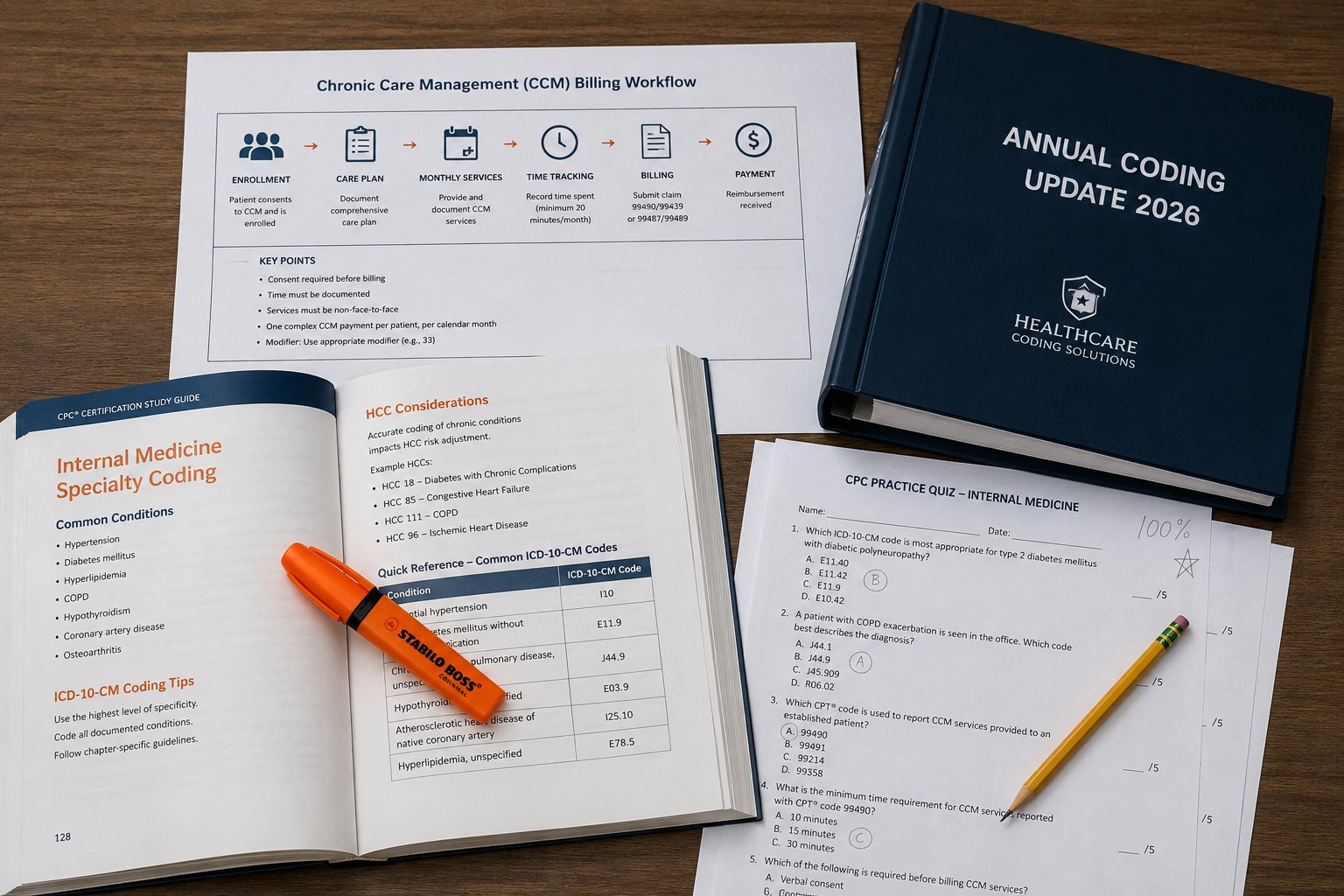
- Annual training aligned with current ICD-10 code and CPT updates
- Specialty-specific training on internal medicine codes — CCM, AWV, E/M, transitional care
- Professional certification pathways for billing staff (CPC, CCS)
- Monthly or quarterly audits with direct feedback loops to providers
Training is often the cheapest intervention with the clearest ROI in billing operations.
Monitor Your Clean Claim Rate
Your clean claim rate — the percentage of claims accepted and paid on first submission — is one of the best single indicators of billing health. The industry standard target is 95% or higher. If yours is below 90%, you’re burning money on rework, extended A/R days, and write-offs.
Track this metric monthly by payer and by provider. When you see a dip, investigate the root cause before it compounds. Clean claim rate improvement over time is almost always the result of better eligibility verification upstream and more accurate coding at the point of documentation.
Common Internal Medicine Billing Mistakes That Cost You Revenue
Even practices with experienced billing teams make recurring errors. Recognizing these patterns is the first step toward fixing them.
Upcoding or Downcoding E/M Visits
Both are problems, just in different directions. Upcoding without proper documentation creates audit and recoupment risk. Downcoding — which is far more common than most practice managers realize — is revenue your physicians earned but never collected. E/M coding internal medicine requires documentation that accurately reflects the clinical complexity of each visit, every time.
Missing or Incorrect ICD-10 Codes
The ICD-10 codes internal medicine practices most frequently miss are combination codes for comorbid conditions (like diabetes with diabetic nephropathy), codes requiring laterality or staging, and Z codes for preventive encounters. Missing specificity or using unspecified codes when a more precise option exists can trigger denials or reduce reimbursement.
Ignoring Chronic Care Management Billing Opportunities
Chronic care management billing gets skipped because the workflow feels complicated to set up. But once it’s running, it’s largely routine — and the revenue impact for a chronic-disease-heavy internal medicine practice is substantial. Don’t let the setup cost prevent you from capturing reimbursement you’ve already earned through the care you’re providing.
Failing to Track Denied Claims
Denied claims that sit unworked beyond 30 days are harder — and often impossible — to recover. Internal medicine claim denial management requires consistent attention. Without a daily or weekly denial workflow, claims age out, deadlines pass, and recoverable revenue becomes a write-off.
Best Billing Solutions for Small Internal Medicine Practices
Small practices sometimes assume that robust billing infrastructure is only available to large hospital-owned groups. That assumption is worth revisiting. The best billing solutions for small internal medicine practices in 2026 are more accessible — and more effective — than ever.

Outsourced billing partnerships are now cost-competitive with in-house teams for practices with 1–5 providers. A specialized billing company brings coder expertise, denial management staff, and compliance oversight without the overhead of full-time employees.
Cloud-based practice management platforms designed for small practices — like Athenahealth, AdvancedMD, or Kareo — offer enterprise-grade billing features at small-practice pricing tiers.
Revenue cycle audits can be transformative. Even a one-time external audit often uncovers revenue leakage that internal staff missed — CCM opportunities, undercoded E/M visits, or unworked denials. Many billing vendors offer free initial assessments.
Structured CCM programs are particularly valuable for small practices with chronic disease-heavy panels. The revenue potential is real, and the workflow doesn’t require significant staff additions once it’s set up correctly.
The right solution depends on your practice size, payer mix, and current pain points — but almost every small internal medicine practice has room to improve billing outcomes meaningfully.
Why Outsource Internal Medicine Medical Billing Services?
Why outsource internal medicine medical billing services? For most practices, the answer comes down to three things: expertise, stability, and return on investment.
Expertise: Internal medicine billing involves specialty-specific nuance — CCM coding, complex E/M documentation, chronic disease management billing, and navigating payer policies for high-acuity patients. A generalist billing team may lack the depth to handle these consistently.
Stability: Outsourced billing for internal medicine eliminates the disruption of staff turnover, training gaps, and sick days affecting your billing cycle. Your revenue doesn’t pause because your biller resigned.
Return on investment: Most outsourced billing services cost between 4–8% of collections. Compare that to the fully loaded cost of an in-house billing employee — salary, benefits, software licenses, and training — plus the revenue left on the table from missed CCM billing or unworked denials. The math often favors outsourcing, especially when you account for improved first-pass acceptance rates.
Medical billing compliance 2026 requirements add another layer to this calculation. Staying current on CMS updates, payer policy changes, and ICD-10 code revisions is a full-time effort. Outsourcing to a team that tracks these changes continuously is often the most reliable way to stay compliant without pulling your clinical staff into administrative work.
How Utreatibill Handles Internal Medicine Revenue Cycle Management
At Utreatibill, our team focuses exclusively on medical billing for internal medicine practices. That specialization isn’t just a selling point — it shapes every part of how we work.
Our approach to internal medicine revenue cycle management covers every stage of the billing cycle:
- Charge capture and coding review — we review documentation for coding accuracy and completeness before claims go out
- Claim submission and follow-up — we track every claim through the payer process and follow up proactively on unpaid or pending claims
- Denial management — we investigate, appeal, and resolve denied claims with internal medicine-specific expertise
- CCM program support — we help practices identify eligible patients, build the monthly workflow, and capture CCM revenue reliably
- Prior authorization handling — we manage authorization requests and status follow-ups, freeing your clinical staff to focus on patients
- Compliance monitoring — we stay current on medical billing compliance 2026 requirements, including CMS updates and payer-specific rule changes
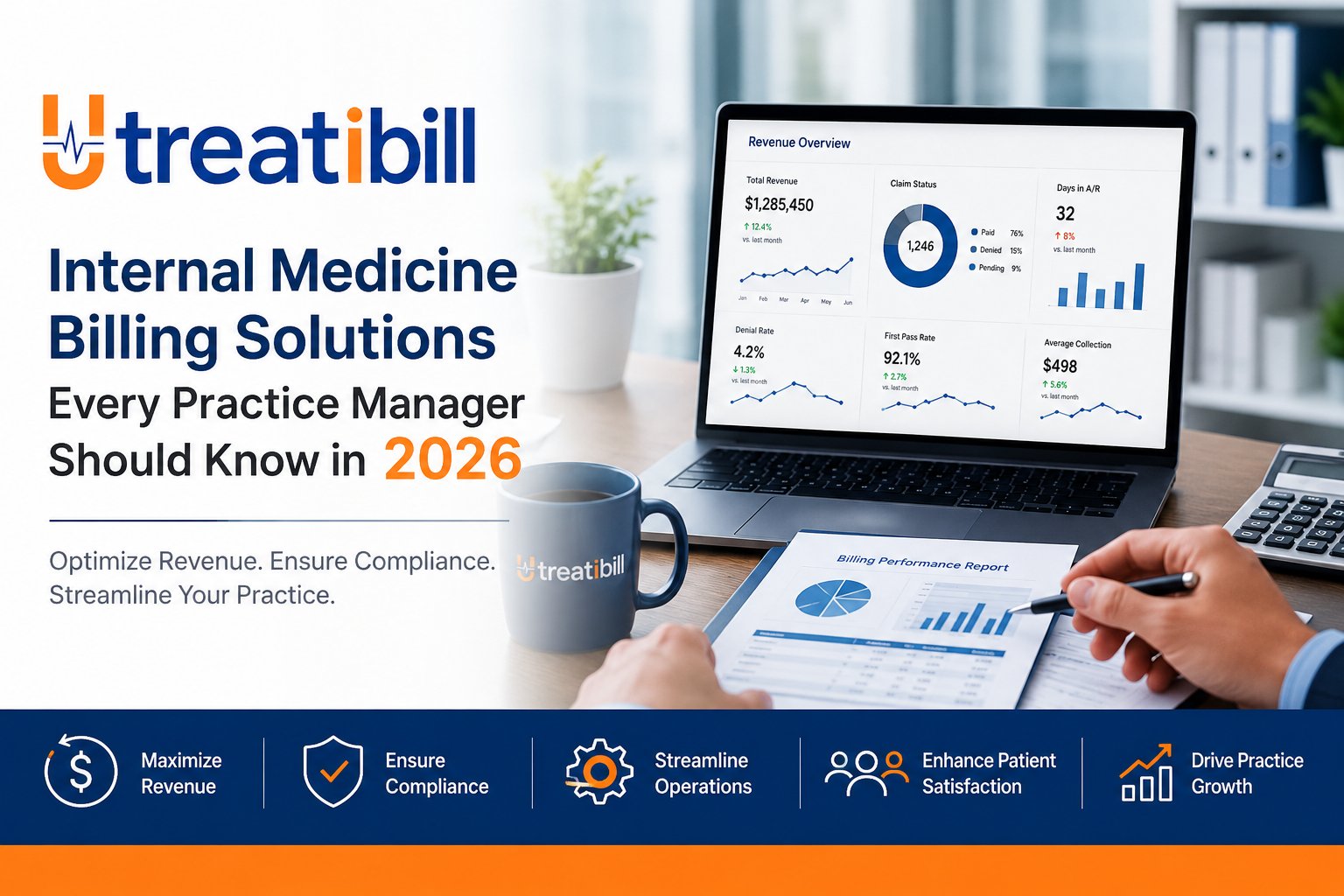
- Real-time reporting — you have full visibility into clean claim rates, denial rates, days in A/R, and collection percentages at all times
We offer flexible engagement models, whether your practice wants end-to-end billing management or targeted support for a specific revenue problem. Explore our internal medicine billing solutions to see how we can support your practice.
Internal Medicine Billing and Coding Tips for Practice Managers
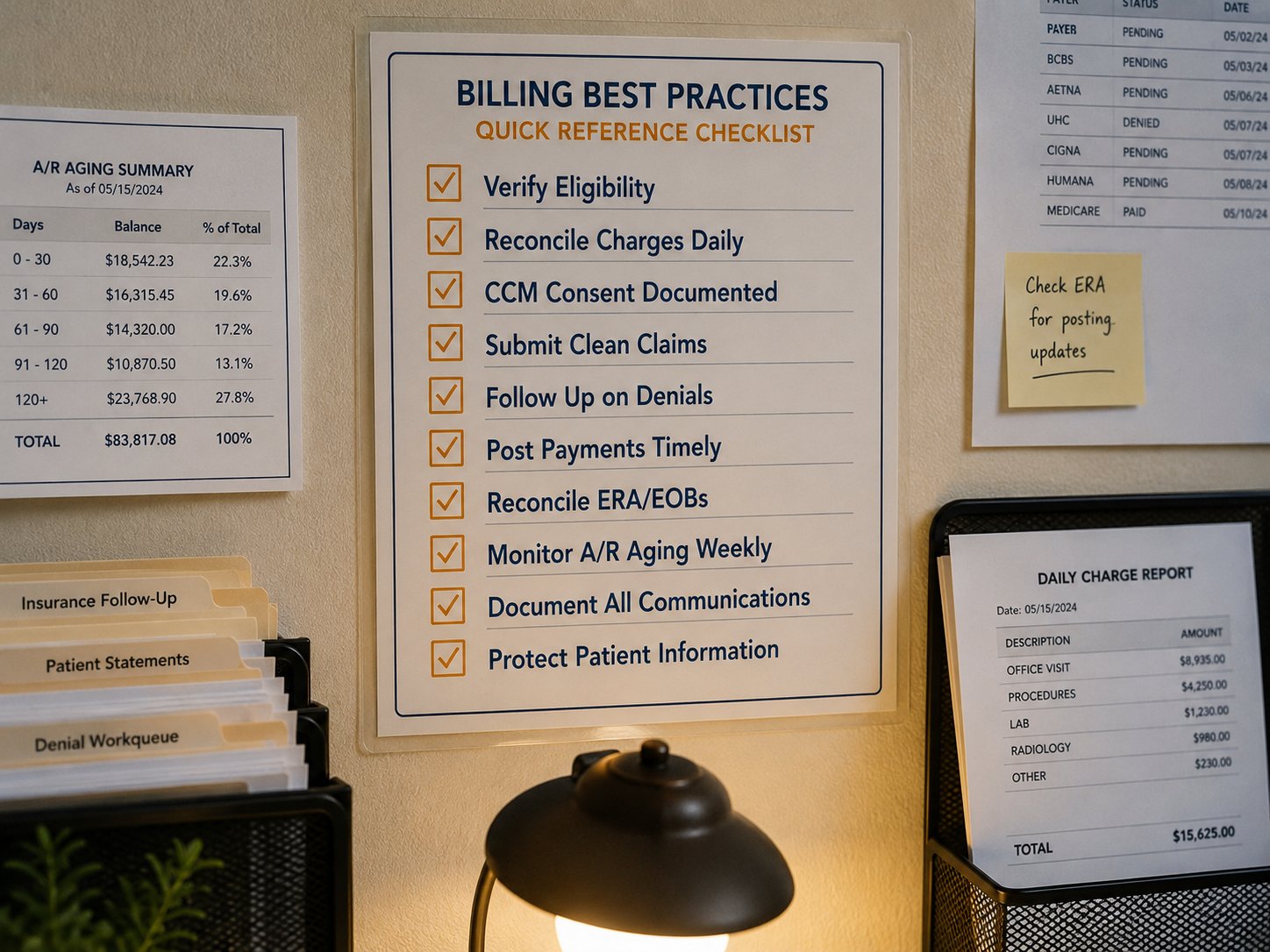
Here are actionable internal medicine billing and coding tips for practice managers to implement now — no large-scale overhaul required.
- Reconcile charges daily. Charge lag is one of the most common and preventable sources of revenue leakage. Don’t let unbilled encounters accumulate past 24–48 hours.
- Verify eligibility before every visit. Real-time eligibility checks catch coverage lapses, plan changes, and coordination of benefits issues before they become denials.
- Audit E/M coding quarterly by provider. Compare each provider’s coding distribution against internal medicine specialty norms. Outliers — high or low — warrant investigation.
- Pursue CCM proactively. Identify your chronic disease patients, obtain consent, and build monthly care coordination workflows into your clinical operations.
- Use CPT codes for internal medicine precisely. Prolonged services, transitional care management codes (99495, 99496), and advance care planning codes (99497, 99498) are frequently missed — check that your team knows when and how to use them.
- Track A/R aging weekly. Claims sitting beyond 60 days without resolution need immediate attention. Don’t wait until month-end to notice.
- Review your payer mix annually. Understanding which payers generate the most denials — or the slowest payments — helps you prioritize where to invest improvement efforts.
- Document medical necessity explicitly. Don’t assume payers will infer why a service was ordered. The clinical reasoning needs to be in the record.
Understanding how to improve internal medicine billing efficiency in 2026 often means returning to these fundamentals. Consistent execution beats complex solutions.
Conclusion
Internal medicine billing in 2026 is undeniably complex — but complexity doesn’t have to mean constant revenue loss. With the right internal medicine billing solutions in place, your practice can reduce denials, capture revenue from services you’re already delivering, and build a healthcare revenue cycle optimization strategy that keeps pace with your growth.
The practices that perform best treat billing as a strategic priority, not a back-office afterthought. They invest in medical coding accuracy, stay current on medical billing compliance 2026 requirements, and use data to make decisions about where to improve. They capture CCM revenue. They work their denial queues. They know their clean claim rate by payer — and they act when numbers move in the wrong direction.
If your practice is ready for a fresh look at its billing operation — or you simply want an expert perspective on what might be underperforming — our team at Utreatibill is here to help. We work exclusively with internal medicine practices and have a proven track record of improving collection rates, reducing denials, and building billing processes that run smoothly without constant intervention.
Book a free billing consultation with our team, or learn more about our Internal Medicine Billing Services and how we support practices like yours. A single conversation could uncover thousands in recoverable revenue — and a clearer path to the financial performance your practice is capable of.