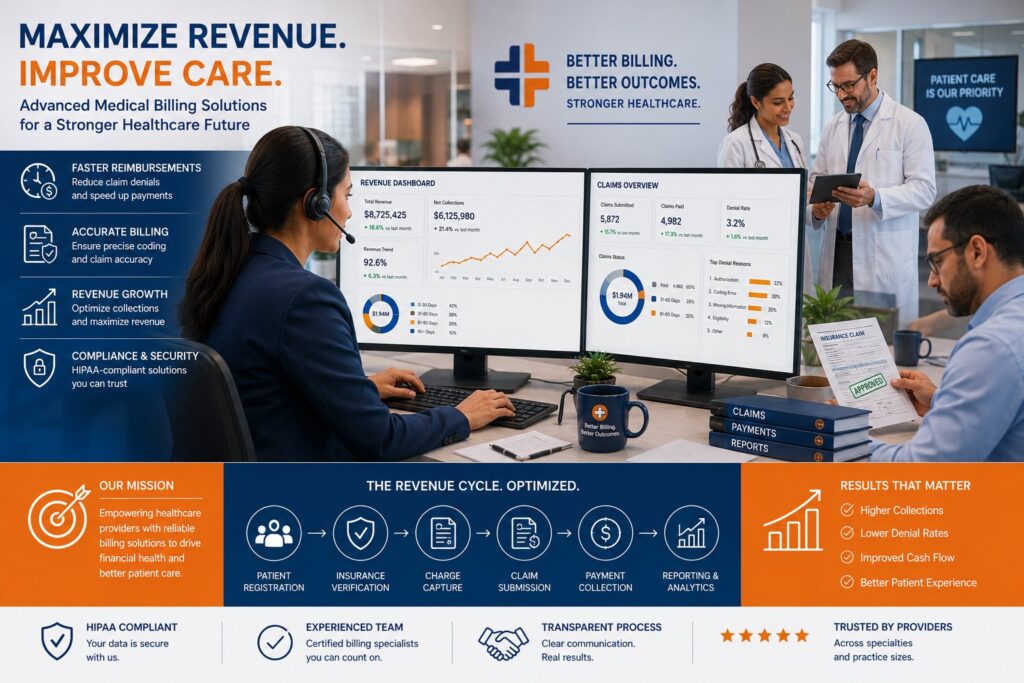


Let me be direct about something most billing vendors won’t tell you upfront: the average medical practice is losing somewhere between 10 and 30 percent of its collectible revenue every single year. Not because they’re bad at medicine. Not because patients aren’t showing up. But because the billing side of the operation has gaps — sometimes small ones, sometimes enormous ones — that quietly bleed cash month after month.
I’ve talked to practice managers who had no idea their denial rate was sitting at 18%. Physicians who didn’t realize they’d been underreporting E/M levels for years. Solo practitioners who found out, too late, that a credentialing lapse had made three months of claims non-billable with a major payer.
These aren’t edge cases. They’re surprisingly common. And the good news is that with the right medical billing solutions in place, most of this lost revenue is recoverable — or preventable in the first place.
This post breaks down how that actually works in practice: what modern billing solutions cover, where the real money is being lost, and what it looks like when you get it right.
The Revenue Problem Most Practices Don’t See Coming
Here’s something that trips up a lot of providers. They associate revenue problems with obvious things — a bad month, a big payer dispute, an unexpected write-off. What they miss is the slow leak.
A 3% coding error rate doesn’t feel catastrophic. Neither does a denial rate of 8%, especially if the office manager is “handling it.” But run the math on a practice seeing 150 patients a week. A few inaccurate codes per day, a handful of denials that never get appealed, some claims aging past their filing limit — that’s real money. Sometimes six figures a year.
Effective revenue cycle management solutions work because they treat billing as a system rather than a series of isolated tasks. Every stage of the patient’s financial journey is connected, and a problem at one stage creates problems downstream. Fix the system, and you don’t just solve today’s billing issue — you prevent next month’s and the month after.
For practices that want a starting point, Utreatibill works with providers across specialties to identify exactly where revenue is slipping and what it would take to recover it.
What Good Healthcare Billing Services Actually Look Like
The phrase “billing services” gets thrown around loosely, so it’s worth getting specific. Comprehensive healthcare billing services aren’t just about sending claims out the door. They cover the full arc of a patient encounter — from before the appointment to the final dollar collected.
Eligibility Verification (And Why Most Practices Rush It)
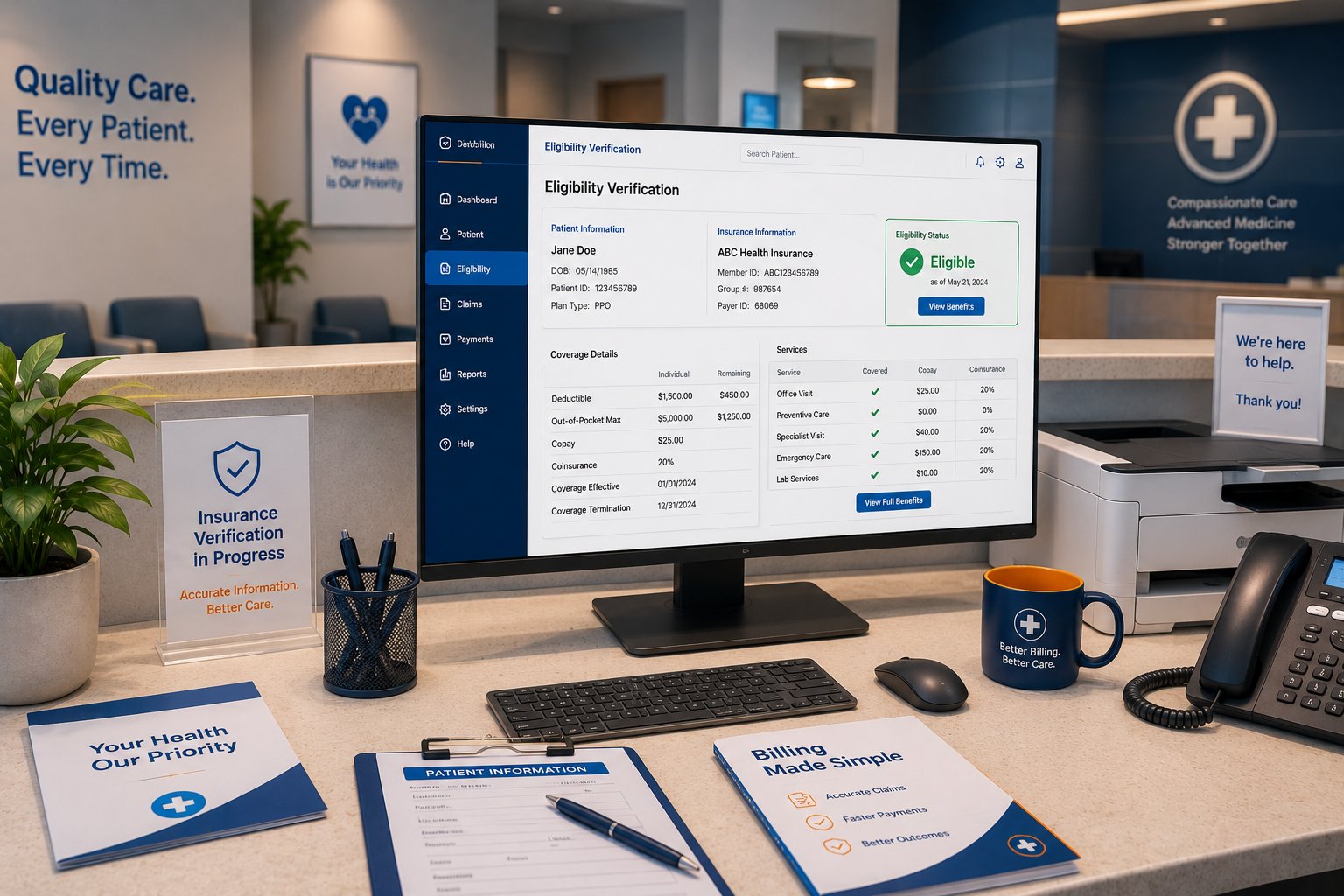
Front desk staff are busy. Phones are ringing. Patients are checking in. In that environment, insurance verification often becomes cursory — a quick check that coverage exists, without digging into whether the specific services planned are actually covered, whether a referral is needed, or what the patient’s deductible situation looks like.
That rushed check is the starting point for a huge percentage of downstream denials. Solid eligibility verification goes deeper: active coverage confirmed, co-pay and deductible amounts noted, coordination of benefits flags identified, and prior authorization requirements flagged before the appointment, not after.
It sounds basic. The reality is that most practices still don’t do it consistently.
Medical Coding Accuracy — Where Money Is Made or Lost
Medical coding accuracy is one of those topics that sounds technical and dry until you realize how directly it affects what you collect. Every patient encounter generates codes — procedure codes (CPT), diagnosis codes (ICD-10), and sometimes additional codes for modifiers, place of service, or equipment. Each of those codes has to be correct, appropriately supported by documentation, and compliant with payer-specific rules.
Errors cut both ways. Undercoding — billing for a lower level of service than was actually provided — means leaving money on the table. Upcoding — billing for more than was documented — creates compliance risk and potential audit exposure. And some combinations of codes trigger automatic edits or bundling rules that result in denials regardless of whether the care was legitimate.
Certified coders who know your specialty make a real difference here. The American Health Information Management Association sets the credentialing standards for this field, and for good reason — it’s genuinely technical work that requires ongoing education as guidelines change.

Claim Submission: Getting to 95% and Staying There
A “clean claim” is one that clears through the clearinghouse and payer edits without triggering a rejection or denial on the first pass. The goal most high-performing billing operations aim for is a clean claim rate of 95% or better.
What that actually requires is a claim scrubbing process that catches errors before submission — missing patient information, invalid code combinations, mismatched provider details, outdated diagnosis codes, missing modifiers. The list of things that can cause a claim to fail is genuinely long, and it changes as payers update their rules throughout the year.
Insurance Claims Processing: The Follow-Up Nobody Wants to Do
Submit a claim and then what? In too many practices, the answer is: wait and hope. Claims sit in a queue until a remittance comes back or a denial lands, and nobody is actively tracking what’s happening in between.
Active insurance claims processing means monitoring claim status, flagging anything that hasn’t adjudicated on time, and following up with payers before claims age into problem territory. Filing deadlines are real — miss one, and that revenue is gone permanently. Payers sometimes “lose” claims or process them incorrectly, and catching that quickly is the difference between getting paid and writing it off.
Claim Denial Management: The Difference Between Reacting and Preventing
If there’s one area where practices consistently underinvest, it’s claim denial management services. Not because they don’t care about denials, but because they address them the wrong way.
The typical approach: a denial comes in, someone reworks it and resubmits, maybe it gets paid. Repeat indefinitely. The problem is that this never actually gets better. The same denial reasons show up month after month because nobody is looking at the pattern — only the individual claim.
Real denial management is analytical. You’re categorizing denials by reason code, by payer, by provider, by service type. You’re asking: why are 40% of our Medicare denials coming back as “medical necessity not established”? Is it a documentation problem? A coding problem? A specific provider’s habits? A payer policy that changed last quarter?
Fix the root cause, and the denial volume drops. That’s what distinguishes reactive rework from genuine claim denial management services — and it’s what actually moves the needle on collection rates.
The Change Healthcare Denials Index has documented that the average denial rate industry-wide hovers around 9%, and that each reworked claim costs between $25 and $30 in administrative time. For a mid-sized practice with high denial volume, that’s not just frustrating — it’s a significant operating cost that doesn’t need to exist.

The Outsourced Medical Billing Question
At some point, most practice owners or administrators ask themselves: should we be doing this in-house, or is outsourced medical billing the better move?
There’s no universal right answer, but the conversation is more nuanced than it used to be. The old assumption was that keeping billing in-house meant more control. In practice, what it often means is more cost, more staff turnover headaches, more training overhead, and more exposure when payer rules change and nobody on the team has caught up yet.
A few things worth thinking through honestly:
What does in-house billing actually cost? Salary, benefits, training, software, clearinghouse fees — add it up against your collections volume. For many practices, especially those under $3–4 million in annual revenue, the math favors outsourcing.
How good is your current team, really? Good billing staff are hard to hire, harder to retain, and hard to evaluate if you don’t know billing yourself. High turnover in the billing role is more common than people admit, and every transition costs the practice in delayed follow-up and missed claims.
What happens when your biller is on vacation? Or leaves? Or gets sick for two weeks? In-house billing is often more fragile than it appears because the knowledge lives with one or two individuals.
What expertise can you realistically maintain? A reputable medical billing company employs certified coders, denial specialists, credentialing support, payer contract analysts, and compliance staff. Replicating that depth internally is genuinely expensive.
For practices that are weighing this decision, Utreatibill’s outsourced billing services are built around specialty-specific expertise and transparent reporting — which is often what practices are missing most when they’re running billing in-house.

How Medical Billing Solutions Improve Revenue Cycle Management — Stage by Stage
Understanding how medical billing solutions improve revenue cycle management requires looking at the whole pipeline, not just claims submission.
Before the Appointment
This is where most practices have the most untapped opportunity. Eligibility checks, prior auth management, demographic verification, coordination of benefits — all of this happens (or should happen) before day one of the visit. When it doesn’t, the consequences show up 30 to 90 days later as denials that are genuinely difficult to appeal.
During the Encounter
Charge capture — making sure every service actually becomes a billable charge — matters enormously. Missed charges are lost revenue, and unlike denied claims, there’s often no way to recover them. Integrated billing and EHR workflows reduce charge leakage by automating this process rather than relying on provider memory.
After the Encounter
This is the bulk of traditional billing work: coding, claim creation, scrubbing, submission, tracking, and follow-up. Healthcare reimbursement optimization at this stage is about speed (faster submission equals faster payment), accuracy (fewer errors means fewer denials), and persistence (claims don’t pay themselves — someone has to follow through).
Patient Collections
The patient billing workflow has changed a lot in the past decade. High-deductible plans are now the norm, which means patient responsibility makes up a bigger share of every dollar billed. Practices that haven’t updated their patient collections approach — still mailing paper statements and waiting — are leaving significant money uncollected.
Digital statements, online payment portals, payment plan options, and proactive outreach (text and email reminders, not just snail mail) all improve what patients actually pay. And importantly, doing this well doesn’t have to damage the patient relationship — done right, it’s actually more convenient for patients, not more burdensome.

Numbers Your Practice Should Be Tracking
If you’re not watching these metrics, you’re essentially flying blind:
Days in AR — how long it takes, on average, to collect after a claim is submitted. Under 40 days is the standard target. Over 50 is a warning sign.
Clean claim rate — percentage of claims that go through on the first submission without rejection. Aim for 95%+.
Denial rate — percentage of submitted claims that come back denied. Under 5% is the benchmark for high performers. Above 10% means something systemic is broken.
Net collection rate — the percentage of collectible revenue you’re actually collecting after adjustments. This is the most important single number in your revenue cycle. 95% or above is the goal.
AR aging buckets — how much of your outstanding AR is 0–30 days, 30–60, 60–90, and 90+ days. A healthy practice has most of its AR in the first bucket. Heavy concentration in the 90+ bucket usually means denials are sitting unappealed and claims are timing out.
What to Actually Look for in a Medical Billing Company
Not all billing vendors are created equal, and price is honestly one of the less important factors when evaluating them. Here’s what actually matters:
Real reporting. Not a PDF with your total collections number. Actual data on denial rates, clean claim rates, AR aging, and what was done about problem accounts. If a vendor can’t show you this, walk away.
Specialty experience. Billing for orthopedics is different from billing for psychiatry is different from billing for primary care. Ask how much of their current client base is in your specialty and what their outcomes look like.
Demonstrated denial management process. Ask specifically how they handle denials — not just “we rework them” but how they track trends and address root causes.
Compliance posture. HIPAA compliance, coding audits, documentation review — these aren’t optional. The HHS Office of Inspector General publishes guidance on compliance program elements, and any credible billing operation should be familiar with and following them.
Communication. You want a partner who reaches out with issues proactively, not one you have to chase for updates.
The Billing Mistakes That Are Quietly Hurting You Right Now
A few patterns show up repeatedly in practices that are underperforming on revenue:
Not following up on claims past 30 days. This is probably the single biggest cash flow killer in small practices.
Accepting what the EOB says without checking it against your fee schedule and contract rates. Payer underpayments are common. Identifying them requires someone actually looking.
Letting credentialing lapse or lag when adding providers. A new physician who isn’t properly credentialed with your major payers can’t bill those payers — and if claims go out anyway under another provider’s number, that’s a compliance problem.
Missing out on billable codes that are legitimately earned — chronic care management, transitional care management, remote patient monitoring. Many practices still don’t capture these even when they’re doing the work.

Building Something That Actually Works Long-Term
The best medical billing solutions for healthcare practices aren’t one-time fixes. They’re ongoing systems — processes that are documented, monitored, regularly reviewed, and adapted as payer rules change.
Practices that take this seriously tend to look different from the ones that don’t. Their AR is cleaner. Their staff spends less time on billing firefighting. Their revenue is more predictable. And perhaps most importantly, compliance exposure is lower because the system is built correctly, not patched together over years of workarounds.
If your practice is ready to look honestly at where billing performance is falling short — and what a structured approach could realistically recover — Utreatibill can walk through your current numbers and show you specifically where the gaps are.
Wrapping Up
There’s no shortage of practices delivering great care while getting paid for less than they’ve earned. That’s the frustrating reality of medical billing done poorly — it’s invisible until you look closely, and by then, real money has already walked out the door.
The good news is that the right medical billing solutions — whether that’s strengthening what you do internally, moving to outsourced medical billing, or finding a smarter hybrid — can recover a meaningful percentage of that lost revenue. For most practices, that’s not a small number.
Getting paid accurately and consistently for the work you do is not a luxury. It’s what keeps the lights on, keeps your staff employed, and keeps your patients cared for. That’s worth taking seriously.
Want to know where your practice’s billing stands today? Utreatibill offers assessments for practices looking to identify revenue gaps and build a stronger financial foundation.