
CPT 99213 vs 99214: How to Choose the Right E/M Level Without Getting Audited
Every time you close a chart and reach for a billing code, you’re making a judgment call. For established outpatient patient visits, that call usually comes down to CPT 99213 vs 99214 — and getting it wrong in either direction carries real consequences. Bill too high without documentation to back it up, and you’re an upcoding target. Bill too low out of caution, and you’re quietly losing thousands of dollars per provider every year without a single payer flag to tip you off.
Our Revenue Cycle Management team at UtreatiBill works with physician practices across Michigan to get this decision right — systematically, on every encounter. This guide gives you the current MDM thresholds, time requirements, documentation standards, and audit-proofing strategies that govern your billing in 2026.
CPT 99213 vs 99214 — What’s the Actual Difference?
📋 Quick Reference — CPT 99213 vs 99214 at a Glance
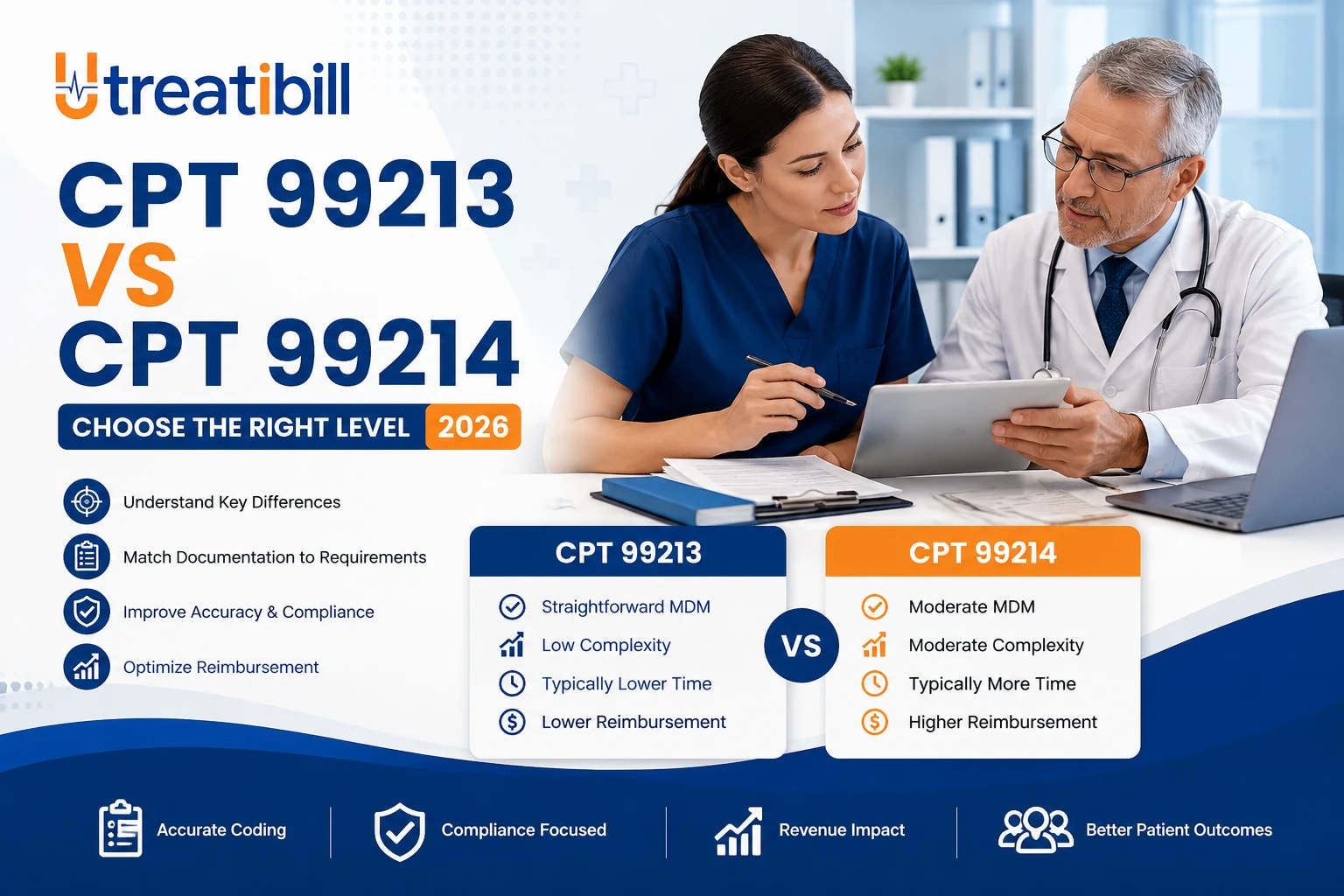
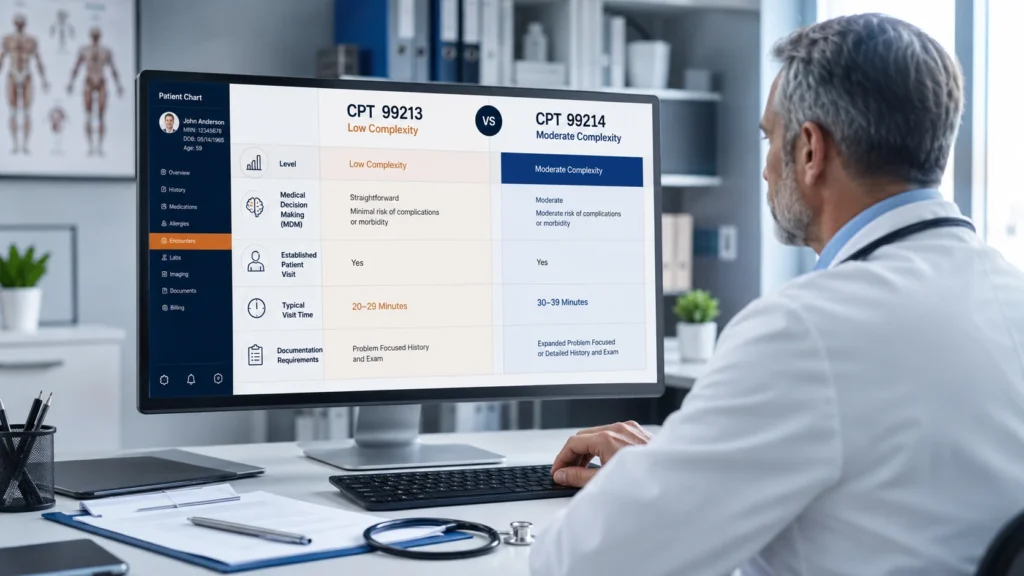
The core distinction in CPT 99213 vs 99214 is medical decision making complexity. Code 99213 applies to established outpatient visits with low MDM complexity — a stable chronic condition, a simple follow-up with minimal data reviewed. Code 99214 requires moderate MDM complexity — a chronic illness with exacerbation, a new problem with uncertain prognosis, or visits involving prescription drug management. Time thresholds differ too: 20–29 minutes for 99213, 30–39 minutes for 99214.
What is the difference between 99213 and 99214 in day-to-day terms? It hinges on how complex the physician’s clinical reasoning was during that encounter — not how thoroughly the patient was examined. The 2021 AMA guideline overhaul made that shift decisive, and it remains the controlling standard for every established patient office visit you bill in 2026.
The AMA E/M Guidelines That Govern CPT 99213 vs 99214
Before 2021, level of service selection leaned heavily on history elements and physical exam volume — count the systems, check the boxes, assign the level. The AMA eliminated that framework entirely for outpatient established patient visits. What replaced it is a clinical reasoning model built around medical decision making MDM and total time. Understanding this framework isn’t optional — it’s the foundation of defensible billing, and gaps here are the most common source of silent compliance risk our Medical Billing Services team encounters across practice types and specialties.
Medical Decision Making (MDM) — The Primary Driver
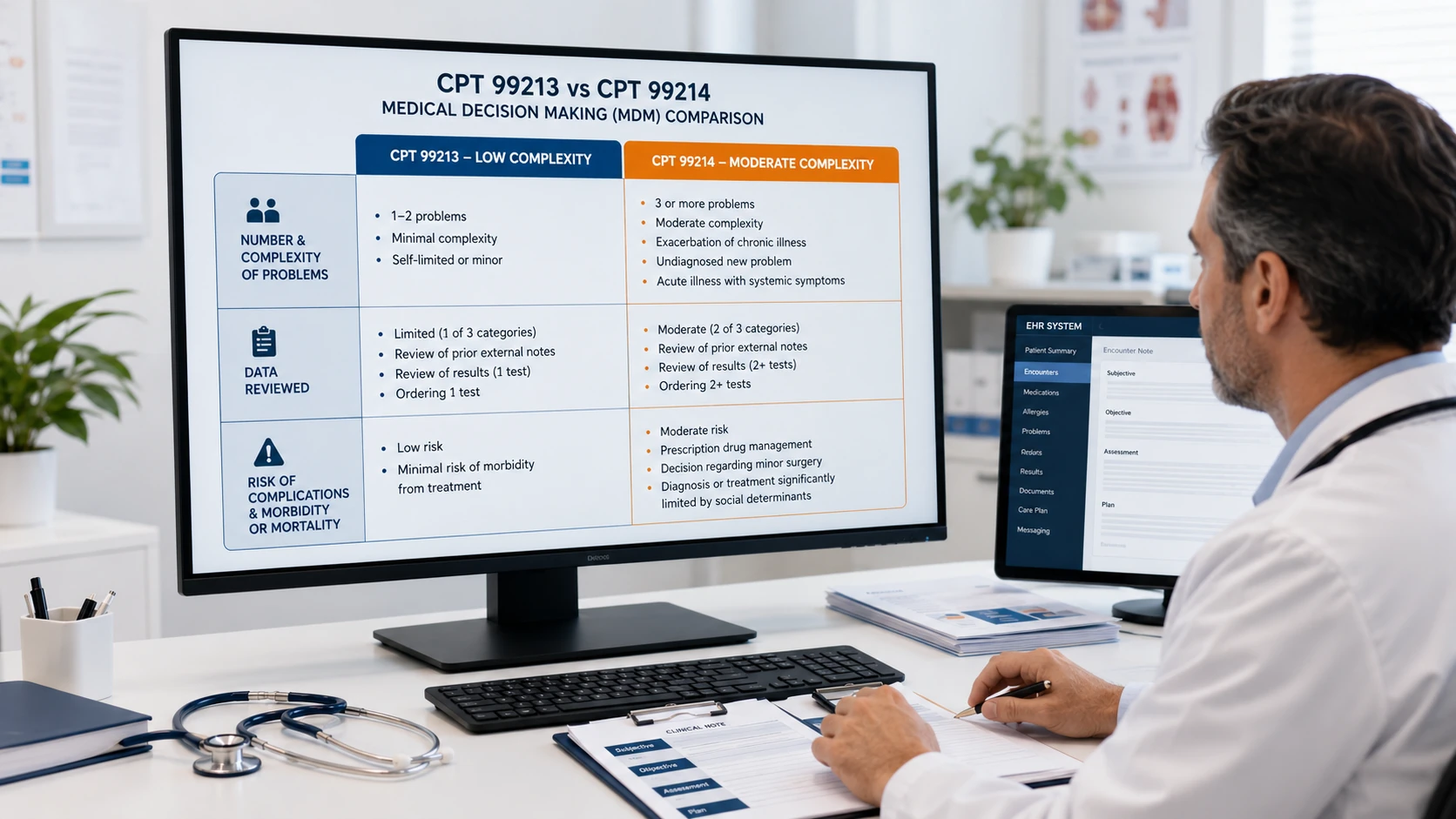
Medical decision making (MDM) is the clinical judgment a physician applies during an encounter. Per current AMA CPT guidelines, MDM has three distinct components:
- Number and complexity of problems addressed — the quantity and acuity of conditions managed during the visit
- Amount and/or complexity of data reviewed — tests ordered, external records reviewed, independent interpretation of results, discussion with other providers
- Risk of complications and/or morbidity or mortality — driven especially by prescription drug management, minor procedures with identified risk, or decisions requiring social determinants considerations
The E/M level reflects the complexity tier where at least two of the three components land. That two-of-three logic is one of the most frequently misunderstood elements of the current framework.
For 99213, MDM must reach the low complexity threshold: two or more self-limiting problems, or one stable chronic illness with limited data reviewed and minimal to low treatment risk. For 99214, MDM must reach moderate complexity — a chronic illness with exacerbation or progression, a new undiagnosed problem with uncertain prognosis, or any visit requiring prescription drug management decisions.
In practical terms: a stable hypertension check-in with controlled readings, a refill, and no new issues — that’s your 99213. A diabetes follow-up where A1C has worsened, you’re ordering labs, reviewing a nephrology note, and adjusting two medications — that’s 99214. Understanding how to choose between CPT 99213 and 99214 for established patients becomes considerably more straightforward once you apply the MDM lens to every encounter.
The official complexity of medical decision making table — the one your coding team should have on hand — is published and maintained by the AMA.
Total Time Billing — The Alternative Pathway
Total time billing is the second valid pathway under both CMS E/M guidelines and the 2021 AMA overhaul. Physicians may bill based on the total time spent on the date of service — a figure that includes face-to-face time with the patient and non-face-to-face work performed that same day.
What legitimately counts toward your total: pre-visit chart review, the encounter itself, ordering tests, reviewing results, care coordination, prescription management, and post-visit documentation completed the same day.
For 99213 vs 99214 documentation requirements 2026 under the time pathway, the thresholds are:
- 99213: 20–29 minutes total on the date of the encounter
- 99214: 30–39 minutes total on the date of the encounter
Either pathway — MDM or total time — is fully valid under CMS standards. What you cannot do is blend both in a single note. Choose your pathway per encounter and document consistently within that choice.
Why History and Physical Exam No Longer Determine Level of Service
This is the most common knowledge gap we see in practices still operating on pre-2021 training: history and physical exam must still be documented as part of the medical record. But under E/M coding guidelines 2026, neither one determines level of service determination.
MDM complexity or total time is the sole determinant. If your clinical staff is still selecting E/M levels based on how many review-of-systems items were captured or how many body regions were examined, they are applying a framework the AMA retired in 2021. This produces systematic downcoding errors — and because no payer flags a code that’s too low, the revenue loss is completely invisible in your denial reports.
99213 Documentation Requirements vs 99214 Documentation Requirements
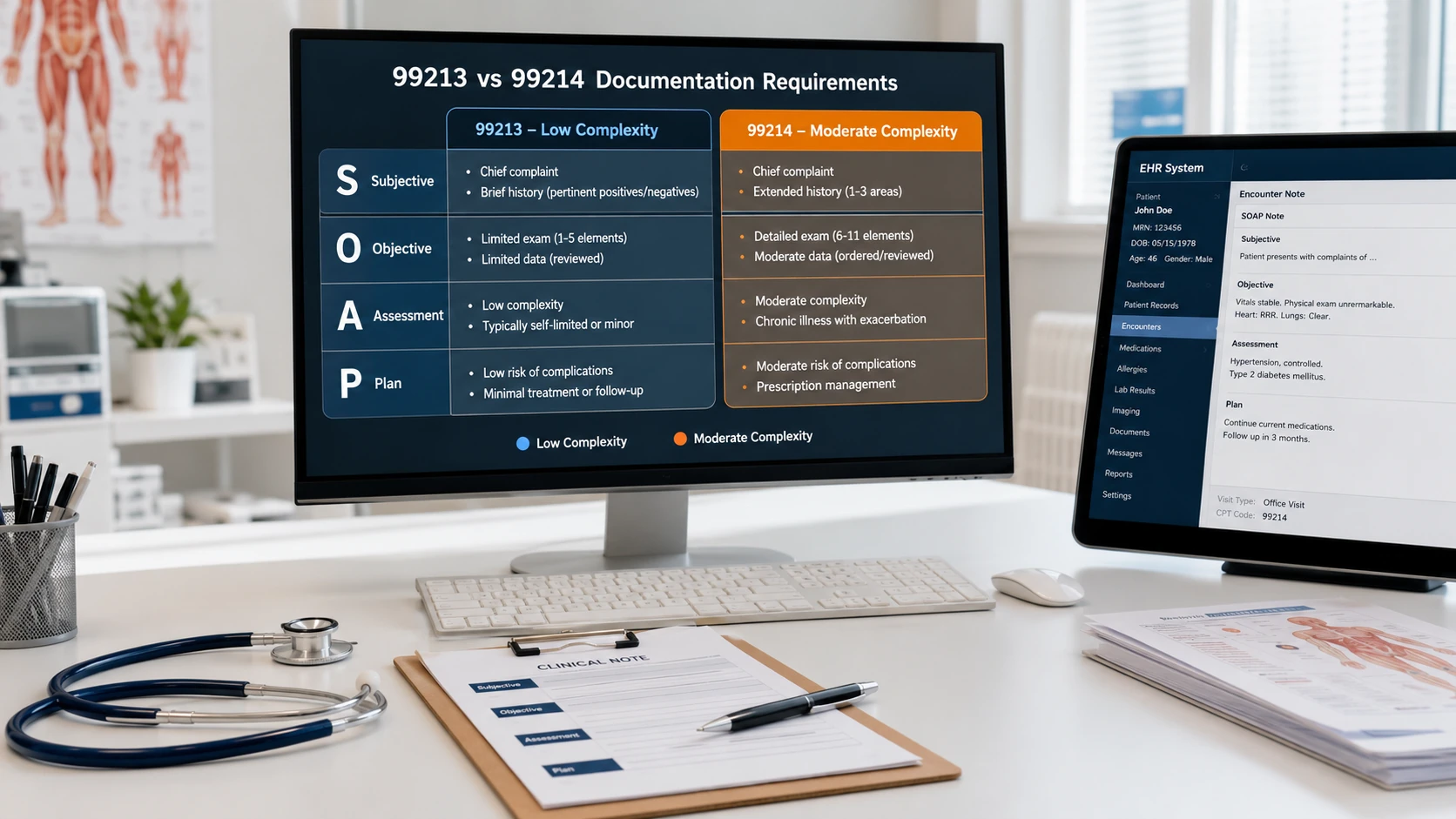
The medical record has to tell the story that justifies the code you selected. Both 99213 documentation requirements and 99214 documentation requirements call for documentation that makes the physician’s clinical reasoning visible — not just a summary of what was observed or ordered. An auditor reviewing your note should be able to trace the problem complexity, the data considered, and the risk assessment without inference.
| Factor | CPT 99213 | CPT 99214 |
|---|---|---|
| MDM Level Required | Low complexity | Moderate complexity |
| Number/Complexity of Problems | 2+ self-limiting problems OR 1 stable chronic illness | 1+ chronic illness with exacerbation OR 1 undiagnosed new problem with uncertain prognosis |
| Data Reviewed | Minimal or limited | Moderate (review of tests, ordering tests, or independent interpretation of results) |
| Risk of Complications | Minimal or low | Moderate (prescription drug management or minor surgery with identified risk factors) |
| Total Time Option | 20–29 minutes | 30–39 minutes |
| History & Exam Required? | Document, but does not drive the level selection | Document, but does not drive the level selection |
| Typical Visit Example | Stable hypertension check-in; simple follow-up | Diabetes with new complication; 3+ chronic conditions; medication adjustment |
| Audit Risk If Misdocumented | Downcoding revenue loss; OIG underpayment findings | Upcoding allegation without sufficient MDM support; repayment demand |
The difference between these two codes is clinical depth — what the physician was deciding, not just what they documented observing.
Why Choosing Wrong Between CPT 99213 vs 99214 Costs Your Practice
Incorrect level selection has two failure modes, and most practices only worry about one of them. Upcoding gets all the attention. Downcoding drains revenue without triggering a single flag. Knowing how to avoid E/M coding audits for office visits means understanding both directions — and building systems that protect against each. Our Medical Billing Audit team and Medical Coding Services staff work both sides of this problem every day.
Upcoding — The Audit Magnet
Upcoding means billing 99214 for a visit the documented record only supports at the 99213 level. It doesn’t require intent — in fact, most flagged upcoding started as a habit or a default, not a scheme.
What draws audit attention: statistical outliers in a provider’s E/M distribution, Recovery Audit Contractor (RAC) claim pattern reviews, OIG Work Plan priorities targeting E/M billing, and payer-specific benchmarking that compares your utilization against specialty norms. When your 99214 rate significantly exceeds those norms, you are in the review queue regardless of whether each individual claim was documented carefully.
The consequences are not minor. Repayment demands, False Claims Act exposure, civil monetary penalties, and potential exclusion from Medicare and Medicaid are all outcomes the AMA has documented extensively in its provider audit exposure guidance.
An orthopedic group in Grand Rapids learned this directly: after the practice’s 99214 utilization rate significantly exceeded specialty benchmarks, it received an RAC audit notice. The records showed clinical activity but lacked the MDM-level reasoning documentation needed to defend the level selection. The result was a repayment demand — entirely preventable with consistent, structured documentation habits.
Downcoding — The Revenue Leak You Don’t See
Downcoding is billing 99213 when the clinical encounter clearly warrants 99214. No payer will flag it. No denial will surface it. But the revenue loss is real, recurring, and compounding.
MGMA data indicates that practices consistently underselecting by one E/M level lose an estimated $15,000–$25,000 per provider annually in uncollected revenue. If your practice sees 200 established patients per month and misclassifies 30% of those visits, the math on annual revenue loss becomes impossible to ignore.
Knowing when to use 99214 instead of 99213 is the skill that prevents this. When a physician manages a chronic condition with new complications, adjusts controlled medications, coordinates care across external providers, or independently interprets diagnostic results, the encounter typically supports moderate MDM. That’s a 99214 — and billing 99213 instead is simply leaving money on the table.
A solo primary care physician in Lansing discovered more than $18,000 per year in uncollected revenue after a coding review revealed consistent downcoding on complex chronic disease management visits. The documentation in those records already supported 99214. It was just never coded that way.
The CPT 99213 vs 99214 Distribution Problem
Payers expect an E/M distribution that reflects a realistic patient population. Practices that bill 99214 on 90% or more of established patient visits draw scrutiny — even when each individual claim is solidly documented. The bell curve expectation exists across all specialties and all payer types.
Under medical decision making MDM standards, SOAP note documentation quality is what stands between your code selection and a repayment demand. The clinical reasoning has to be visible in the record, not assumed. Getting 99213 vs 99214 documentation requirements 2026 right is not just a compliance task — it is your audit protection layer, and it works best when applied consistently on every encounter rather than selectively after an audit notice arrives.
Common Coding Mistakes and How to Avoid Them
These mistakes do not only happen at small, understaffed practices. They appear regularly in multi-provider groups with dedicated billing departments. The root cause is almost always systemic — a training gap or a workflow that hasn’t caught up to current guidelines.
Defaulting to the Same Code for Every Visit Type
Selecting 99213 or 99214 as a blanket code for all established patient visits — regardless of actual complexity — is a red flag in any payer review. It signals that code selection is driven by habit rather than E/M coding guidelines 2026 and clinical reality.
Every encounter requires its own individual assessment against MDM criteria or documented time. No default survives an audit. The correction is structural: build a per-encounter review step into your billing workflow, not a post-submission cleanup process.
Inadequate MDM Documentation in the Medical Record
A defensible record shows what the physician was thinking, not just what they observed. Under evaluation and management coding standards, that means the note must reflect the problem list, alternatives evaluated, data sources reviewed, and the risk rationale — not just the plan that was executed.
The most common failures: vague templated assessment language (“Continue current management”), missing or stale problem list updates, no documentation of data reviewed or interpreted, and absent risk justification. Each of these gaps creates audit risk E/M exposure and can result in claim denials on post-submission review. Building documentation habits that capture MDM reasoning at the point of care is the most direct path how to avoid E/M coding audits for office visits.
Misapplying the Time-Based Billing Pathway
Time-based billing errors are more common than most practices realize. The most frequent: including activities from a different date, double-counting overlapping tasks, and failing to state time clearly enough for an auditor to reconstruct it.
Per CMS documentation requirements, the standard is explicit: the record must state the total time spent on that date of service. A statement such as “Total time spent on this encounter date: 34 minutes” creates an auditable record. Anything vague or time-range based leaves the claim exposed.
ICD-10 diagnosis coding accuracy is equally important here. The diagnoses documented must align with and justify the MDM complexity level billed. A 99214 supported only by a stable chronic condition diagnosis list is internally inconsistent — and inconsistency is precisely what triggers closer review.
In-House Coding vs. Professional Medical Coding for 99213 and 99214 Accuracy
This is not a question of trust or effort. Most in-house billing teams are doing exactly what they were trained to do. The question is whether that training reflects current AMA 2021+ standards — and for many practices, it doesn’t.
| Factor | In-House Coding | Professional Coding (UtreatiBill) |
|---|---|---|
| Coder credentials | Variable; dependent on individual staff training | Certified coders (CPC, CCS) trained on current AMA 2021+ and 2026 CMS guidelines |
| E/M accuracy rate | 75–85% (industry average) | 95–98% first-pass accuracy |
| Audit preparedness | Reactive — documentation reviewed only after audit notice arrives | Proactive — coding reviewed and validated before claim submission |
| Upcoding risk | Higher — inconsistent level selection without systematic oversight | Minimized — structured MDM review applied per encounter |
| Downcoding risk | High — common when staff apply outdated 1995/1997 documentation guidelines | Eliminated — coders apply current AMA 2021+ standards consistently |
| Provider training feedback | Rarely provided | Regular provider education and real-time documentation feedback loops |
| Training burden | Ongoing; staff must self-update on CMS and AMA rule changes | Handled internally by the professional coding team |
| Scalability | Limited by headcount and training capacity | Immediate capacity for volume increases or new provider onboarding |
What Your In-House Team May Be Missing
The 1995 and 1997 E/M documentation guidelines shaped how an entire generation of billing professionals learned to code. Many still apply those frameworks today — evaluating visits based on history and exam volume against criteria that have been retired and replaced.
First-pass claim acceptance rate is the metric that exposes the gap. Per MGMA and HFMA benchmarks, in-house teams average 75–85% accuracy on E/M level selection. Most teams don’t track this at the individual code level — so the systematic error stays invisible until an audit surfaces it.
Per AMA data on administrative burden and training lag in physician practices, this is a structural problem, not a performance problem. Your in-house staff is working with insufficient tools and infrequent access to current training. That’s a systems gap — and it has a systems solution.
What a Professional Coding Partner Delivers
UtreatiBill’s certified coding team applies MDM criteria to every outpatient encounter before submission. That means per-encounter review against current AMA guidelines, time documentation validation when the time pathway is selected, ICD-10 diagnosis coding specificity alignment, and records that are audit-ready from the moment a claim goes out.
Practices onboarding with our team typically see measurable improvement in coding accuracy and first-pass claim acceptance rate within 60–90 days. Provider-specific feedback loops drive documentation quality upstream — physicians start capturing clinical reasoning more precisely because they see the impact in real time, not because compliance issued a memo.
Our expertise across office visit billing codes spans specialties statewide. Our Medical Billing Services in Michigan team works with practices across the state. And for practices navigating payer-specific billing requirements, proper Provider Credentialing Services matter too — a rendering physician’s enrollment status directly affects E/M policy compliance with each contracted payer.
CPT 99213 vs 99214 by Specialty — 2026 Breakdown
CPT 99213 vs 99214 selection looks different across clinical environments, and the right code for a “routine” visit varies significantly by what “routine” means in your specialty.
Primary Care / Family Medicine: High volume of established patients with multiple chronic conditions means moderate MDM is more common than many practices code for. Practices that apply 99213 as a default across the board are almost certainly leaving significant revenue behind. The Lansing physician referenced earlier represents a pattern we see repeatedly in primary care billing reviews.
Internal Medicine: Complex medication regimens, comorbidity stacking, and frequent lab result interpretation push a meaningful share of established patient visits into 99214 territory. Coders must document data reviewed and risk rationale explicitly — the medication list alone does not establish MDM complexity.
Cardiology: Visits involving EKG review, anticoagulation management, medication titration, or post-procedure follow-up frequently qualify for 99214 under moderate MDM. High 99214 utilization in procedure-heavy specialties is clinically appropriate — but it must be backed by MDM-level documentation. The Grand Rapids orthopedic example reflects what happens when the utilization rate is correct but the documentation depth is not.
Behavioral Health: Total time billing tends to be more practical here given encounter structure. Documenting total time clearly and consistently is the core requirement. MDM remains valid but requires careful documentation of problem complexity, data sources reviewed (prior treatment records, collateral information), and treatment risk — particularly where controlled substances are involved.
Key E/M Coding Metrics Every Practice Owner Should Track

Tracking the right numbers turns E/M compliance from a reactive obligation into a revenue management tool.
E/M code distribution by level: Your spread across 99211–99215 should reflect your actual patient population and specialty benchmarks from MGMA. A distribution that doesn’t match those benchmarks is the first signal to investigate — in either direction.
99214 utilization rate vs. specialty benchmark: Well above benchmark signals potential upcoding exposure. Well below benchmark in a complex chronic disease practice signals consistent downcoding and uncollected revenue.
First-pass claim acceptance rate: Industry average for in-house teams runs 75–85% per MGMA/HFMA data. Rates consistently below that threshold often trace back to E/M level inconsistencies at the documentation level.
E/M-specific denial rate: Denials tied specifically to level-of-service determinations indicate a documentation gap, not just a coding habit. Track this separately from your general denial rate.
Downcoding rate: Measured by comparing coded level against the MDM-supported level in a coding audit. Any systematic gap reveals either outdated training or workflow problems that are correctable.
Overall coding accuracy rate: The composite metric. Professional coding teams maintain 95–98% accuracy. In-house averages run 75–85%. The difference between those two numbers — scaled across your annual visit volume and reimbursement rates — is your revenue gap.
How Getting CPT 99213 vs 99214 Right Impacts Your Bottom Line

The financial case for correct E/M level selection is not abstract. It shows up in your revenue cycle reports — or it doesn’t show up, which is the downcoding problem. Here is what the data tells us.
The accuracy gap is significant and measurable. In-house coding teams average 75–85% accuracy on E/M level selection. Professional medical coders consistently reach 95–98%. Scaled across a full year of billing volume, that gap translates directly into uncollected revenue and avoidable claim rework. (Source: MGMA / HFMA)
Downcoding costs more than most practice owners realize. Practices that consistently underselect E/M levels lose an estimated $15,000–$25,000 per provider annually in uncollected revenue. For a three-physician group, that number can approach $75,000 per year — with zero denial reports to flag it. (Source: MGMA)
Upcoding exposure has intensified under federal enforcement priorities. The OIG has flagged E/M upcoding as a top Medicare billing compliance priority. Medicare overpayments from E/M miscoding total hundreds of millions of dollars annually, and RAC audit activity has increased accordingly. (Source: AMA / OIG)
Revenue improvement after professional coding implementation is real and fast. Practices that implement professional coding review for E/M services typically see 10–20% revenue improvement within 90 days — driven by elimination of systematic downcoding and cleaner claim submission. This is not a projection; it reflects the results we see during onboarding. (Source: MGMA / HFMA)
The administrative savings compound the revenue gain. Professional coding support saves an average of 8–15 hours per week in documentation review and rework for a mid-sized practice. At $22–$28 per hour for billing staff, that equals $9,000–$22,000 per year in direct labor savings — before accounting for recaptured revenue and avoided audit costs. (Source: AMA)
A multi-specialty practice in Detroit reduced E/M coding errors by 94% within 60 days of outsourcing coding review to UtreatiBill. The impact showed up in both cleaner claims and measurably improved physician documentation quality that continued strengthening through and beyond the onboarding window.
How UtreatiBill Helps Michigan Practices Get CPT 99213 vs 99214 Right — Every Time

The 2021 AMA guideline changes answered many questions about how to choose between CPT 99213 and 99214 for established patients — but they also raised the bar on documentation quality and coder expertise. Most practices need a partner who operates at that bar consistently, not just in the weeks after an audit notice arrives.
UtreatiBill works with physician practices across specialties throughout Michigan — primary care, internal medicine, cardiology, endocrinology, behavioral health, orthopedics, and more. Here is what that engagement looks like in practice:
- Per-encounter MDM review against current AMA 2021+ criteria, applied before each claim is submitted
- Time documentation validation when the time-based pathway is selected, including specificity of the total time statement in the record
- ICD-10 specificity alignment — diagnoses are reviewed against the complexity level billed to confirm clinical consistency
- Provider feedback loops — real-time, code-level documentation feedback to physicians and clinical staff when gaps are identified, not after a denial
- HIPAA-compliant workflows throughout the entire coding and claims pipeline
- Transparent performance reporting on E/M code distribution, first-pass acceptance rate, coding accuracy, and specialty benchmark comparison
When evaluating any medical coding partner, look for CPC- or CCS-credentialed coders with fluency in AMA 2021+ MDM criteria, a systematic pre-submission review process, structured provider education that improves documentation quality at the source, and performance reporting that gives your practice visibility into E/M coding trends over time.
Book a Free Consultation with our team to see exactly where your practice’s E/M coding stands — and what it would take to close the gap.
Key Takeaways
- CPT 99213 vs 99214 selection is determined by medical decision making complexity or total time — not by history or physical exam volume, regardless of how your team was originally trained.
- Under 2026 AMA and CMS standards, low MDM complexity supports 99213; moderate MDM complexity — including prescription drug management and chronic illness with exacerbation — supports 99214.
- Total time billing offers a valid alternative pathway: 20–29 minutes for 99213, 30–39 minutes for 99214, with same-day pre- and post-visit work counting toward the total.
- Upcoding and downcoding are equally damaging — one creates audit exposure and potential False Claims Act liability, the other drains revenue silently without triggering a single denial.
- Strong MDM documentation in the assessment and plan — capturing problems addressed, data reviewed, and risk assessed — is the single most durable form of audit protection available.
- Practices that consistently track E/M code distribution, utilization rates by specialty benchmark, and first-pass claim acceptance rate identify compliance gaps before payers do.
- Professional coding review typically delivers measurable revenue improvement within 60–90 days and can reduce E/M coding errors by a significant margin — without disrupting clinical workflow.
Final Thoughts
If you’ve worked through this guide, you know that the decision between 99213 and 99214 is not a minor administrative detail. It’s where revenue is either captured or lost, where audit risk either accumulates or gets controlled, and where the quality of your documentation either protects your practice or exposes it. Getting CPT 99213 vs 99214 right consistently requires the right framework, the right documentation habits, and — for most practices — a coding partner who applies both on every single encounter.
UtreatiBill’s certified coders bring current guideline expertise and a systematic MDM review process to every practice we work with. The results show up in 60–90 days. Book a Free Consultation and find out exactly where your E/M coding stands today.