
Payer AI vs. Your Practice: How Insurance Companies Are Using AI to Deny More Claims in 2026 — And How to Fight Back
AI claim denials 2026 have become the defining revenue threat for practices of every size. Payers have quietly rebuilt their claims review systems around machine learning, and the result is more automated rejections, faster denial cycles, and shrinking reimbursement windows for your billing team. If your practice still relies on manual review and reactive appeals, you’re already behind. Strengthening your Revenue Cycle Management strategy now is the single most effective way to protect what you’ve earned.
What Are AI Claim Denials? AI claim denials are insurance rejections generated, flagged, or recommended by a payer’s automated decision-making system rather than a human reviewer. These systems scan codes, modifiers, and documentation in seconds, often denying claims in batches before a person ever reviews the file. In 2026, this automation is reshaping how — and how fast — your practice gets paid.
What Are AI Claim Denials in 2026?
AI claim denials 2026 describe a shift from spot-checked manual audits to continuous, machine-driven claims scrutiny. Payer AI claim denials now happen at submission, not weeks later, using natural language processing and predictive models trained on millions of historical claims.
What Changed in Payer Claims Review Technology in 2026
Major payers expanded automated decision-making across prior authorization, medical necessity review, and coding validation. Regulators have noticed: the CMS Interoperability and Prior Authorization Final Rule now requires specific denial reasons and 72-hour urgent / 7-day standard response times, starting in 2026. Physicians feel the shift too — a recent AMA survey found three-quarters report rising denials over five years, and six in 10 fear AI will push rates even higher.
From Manual Review to NLP — How Insurers Scrutinize Claims Now
NLP claims review insurance companies use today reads clinical notes, cross-references billed codes, and scores the likelihood of medical necessity in real time. Where a human adjuster once needed days, an NLP model flags a mismatch instantly — and routes the claim straight to denial.
Why Many Practices Are Still Losing Revenue to AI-Driven Denials
Most billing teams were built for a slower, more forgiving payer environment. They catch errors after the payer already has the claim, which is too late once AI claim denials 2026 logic has already triggered a rejection. By the time staff notice, the claim is aging and the appeal clock is ticking.
The Hidden Revenue Risk of Outdated In-House Billing Tools
Legacy practice management systems weren’t built for insurance AI denying claims 2026 at this scale. They check for typos and missing fields, not the subtle medical-necessity and modifier patterns that trigger today’s automated rejections — leaving real revenue exposed long before a claim ever reaches the payer.
Why the Payer AI Arms Race Is a Revenue Priority for Every Practice
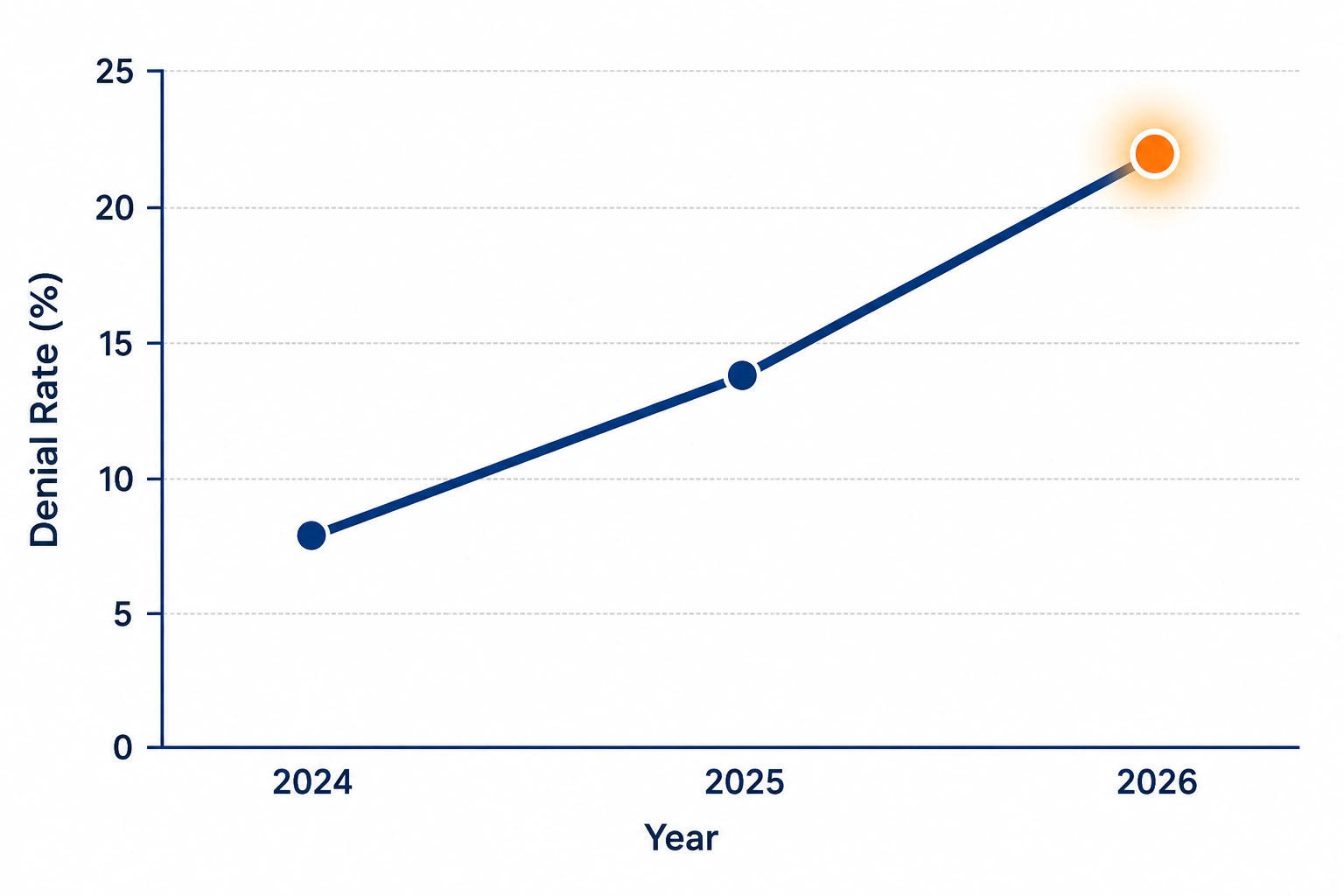
This isn’t a billing inconvenience — it’s a revenue-protection issue. Payer AI claim denials move faster than most appeals teams, and every day a claim sits unworked is a day closer to a missed filing deadline. Treating denial defense as an afterthought is no longer realistic in 2026.
The Biggest Causes of Rising AI Claim Denials in 2026
Insurance AI denying claims 2026 typically traces back to one of six recurring failure points. Knowing them is the first step toward fixing them.
Missing or Mismatched Modifiers Flagged by Payer AI
Modifier errors — especially around bundled or bilateral procedures — are among the easiest patterns for AI to catch and the easiest for tired staff to miss.
Medical Necessity Mismatches Between Documentation and Billed Codes
If the clinical note doesn’t clearly support the billed code, AI models flag the gap instantly, regardless of whether the care was appropriate.
Prior Authorization Gaps Triggering Automatic Rejections
A missing or expired authorization is one of the fastest paths to an automatic denial, with no human review involved at all — a direct result of prior authorization AI automation now standard at most major payers.
Coding Pattern Anomalies That Trigger AI Audits
Payer models compare your coding patterns against peer benchmarks. Outlier patterns — even legitimate ones — can trigger automated audits and holds.
Eligibility and Coverage Errors Caught in Real Time
Coverage lapses, plan changes, and subscriber mismatches are now caught before the claim is even fully adjudicated.
Slow Manual Appeals That Can’t Keep Pace With AI Denial Speed
Payers can generate thousands of automated denials in the time it takes a billing team to appeal a handful by hand — and that speed gap compounds every month.
The Complete 2026 Playbook for Fighting AI Claim Denials
AI-powered claim denial prevention means meeting payer automation with your own. Here’s the four-part defense your practice needs.
AI-Powered Pre-Submission Claim Scrubbing
AI claim scrubbing technology checks every claim against payer-specific rules, modifier logic, and medical necessity criteria before submission — catching what a human reviewer would miss under deadline pressure.
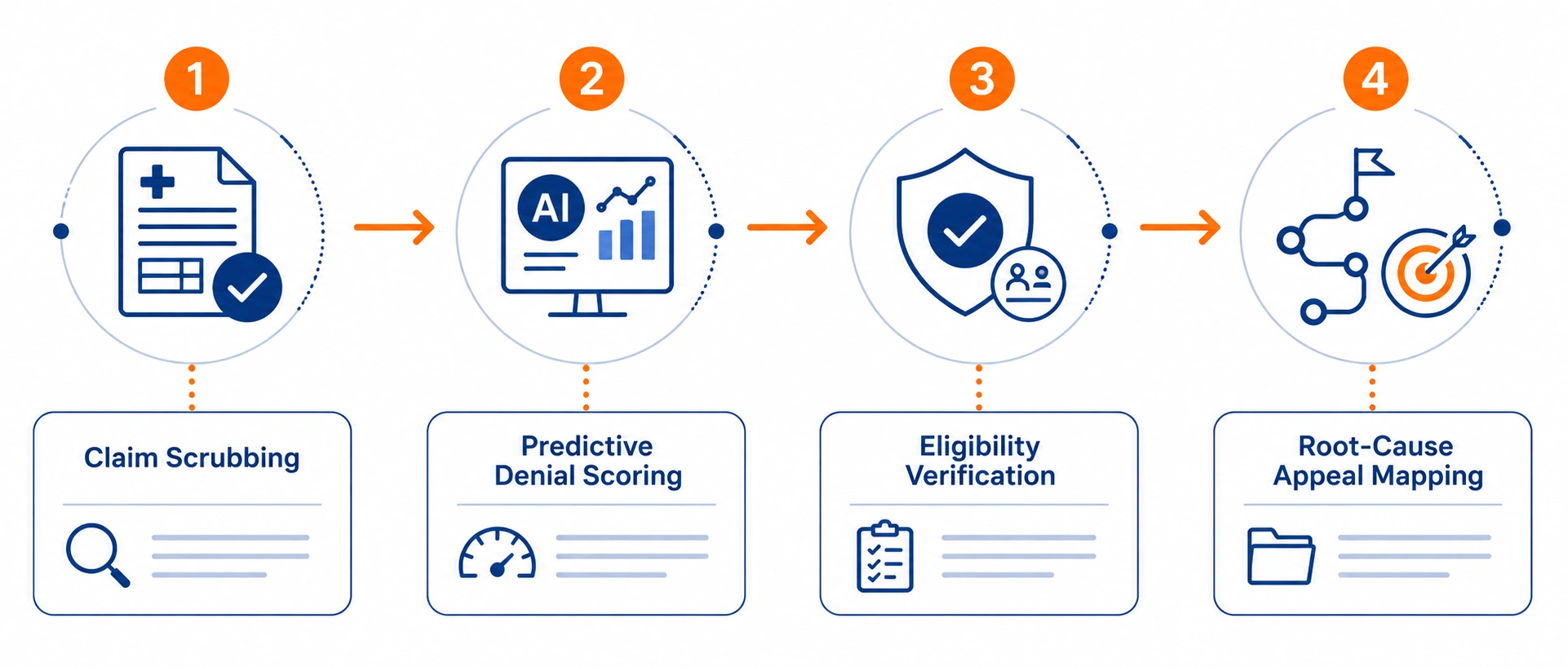
Predictive Denial Scoring Before You Submit
Predictive denial scoring assigns each claim a risk score based on historical payer behavior, flagging high-risk claims for review before they ever leave your office.
Real-Time Eligibility Verification
Real-time eligibility verification AI confirms active coverage, plan details, and authorization status at the point of scheduling, not after the visit.
Automated Denial Root-Cause Mapping and Appeals
Automated denial root-cause mapping identifies exactly why a claim was denied and routes it into a templated, evidence-backed appeal — fast enough to beat payer-imposed deadlines.
How Much Revenue Is Your Practice Losing to AI-Driven Denials?
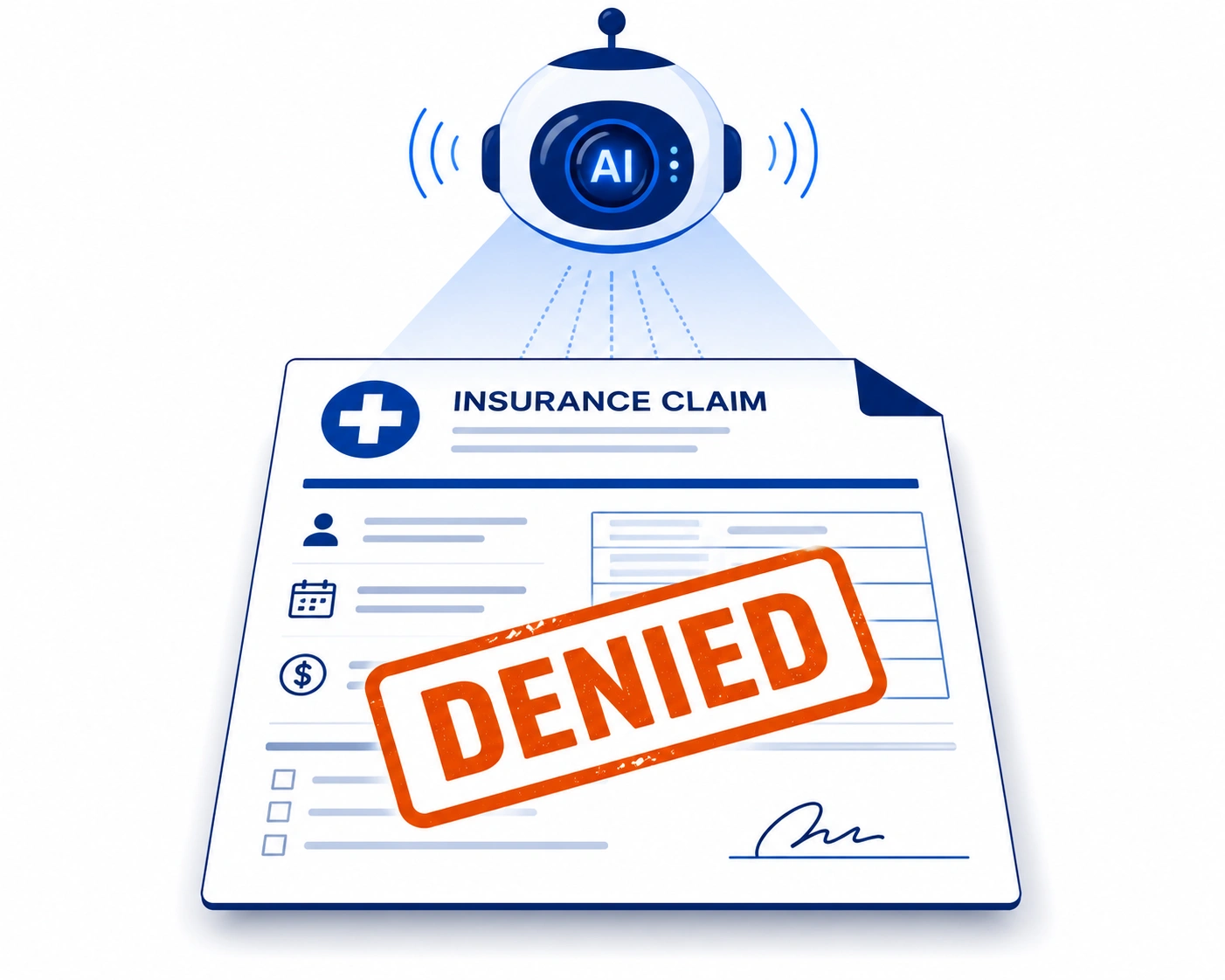
Example 1 — High-Cost Procedure Denied by Payer AI for Medical Necessity
A $3,200 imaging-guided procedure gets denied because the clinical note didn’t explicitly tie symptoms to the billed CPT code — even though the care was clearly warranted.
Example 2 — Modifier Mismatch Flagged and Auto-Rejected
A same-day E/M and procedure claim is auto-rejected for a missing modifier 25, a pattern AI catches almost instantly across thousands of claims.
Example 3 — Prior Auth Gap Caught by AI Before Claim Submission
A specialist visit is denied because the payer’s system flags an expired authorization the moment the claim hits its queue — no appeal needed on the payer’s end, just a rejection.
In-House Billing vs. Outsourced AI-Powered RCM: A 2026 Comparison
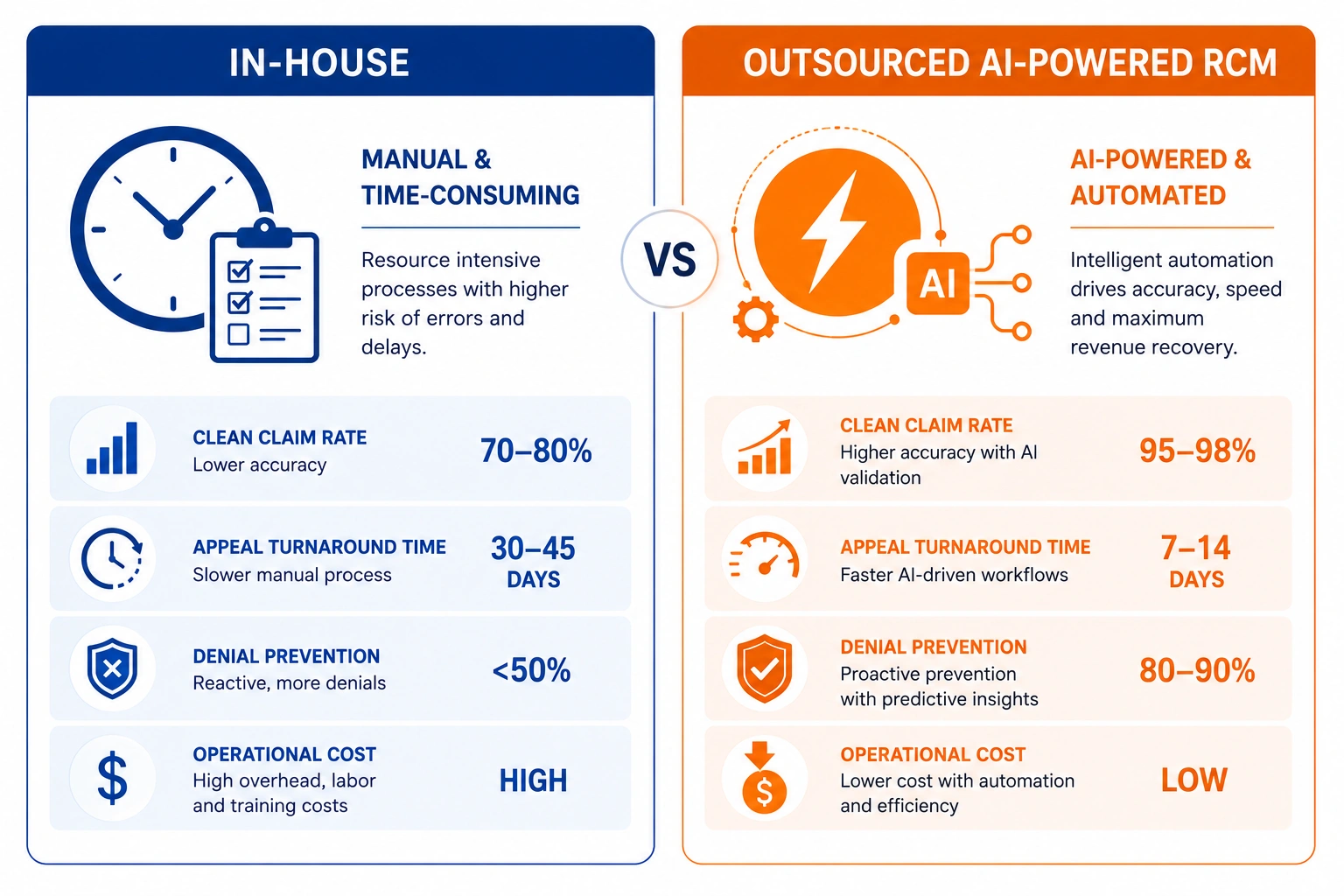
| Factor | In-House Billing | Outsourced AI-Powered RCM |
|---|---|---|
| Speed vs. payer AI | Reactive, manual review | Real-time, automated scrubbing |
| Clean claim rate | Often 85%–92% | Typically 95%–98%+ |
| Appeal turnaround | Days to weeks | Hours to days |
| Denial trend visibility | Limited, manual reporting | Payer-specific dashboards |
| Staffing cost | Fixed salaries + benefits | Scalable, usage-based |
Why In-House Teams Struggle to Match Payer AI Speed
Most in-house teams are still comparing AI vs. human claims adjusters on uneven terms — one side works 24/7 at machine speed, the other clocks out at 5 p.m.
What AI-Powered Outsourced Partners Bring to the Fight
A specialized Medical Billing Assistance partner brings dedicated revenue cycle management AI tools, payer-specific rule libraries, and staff who do nothing but fight denials all day.
Nearshore vs. Offshore RCM Models in 2026
Nearshore vs. offshore RCM outsourcing 2026 decisions usually come down to time-zone overlap and communication speed; nearshore teams typically offer closer real-time collaboration with your front office.
Documentation Strategies to Beat AI Claim Denials
What Must Be in the Clinical Note to Survive AI Review
Every note should explicitly connect symptoms, exam findings, and medical decision-making to the billed code — the exact link AI medical-necessity models scan for first.
Building Appeal-Ready Documentation From Day One
Capture the supporting detail at the point of care, not after a denial arrives. Appeal-ready documentation built upfront cuts your rework time dramatically.
Avoiding Patterns That Trigger Automated Audits
Review your coding patterns quarterly against peer benchmarks so outlier behavior gets caught internally before a payer’s model flags it.
Strategies Every Practice Should Implement Right Now
The right denial management software 2026 stack plus a few process changes can close most of the gap with payer AI. Start here.
Audit Your Current Clean Claim Rate
You can’t fix what you don’t measure. Start with a Medical Billing Audit to see exactly where your claims are failing.
Verify Eligibility and Prior Auth Before Every Visit
Confirm coverage and authorization status before the patient is seen, not after the claim is denied.
Standardize Coding and Modifier Workflows
Consistent, Medical Coding Services-backed workflows close the gaps that AI claim scrubbing technology is built to exploit.
Train Billing Staff on Payer-Specific AI Denial Patterns
Different payers’ AI models flag different things. Train your team payer by payer, not generically.
Outsource to an AI-Powered Billing Partner
When internal bandwidth can’t match payer AI speed, outsourced billing AI denial defense closes that gap immediately.
How Outsourced AI-Powered Billing Protects Your Revenue
So how does outsourced billing protect against AI claim denials? It combines proactive prevention, fast appeals, and payer-specific tracking into one system, instead of leaving your team to fight payer AI one claim at a time.
Proactive Denial Prevention Before Claims Leave Your Office
AI-powered claim denial prevention catches errors before submission, not after — protecting cash flow instead of chasing it.
Faster, Evidence-Backed Appeals
Outsourced billing AI denial defense pairs automated root-cause mapping with experienced appeal specialists, so denials get challenged within days, not weeks.
Payer-Specific Denial Tracking and Trend Reporting
Ongoing Denial Management Services give your practice visibility into which payers, codes, and modifiers are driving the most denials — so you can fix root causes, not just symptoms.
How UtreatiBill Helps Practices Win Against Payer AI
Our team built UtreatiBill around one goal: matching payer AI claim denials with smarter, faster defense. We combine AI-powered claim scrubbing, risk-based denial scoring, real-time eligibility verification, and payer-specific appeal workflows to keep your revenue moving instead of stuck in a denial queue. We don’t just rework claims — we fix the root causes so the same denial doesn’t happen twice.
The Financial Cost of AI Claim Denials in 2026
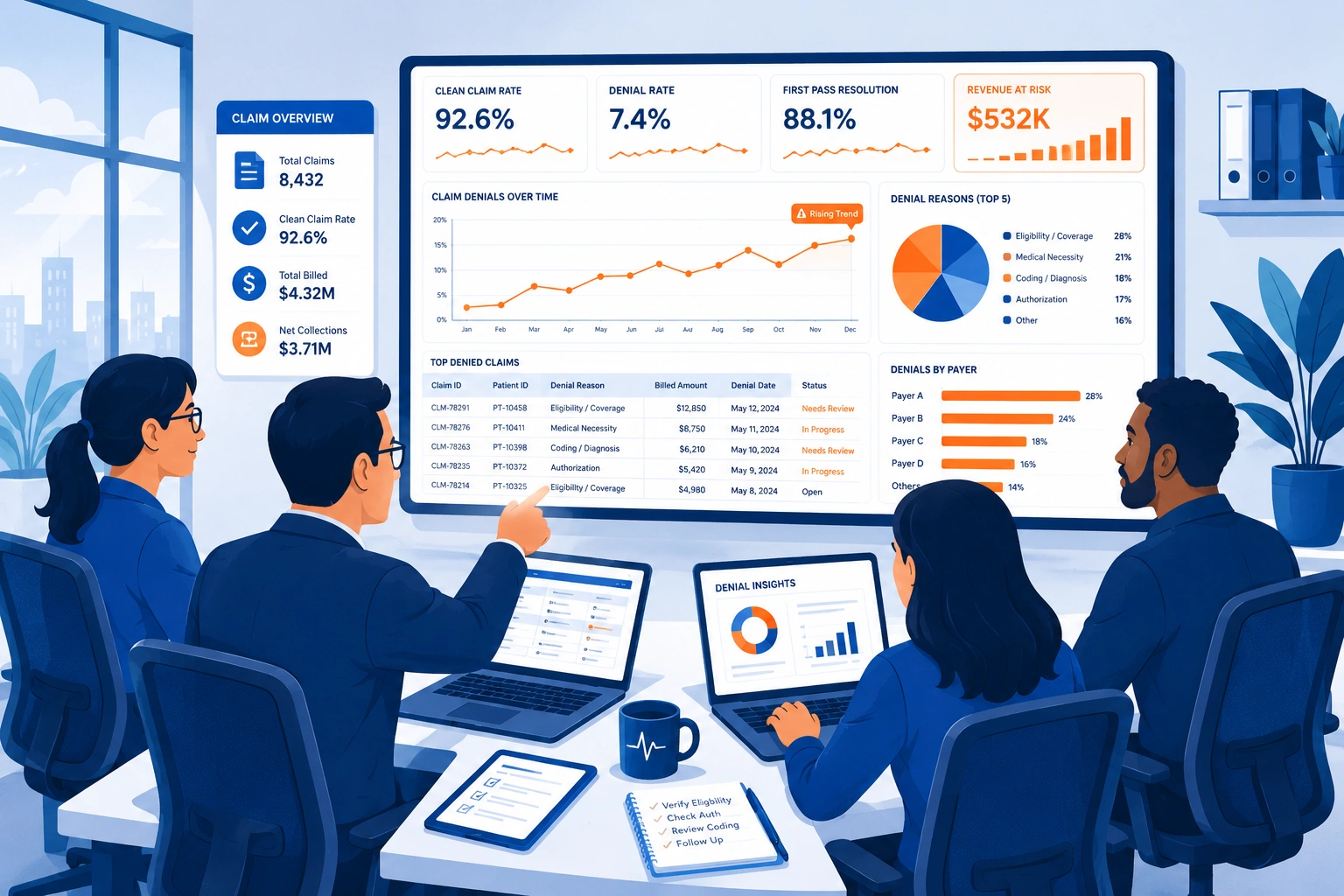
The numbers behind AI claim denials 2026 are stark. Industry data from HFMA and MGMA shows the cost to rework a single denied claim ranges from roughly $25 to $118, depending on complexity. Initial denial rates industry-wide now sit around 10%–15%, with some payers exceeding 20% on specific procedure categories. Clean claim rate benchmarks 2026 have shifted too — a 95% clean claim rate was once acceptable, but top performers now target 98% or higher, while anything under 90% signals a structural billing problem. First-pass resolution lags too: HFMA MAP Keys sets high-performer benchmarks at 90% or above, while the industry median runs closer to 80%–85%. Payer-side scrutiny is intensifying as well: 61% of physicians believe unregulated AI is increasing prior authorization denials, and appealed Medicare Advantage prior authorization decisions show an 82% overturn rate — a sign many automated denials shouldn’t have happened at all.
Key Takeaways
- AI claim denials 2026 are faster, more automated, and harder to catch with manual review alone.
- The average cost to rework a denied claim ranges from $25 to $118, and most denials are preventable.
- Clean claim rate benchmarks have climbed to 95%–98%+ for top performers in 2026.
- Predictive risk scoring and real-time eligibility verification stop denials before they happen.
- Outsourced billing AI denial defense closes the speed gap that in-house teams can’t match alone.
Final Thoughts
Payer AI claim denials aren’t slowing down in 2026 — and neither should your defense. The practices protecting their revenue right now are the ones pairing strong documentation with AI-powered claim denial prevention and a billing partner built to match payer speed. If your team is still reworking denials by hand, it’s time for a different approach. Talk to the UtreatiBill revenue cycle management team about an AI-powered denial defense built for your specialty and your payer mix.