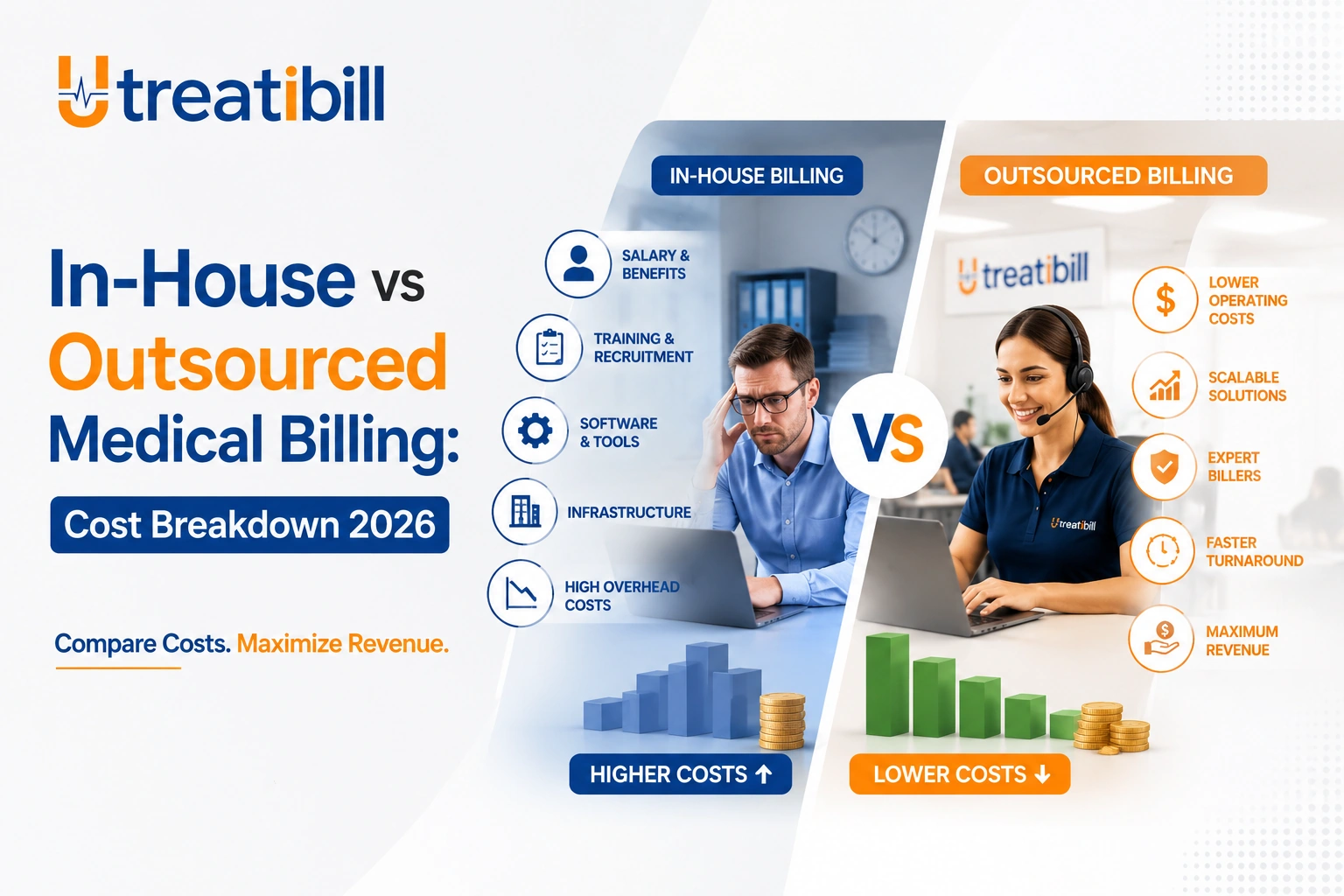

In-House vs Outsourced Medical Billing: The Real Cost Breakdown for Your Practice
Every dollar your practice collects starts with a billing decision you may not have revisited in years. The in-house vs outsourced medical billing question shapes your overhead, your cash flow, and how many claims slip through the cracks before timely filing windows close. In 2026, rising staff costs, stricter payer rules, and AI-assisted billing tools have changed the math on both sides. This guide breaks down the real numbers — salaries, software, denial rework, and outsourcing fees — so you can see exactly where your money goes and build a smarter Revenue Cycle Management strategy for your practice.
What Is In-House vs. Outsourced Medical Billing? In-house medical billing means your own staff handle claims, coding, and collections using software you license and manage. Outsourced medical billing means a third-party partner handles those tasks for a fee, usually a percentage of collections. The in-house vs outsourced medical billing decision ultimately comes down to cost, control, and how much administrative burden your team can absorb.
What Is In-House vs. Outsourced Medical Billing in 2026?
In-house billing keeps every step — eligibility checks, coding, claim submission, payment posting, denial follow-up — under your roof. You own the software, the salaries, and the mistakes. Outsourced billing hands those same functions to a specialized vendor, who is typically paid a percentage of what they collect for you. Most practices in 2026 aren’t choosing one model forever; they’re reevaluating the decision every few years as staffing, payer rules, and technology shift the cost equation underneath them.
Why This Decision Is a Bigger Revenue Driver Than Most Practices Realize
This isn’t just an operations question — it’s a revenue question. The gap between a well-run billing operation and a struggling one routinely exceeds the cost of the billing model itself.
What’s Changed in Medical Billing Costs and Technology in 2026
Billing staff salaries have climbed alongside healthcare wages generally, and so has the cost of replacing them. Meanwhile, CMS finalized new interoperability and prior authorization rules (CMS-0057-F) requiring payers to give specific denial reasons starting in 2026, and a separate claims-attachment standards rule (CMS-0053-F) takes effect May 26, 2026 — both reshaping what “compliant” billing looks like this year.
From Paper Claims to AI-Assisted Billing — How the Landscape Has Shifted
AI-assisted claim scrubbing, predictive denial analytics, and automated eligibility checks have moved from experimental to standard in many revenue cycle workflows, narrowing the technology gap between in-house teams and outsourced vendors.
Why So Many Practices Are Reevaluating In-House Billing Right Now
Staffing is the top pressure point. Billing staff turnover runs 20%–30% annually in healthcare administration, and physicians now face heavier administrative loads industry-wide — the American Medical Association’s 2025 Prior Authorization Physician Survey found physicians complete roughly 40 prior authorizations a week, and 94% say the process contributes to burnout.
The Hidden Revenue Risk of Outdated In-House Billing Processes
A single staff vacancy during a timely filing window — often 90 to 180 days — can turn a collectible claim into a permanent write-off. That risk rarely shows up on a budget line, but it shows up in your collections.

The True Cost of In-House Medical Billing
The salary line is only the start. Once you add benefits, software, training, and denial rework, in-house billing staff costs typically run well above the number on an offer letter.
Salary, Benefits, and Turnover Costs for Billing Staff
Medical billing specialists currently earn roughly $42,000–$54,000 in base salary, with medical coders averaging closer to $55,000. Add billing staff salary and benefits — payroll taxes, health insurance, and PTO typically run 25%–30% on top of base pay — and a single fully loaded biller often costs $58,000–$70,000 a year before software or training. Turnover compounds this: replacing a billing employee can cost 50%–75% of their annual salary in recruiting and lost productivity during ramp-up.
Billing Software, Clearinghouse, and IT Infrastructure Costs
Medical billing software costs range from roughly $200–$2,000 a month for cloud-based platforms, with popular tools like Kareo and AdvancedMD pricing between $150 and $799 per provider per month depending on features. Add clearinghouse fees of $0.25–$0.50 per claim and you’ve built a meaningful line item before a single claim is worked.
Training, Compliance, and Ongoing Education Costs
Payer rules, CPT/ICD-10 updates, and HIPAA requirements change constantly. Ongoing certification and training for an in-house team commonly runs $150–$500 per employee annually — and that’s before the time cost of staff sitting in training instead of working claims.
The Cost of Claim Denials and Rework Under In-House Teams
Every denied claim has to be diagnosed, corrected, and resubmitted. HFMA-cited industry data puts the cost to rework a single denial at $25–$118, and MGMA’s most recent Cost and Revenue Survey puts the median cost to work any claim at $6.50–$12.80. At a 10%+ denial rate, that adds up fast across thousands of monthly claims.
Overhead You’re Not Accounting For (Office Space, Management Time)
Practice overhead and staffing costs rarely stop at payroll. Office space, computers, management time spent supervising billing staff, and the owner-hours spent solving billing problems instead of seeing patients are real costs — they just don’t appear on a line labeled “billing.”
The True Cost of Outsourced Medical Billing
Outsourced medical billing services shift most of these fixed costs into a single variable fee, which is exactly why medical billing outsourcing pricing 2026 has become a board-level conversation for multi-provider groups.
Percentage-of-Collections vs. Flat-Fee Pricing Models
Most vendors charge 4%–10% of collections, with 4%–9% as the typical range and higher-complexity specialties (cardiology, behavioral health, orthopedic surgery) running toward 10%–12%. Flat per-claim pricing usually falls between $3 and $12 per claim — so the average cost of outsourced medical billing per claim depends heavily on your specialty and claim value. Hybrid models (a lower percentage plus a small per-claim fee) are gaining ground in 2026.
What’s Included (and What Isn’t) in Outsourced Billing Contracts
A full-service contract should cover eligibility verification, coding support, claim submission, payment posting, and denial management. Some vendors advertise a low headline rate but bill separately for denial appeals, patient statements, or reporting — always get scope of services in writing, alongside a signed HIPAA Business Associate Agreement. Learn more about what’s typically bundled into Medical Billing Services.
Setup, Transition, and Onboarding Costs
Onboarding a new billing vendor usually takes 30–90 days and may include setup fees, data migration, and payer enrollment. If your practice also needs payer enrollment handled, Provider Credentialing Services are worth bundling into the same transition, since enrollment delays are a common source of early revenue gaps.
Nearshore vs. Offshore Medical Billing Pricing in 2026
Nearshore vs. offshore medical billing 2026 pricing varies widely: offshore teams (often in the Philippines or India) typically run $8–$15 per claim versus $25–$40 onshore, with labor savings of 30%–70%. Nearshore partners (commonly in Latin America) trade some of that discount for overlapping U.S. time zones and easier real-time communication. Either model requires HIPAA-compliant billing outsourcing practices — a signed BAA, encrypted data handling, and documented access controls — regardless of where the team sits.

In-House vs. Outsourced Medical Billing: A Side-by-Side Cost Comparison
This medical billing cost comparison 2026 table summarizes the trade-offs at a glance, using a hypothetical 5-provider primary care practice collecting roughly $2 million annually.
| Factor | In-House Billing | Outsourced Billing |
|---|---|---|
| Typical annual cost | ~$140,000–$170,000 (2 FTEs, software, overhead) | ~$80,000–$200,000 (4%–10% of collections) |
| Pricing predictability | Fixed regardless of collections | Scales with revenue |
| Denial rate benchmark | Often 10%+ | Often 2.5%–5% with specialty vendors |
| A/R days benchmark | 40–55 days common | 30–36 days common |
| Staffing/turnover risk | High — concentrated in 1–2 people | Low — vendor absorbs it |
| Setup/transition effort | Low (already running) | Moderate (30–90 day onboarding) |

Example 1 — Solo Practice Comparing Staff Salary to Outsourced Fees
A solo physician collecting $400,000 annually who employs one in-house biller might spend $60,000–$80,000 a year on salary, benefits, and software. The same practice outsourcing at 7% of collections would pay roughly $28,000 a year — illustrating why is outsourced medical billing worth it for small practices is one of the most common questions solo and small-group physicians ask.
Example 2 — Multi-Provider Group Reducing Denial Rates After Outsourcing
A multi-provider group running an in-house denial rate above 10% could reasonably expect a specialty-focused outsourced partner to bring that closer to the 2.5%–5% range, translating denial-rate improvement directly into recovered collections — often enough to offset the outsourcing fee itself.
Example 3 — Practice That Stayed In-House and Scaled Successfully
Not every practice should outsource. A growing group with a stable, well-trained billing team, strong denial rates, and A/R days already under 35 may get more value from investing in better software and a second biller than from handing the function to a vendor.
Claim Denials, A/R Days, and Collections: Where the Real Money Is Won or Lost
Claim denial rate benchmarks and accounts receivable (A/R) days are the two numbers that matter more than the billing model itself.
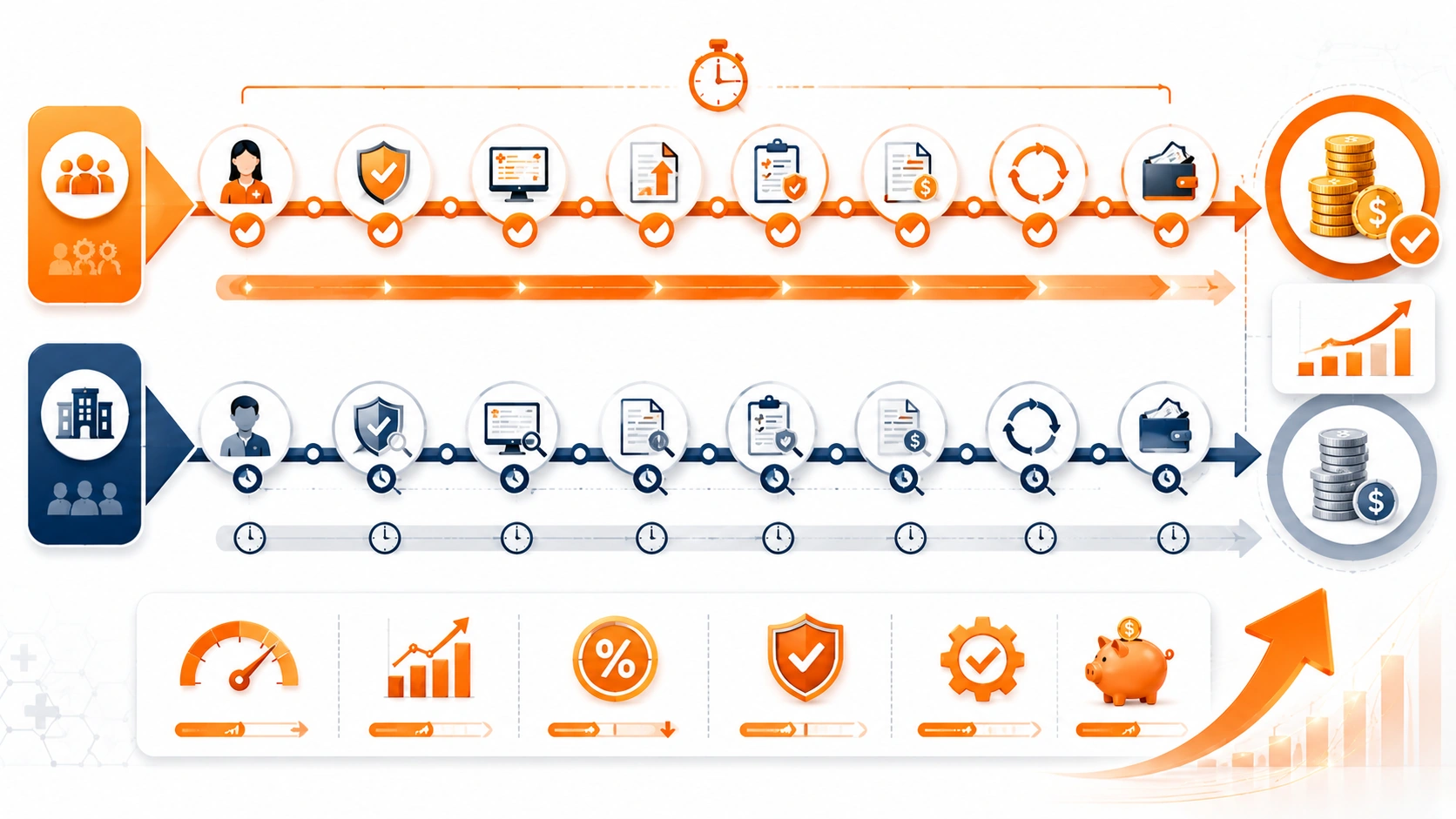
How In-House Teams Typically Perform on Denial Rates and A/R Days
HFMA puts the industry average denial rate at 5%–10%, with under 5% considered optimal — yet MGMA’s denial benchmarking work found more than half of organizations report denial rates above 10%. MGMA also recommends keeping days in A/R under 40, with top performers closer to 35 or below.
How Outsourced Billing Partners Track and Improve KPIs
Specialty-focused outsourced partners build medical billing KPI tracking into the contract itself — clean-claim rate, denial rate by category, and A/R aging are reviewed on a set cadence, with performance guarantees written into the agreement.
Why Faster Reimbursement Timelines Matter for Cash Flow
Every extra day in A/R is a day your practice is financing patient care out of pocket. HFMA recommends keeping A/R over 90 days below 10% of total receivables — once it climbs past that, recovery odds drop fast as timely filing windows close.
When In-House Medical Billing Makes Sense
Practice Size and Specialty Considerations
Larger groups with high claim volume and stable staff can spread fixed billing costs across more revenue, often making in-house billing more cost-efficient per claim than it would be for a solo practice.
Control, Compliance, and Data Security Priorities
If your practice prioritizes direct oversight of patient billing data and a hands-on relationship between clinical and billing staff, in-house billing keeps that control inside your four walls.
When Outsourced Medical Billing Makes Sense
Practices Struggling With Staffing Shortages or Turnover
If you’ve spent the last year posting the same billing job repeatedly, outsourcing — or supplementing your team with Virtual Medical Billing Assistance — removes that hiring cycle entirely.
Practices Scaling Across Multiple States or Locations
Revenue cycle outsourcing gives multi-location groups access to payer-specific expertise across states without hiring a specialist for every market you enter.
Practices Looking to Reduce Denials and Improve Cash Flow Fast
If your denial rate is climbing and your A/R is aging past 60 days, a specialty-focused outsourced partner can typically show measurable improvement within the first 60–90 days.
How to Decide: A Practical Framework for Your Practice
Calculate Your True In-House Cost Per Claim
Add salary, benefits, software, clearinghouse fees, training, and denial rework, then divide by your monthly claim volume. A Medical Billing Audit is the fastest way to get an accurate number instead of guessing.
Compare Against Outsourced Pricing Models
Run that true cost-per-claim figure against a 4%–10% outsourced fee on your actual collections — not your charges — to see which model wins at your current volume.
Weigh Control vs. Convenience for Your Specialty
High-complexity specialties often benefit most from outsourced expertise; high-volume, simpler specialties may do fine in-house if denial rates stay low.
Pilot or Phase In Outsourcing Without Disrupting Revenue
Most practices wondering how do you switch from in-house to outsourced medical billing find success by running both systems in parallel for one billing cycle, then transitioning fully once the vendor’s accuracy is confirmed.
How UtreatiBill Helps Practices Make the Right Billing Decision
UtreatiBill’s revenue cycle management team builds practice-specific cost comparisons, not generic pricing sheets. Whether you stay in-house, move to outsourced medical billing services, or land somewhere in between with a hybrid model, we help you make the call with your actual numbers instead of industry averages alone.

The Financial Data Behind In-House vs. Outsourced Medical Billing in 2026
The medical billing cost comparison 2026 numbers, gathered from CMS, AMA, HFMA, and MGMA data and industry pricing surveys:
- Cost per claim: Outsourced pricing has held fairly steady in the 4%–10%-of-collections range over the past year, while in-house cost pressure has risen — MGMA’s Cost and Revenue Survey puts the median cost to work a claim at $6.50–$12.80, and denial rework alone can cost $25–$118 per claim.
- Fully-loaded cost per billing FTE: Roughly $58,000–$70,000 once benefits (25%–30% of base salary), software, and training are included on top of a $42,000–$54,000 base salary.
- Outsourced fee as a share of collections: 4%–10%, with most full-service contracts in the 4%–9% band.
- Denial rate benchmarks: HFMA reports an industry average of 5%–10%; MGMA data shows over half of organizations exceed 10%, while specialty-focused outsourced vendors commonly report 2.5%–5%.
- A/R days: MGMA’s benchmark is under 40 days, with top performers under 35; outsourced partners frequently report averages in the 30–36 day range. CMS compliance changes taking effect in 2026 — including required denial-reason transparency — are expected to influence both numbers further this year.
Key Takeaways
- In-house billing carries fixed costs (salary, benefits, software) that don’t shrink when collections slow down.
- Outsourced billing shifts cost into a variable fee, typically 4%–10% of collections.
- Denial rate and A/R days matter more to your bottom line than the headline price of either model.
- Specialty complexity, claim volume, and staffing stability should drive your decision more than cost alone.
- A short pilot period is the lowest-risk way to test outsourcing without disrupting revenue.
Final Thoughts
There’s no universal right answer to in-house vs outsourced medical billing — only the right answer for your claim volume, specialty, and current denial performance. The practices that get this right run the numbers first, rather than defaulting to whatever model they inherited. If you want help running those numbers for your practice, UtreatiBill’s team can build a side-by-side comparison using your actual billing data.