Provider Credentialing Timeline: How Long Does It Really Take in 2026?
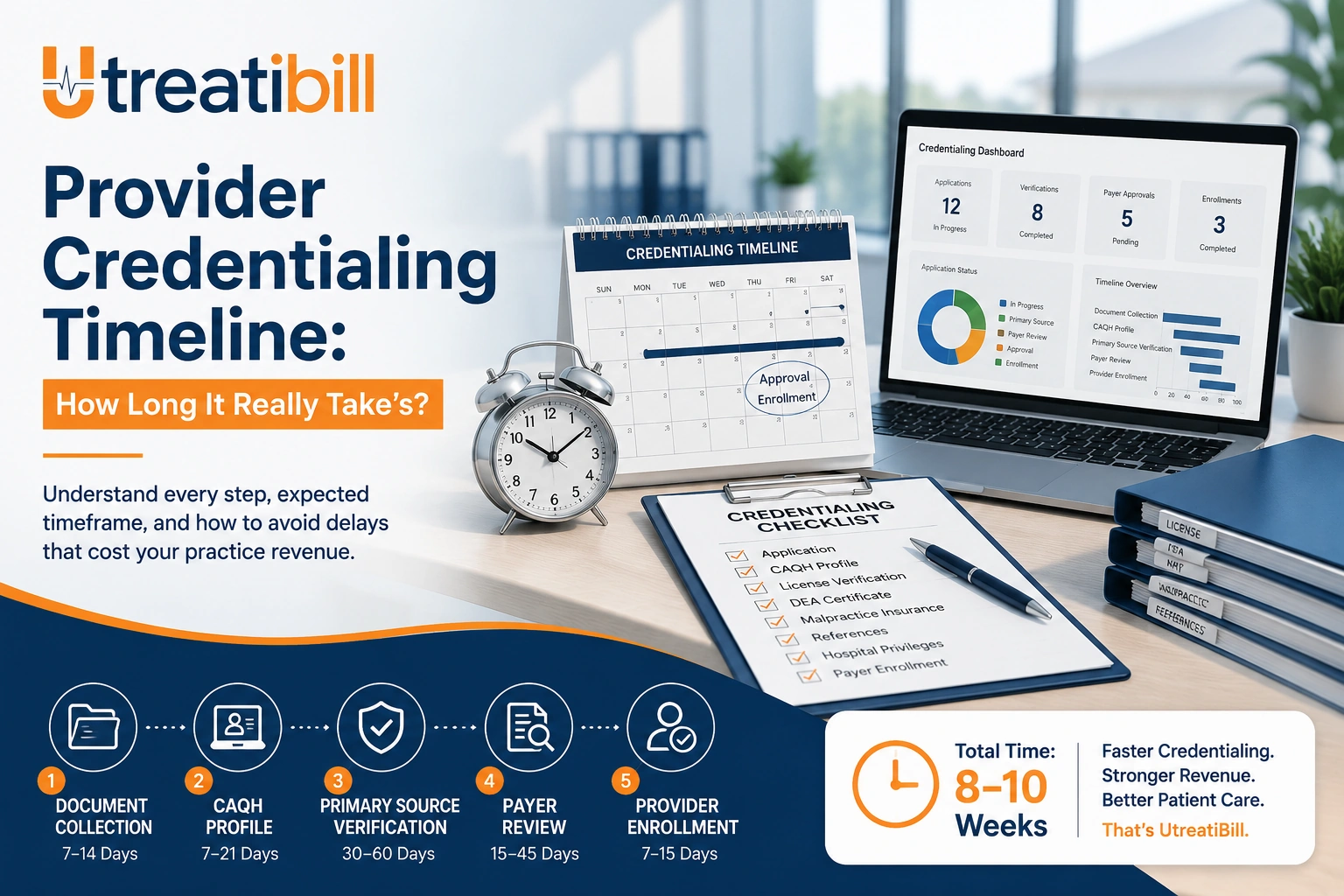
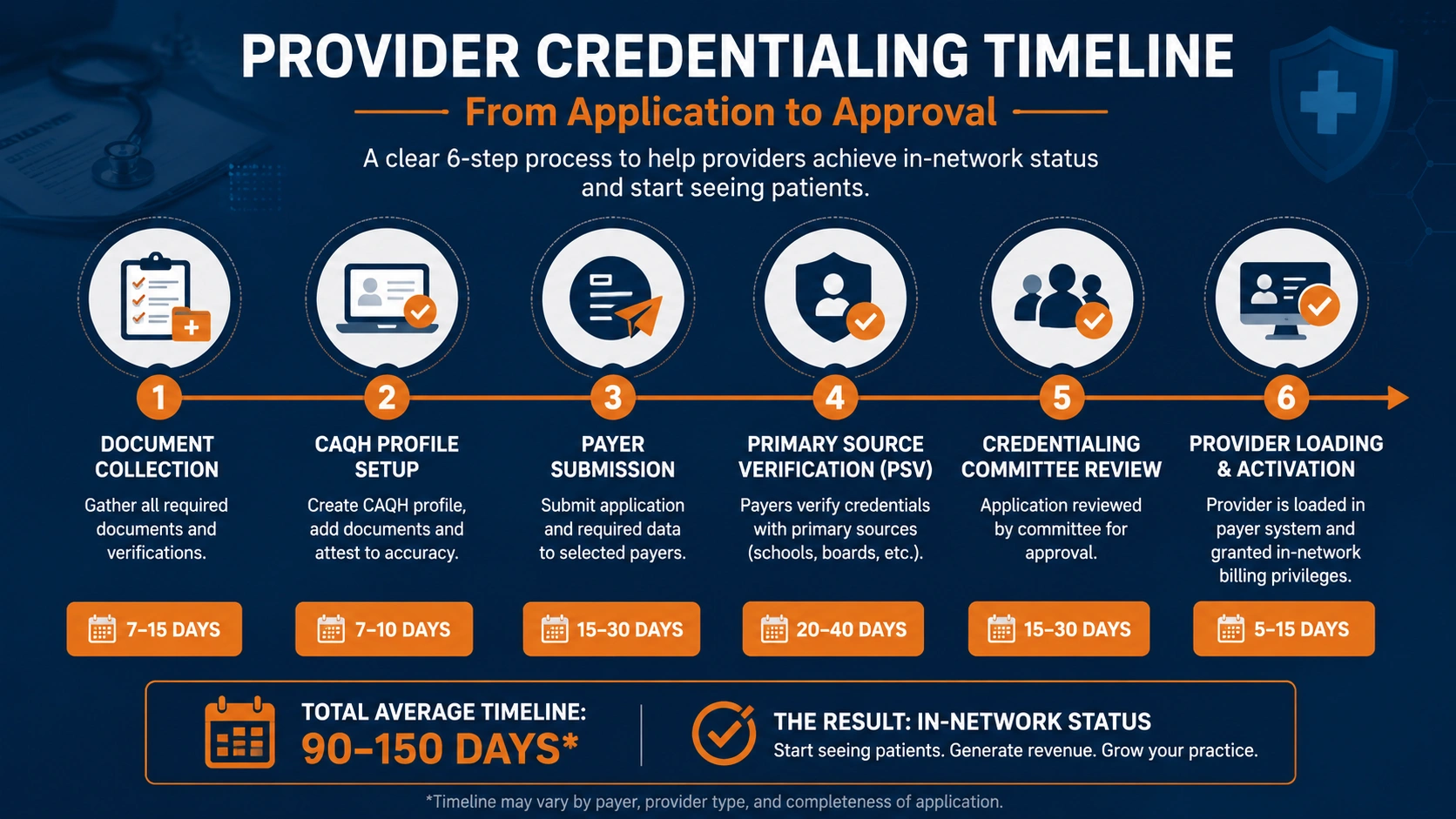
If you’re a new provider or adding staff to your practice, the provider credentialing timeline is one of the most critical — and most misunderstood — processes you’ll face. On average, the insurance credentialing process takes 90 to 150 days depending on the payer. Every day your provider isn’t approved is a day your practice isn’t getting paid. Our Provider Credentialing Services team at UtreatiBill has guided hundreds of practices through this exact process. In this guide, we break down exactly what to expect — and how to shorten the wait.
What Is the Provider Credentialing Timeline?
The provider credentialing timeline is the total time from submitting your credentialing application to receiving active in-network billing privileges with an insurance payer. In 2026, that process averages 90 to 150 days for commercial payers, 60 to 90 days for Medicare, and 45 to 90 days for Medicaid, depending on state and payer.
Why the Provider Credentialing Timeline Costs More Than You Think
Most providers know credentialing takes time. What they don’t anticipate is how much that time costs them financially. The provider credentialing timeline isn’t just an administrative hurdle — it’s a direct drain on your practice’s cash flow.
How Much Revenue Do Practices Lose During Credentialing Delays?
According to MGMA benchmarks, a mid-level provider can generate $150 to $250 or more per day in billable services. When credentialing is pending, those services either can’t be billed to insurance or must be held as accounts receivable with no guarantee of retroactive payment. At that rate, credentialing delays revenue loss over a 120-day period can easily reach $18,000 to $30,000 per provider.
For a group practice adding three providers at once, that figure multiplies fast. Credentialing delays revenue loss isn’t just a billing inconvenience — it’s a cash flow crisis that affects your ability to pay staff, cover overhead, and grow.
What Changed in Credentialing Requirements in 2026
Payers have increased their scrutiny of provider enrollment applications over the past year. Several commercial insurers now require additional attestation of telehealth capabilities, updated DEA registration, and confirmation of state licensure within the past 90 days. CMS.gov has also updated its PECOS enrollment process to require re-verification of certain provider data fields that were previously auto-populated. These changes make the insurance credentialing process more document-intensive than it was even two years ago.
Why Most New Providers Underestimate the Timeline
New providers often assume credentialing works like a job application — submit, wait a few weeks, get approved. That’s not how it works. The credentialing turnaround time depends on payer processing queues, primary source verification timelines, and credentialing committee review schedules that meet only once per month at many organizations. Providers who aren’t prepared for these realities routinely find themselves four to six months in with no approval in sight.
How Long Does Credentialing Take? A Breakdown by Payer Type
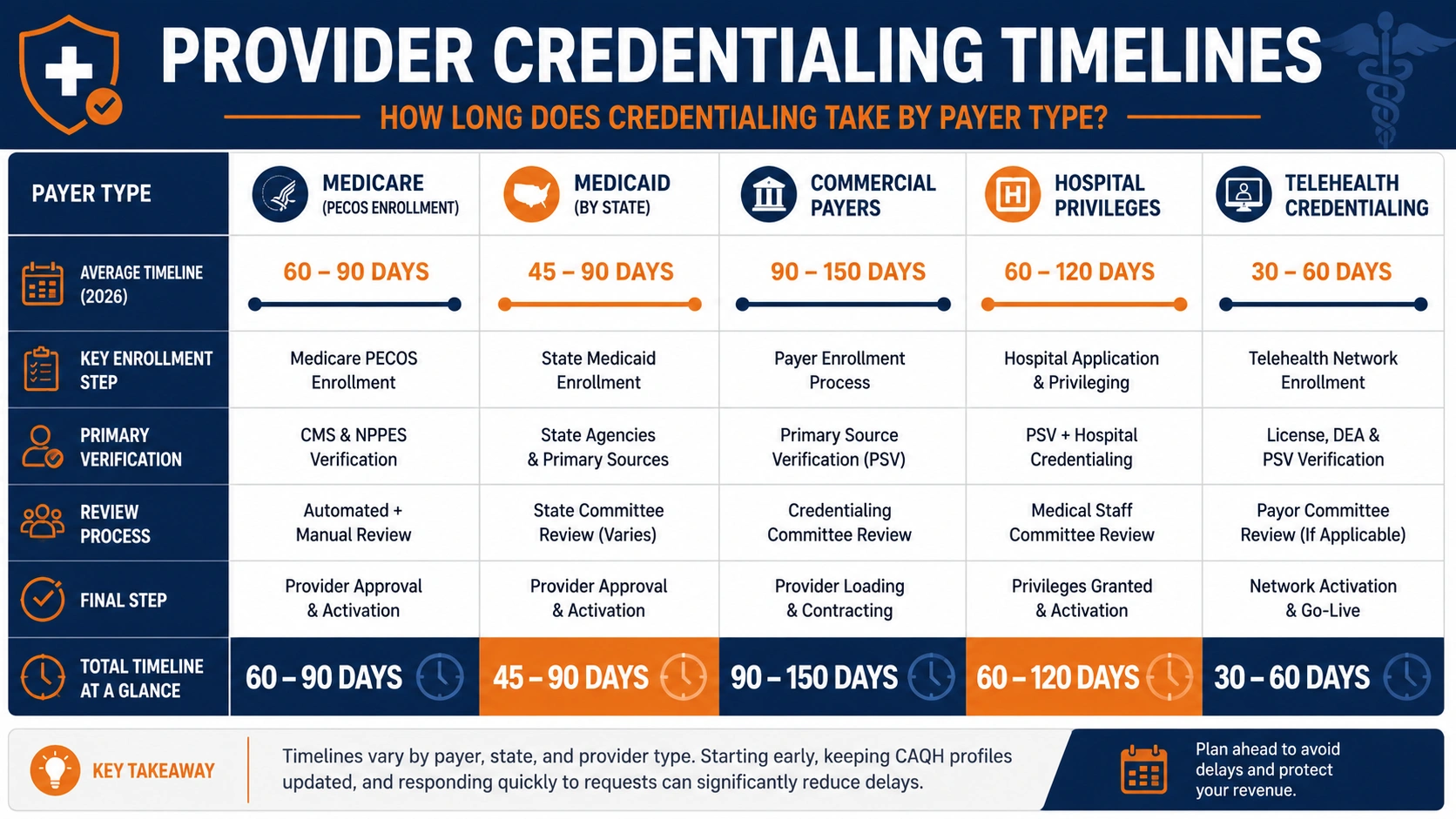
Here’s a straightforward comparison of typical timelines across payer types:
| Payer Type | Average Timeline | Key Factor |
|---|---|---|
| Medicare (PECOS) | 60–90 days | CMS processing queue, NPI verification |
| Medicaid | 45–90 days | Varies significantly by state |
| Commercial Payers | 90–150 days | Monthly credentialing committee review cycles |
| Hospital Privileges | 60–120 days | Medical staff office processing speed |
| Telehealth Payers | 30–90 days | Platform-specific enrollment rules |
Medicare Credentialing Timeline (PECOS Enrollment)
So how long does Medicare credentialing take? Medicare PECOS enrollment typically runs 60 to 90 days after a complete application is submitted through CMS.gov‘s Provider Enrollment, Chain, and Ownership System. Any missing document triggers a Request for Development (RFD), which can add 30 to 60 additional days to the process. Providers must have a valid NPI, a current state license, and a clean malpractice history to move through Medicare PECOS enrollment without interruption.
Medicaid Credentialing Timeline by State
Medicaid credentialing is handled at the state level, which creates wide variation in timelines. Some states process applications in 45 days. Others take 90 days or longer. If you’re credentialing across multiple states, expect each to operate on its own schedule with its own documentation requirements and payer enrollment process.
Commercial Payer Credentialing Timeline
Commercial payers — Blue Cross Blue Shield, Aetna, Cigna, United Healthcare — have the longest and most variable timelines. Most average 90 to 150 days, largely because of monthly credentialing committee review cycles and the need to complete primary source verification through NCQA-compliant processes. Missing a committee meeting by one day means waiting another full month.
Hospital Credentialing and Privileges Timeline
Hospital credentialing is separate from insurance credentialing. Even if a provider is fully credentialed with payers, they must separately obtain hospital privileges through the hospital’s medical staff office. This process typically takes 60 to 120 days and requires its own credentialing documentation checklist distinct from payer applications.
Telehealth Credentialing Timeline in 2026
Telehealth platforms have streamlined parts of the payer enrollment process, but providers credentialing with telehealth-specific payers still face 30 to 90 day timelines. In 2026, payers require documentation of the technology platform, secure video capabilities, and state-by-state licensure in every jurisdiction where the provider sees patients.
The Provider Credentialing Process Step by Step
Understanding each phase helps you anticipate where delays typically occur and how to avoid them.

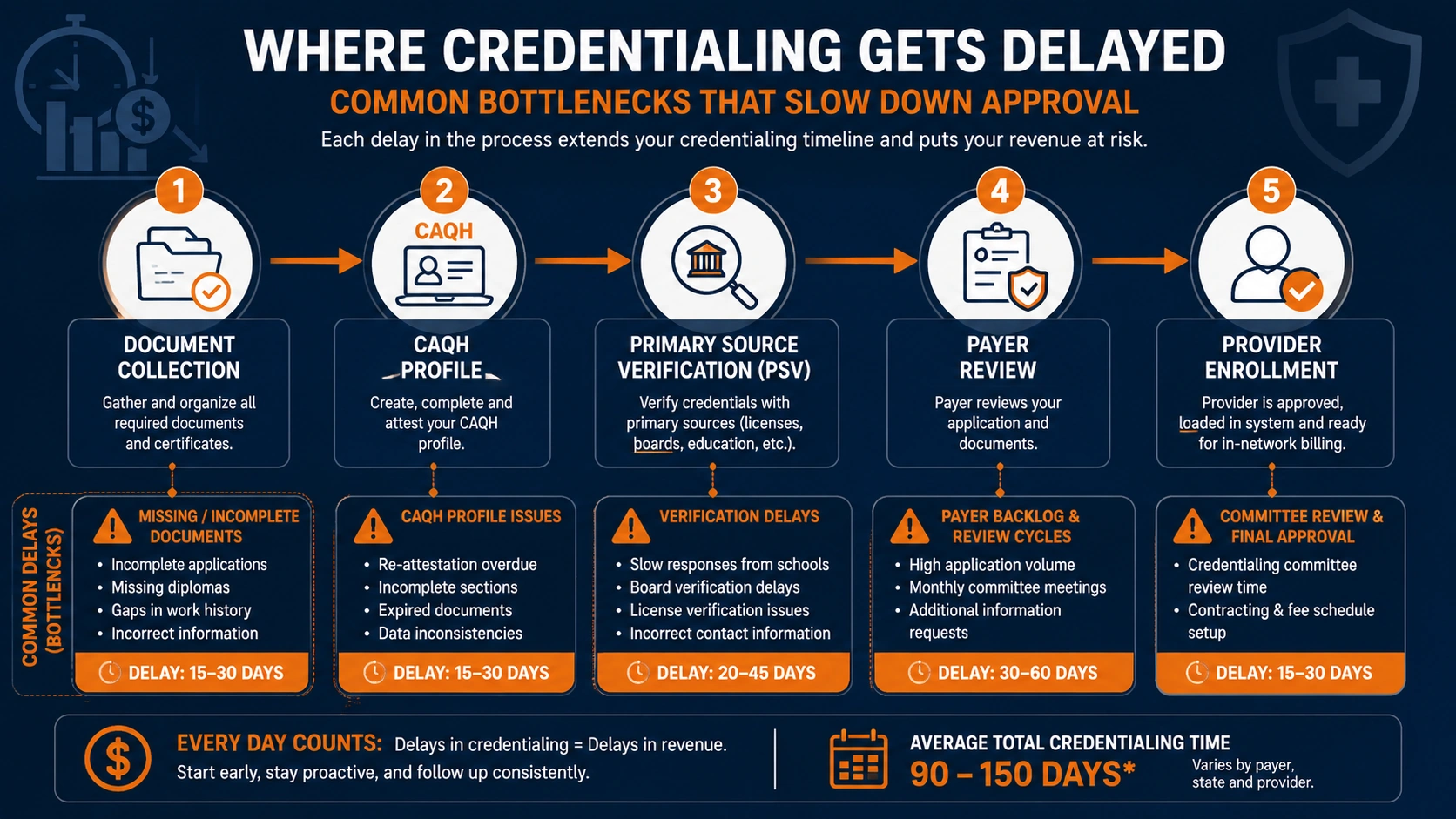
Step 1 — Document Collection and CAQH Profile Setup
The first step is gathering your credentialing documentation checklist: medical license, DEA registration, NPI, malpractice insurance certificates, board certifications, CV, and complete work history. Most payers require you to establish or update a CAQH provider enrollment profile before they’ll process your application. CAQH profile attestation must be completed and re-attested every 120 days. Skipping an attestation window freezes your profile and delays every payer relying on it. Allow two to four weeks for this step if you’re starting from scratch.
Step 2 — Application Submission to Payers
Once your CAQH profile is complete, you submit applications directly to each payer. Some accept CAQH as a universal application. Others have proprietary forms and portals. A real-world example: a family practice in Texas adding a new PA found that three of their five payers required separate portal submissions with additional state-specific attestations — adding two weeks to the timeline before the payer enrollment process even began.
Step 3 — Primary Source Verification
Primary source verification (PSV) is where payers confirm your credentials directly with issuing bodies — your state medical board, malpractice carrier, medical school, and board certification organizations. This step follows NCQA compliance standards and typically takes two to six weeks depending on how quickly those organizations respond. Provider enrollment delays frequently originate here. State licensing boards are notoriously slow to respond, particularly in high-volume states.
Step 4 — Credentialing Committee Review
After PSV is complete, your file goes before a credentialing committee review. This is a step within the provider credentialing timeline where most providers lose unexpected weeks. Most hospital systems and many commercial payers have committees that meet only once per month. If your file arrives the day after a meeting, you wait until next month. This single scheduling factor can add 30 days to your timeline with no error or fault on your part.
Step 5 — Payer Enrollment and Provider Loading
After committee approval, the payer loads your provider data into their billing system. This final step takes one to three weeks and is where your in-network billing privileges become active. Only after provider loading can your practice begin submitting claims and receiving in-network reimbursement.
What Causes Credentialing Delays?
Knowing the common pitfalls is the first step toward knowing how to avoid credentialing delays for new providers before they cost you weeks or months of lost revenue.
Incomplete or Inaccurate Documentation
A single missing document — an expired malpractice certificate, a missing supervision agreement, an outdated CV — triggers a payer request that can pause your application for weeks. This is one of the top reasons people ask why does credentialing take so long. The answer often isn’t the payer — it’s the paperwork.
CAQH Profile Errors and Missed Re-Attestations
CAQH profile attestation must stay current. If your re-attestation window passes, your profile deactivates. Every payer pulling data from CAQH sees an inactive profile and stops processing your application. This is one of the most common and most preventable provider enrollment delays in the insurance credentialing process.
Monthly Credentialing Committee Meeting Cycles
You have no control over when a committee meets — but you can control when your file is submitted. Getting complete, accurate applications in early gives you the best shot at making the next scheduled meeting instead of waiting another 30 days.
Multi-State and Multi-Payer Complexity
Providers credentialing in multiple states or with multiple payers face compounding timelines. A provider joining a telehealth group operating in five states may face five separate Medicaid applications, each with its own documentation requirements, payer enrollment process, and processing timeline.
Slow Primary Source Responses
Your state medical board may take four to eight weeks to respond to a primary source verification request. You can’t rush them — but you can ensure your license is in good standing, renewal fees are paid, and no outstanding complaints are pending before you submit your application.
Can You See Patients or Bill Before Credentialing Is Approved?
This is one of the most urgent questions we hear from practices onboarding new providers.
Provisional Privileges and What They Cover
Hospitals can grant provisional privileges that allow a provider to see patients before full credentialing is complete. This is common in acute care settings when a specialist is urgently needed. Commercial payer networks, however, rarely offer equivalent interim status. Provisional hospital privileges do not automatically translate into insurance billing rights.
Retroactive Billing — What Is Possible and What Isn’t
Some payers allow retroactive billing to the date of application submission once credentialing is approved. Medicare and Medicaid permit this in specific circumstances. Commercial payers vary widely — many do not allow it at all. Before assuming retroactive coverage exists, verify the policy with each payer directly. Our Revenue Cycle Management team can help you identify which payers in your network permit retroactive billing and how to document services properly in the interim.
The Financial Risk of Billing Without Active Credentialing
If you’re asking whether you can bill before credentialing is approved — the risk of doing so is significant. Submitting claims to a commercial payer before you have active in-network billing privileges can result in claim denials, repayment demands, and compliance flags. If your Medical Billing Services team submits claims prematurely, you may face costly appeals — or payer audits. A proactive Medical Billing Audit can identify billing exposure before it escalates.
How to Speed Up the Provider Credentialing Timeline
Knowing how to speed up insurance credentialing starts long before a provider’s first day.
Start the Process Before the Provider’s First Day
Begin the insurance credentialing process at least 90 to 120 days before a provider’s intended start date. If you wait until their first week, you’ve already forfeited two to three months of billing potential. Every day of delay at the start compounds into weeks of lost revenue at the end.
Keep Your CAQH Profile Current and Re-Attested
Log into your CAQH account every 90 days. Confirm all license numbers, expiration dates, and malpractice certificates are current. Set calendar reminders. This single habit eliminates one of the most preventable provider enrollment delays in the credentialing process.
Follow Up With Payers Every Two Weeks
Payers process thousands of applications simultaneously. Yours isn’t the priority unless you make it one. A professional follow-up call or email every two weeks keeps your file from sitting at the bottom of a processing queue for months.
Prioritize Your Highest-Volume Payers First
If you’re credentialing with eight payers, identify the two or three that represent the largest portion of your patient panel. Submit those applications first and follow up most aggressively. This strategy limits credentialing delays revenue loss during the waiting period by getting your most-used payers approved earliest.
Outsource to a Credentialing Specialist
If your practice doesn’t have dedicated in-house staff for credentialing, outsourcing to professional medical credentialing services is often the most effective solution. Virtual Medical Billing Assistance specialists manage document collection, payer portal submissions, follow-up calls, and re-attestation schedules on your behalf — keeping applications moving even when your staff is occupied elsewhere.
Re-Credentialing: How Often Does It Happen and How Long Does It Take?
Credentialing isn’t a one-time event. Most payers require re-credentialing every two to three years. The re-credentialing timeline is typically 60 to 90 days — shorter than initial credentialing because primary source verification data already exists in payer systems from your first cycle. However, missed re-credentialing deadlines can result in suspension of your in-network billing privileges. Put re-credentialing dates on a rolling 24-month calendar and start the process at least 90 days before each expiration.
When to Outsource Your Credentialing Process
Managing credentialing in-house works when you have a dedicated, trained staff member with the bandwidth to handle multiple payer applications simultaneously. For most practices, that’s not realistic. When your office manager is juggling billing, scheduling, and credentialing at the same time, applications get delayed, follow-ups get missed, and re-attestation windows close unnoticed.
Outsourcing to professional medical credentialing services makes sense when:
- You’re adding more than one provider in a calendar year
- You’re credentialing across multiple states or payer types
- You’ve experienced repeated credentialing delays revenue loss from incomplete submissions
- Your staff lacks dedicated training in the payer enrollment process
- You can’t commit to biweekly payer follow-up calls across multiple active applications
How UtreatiBill Streamlines the Provider Credentialing Timeline
At UtreatiBill, our Provider Credentialing Services team manages every phase of the insurance credentialing process — from CAQH profile setup and document collection to payer application submission, primary source verification follow-up, and provider loading confirmation. We track every application, follow up with payers on a consistent schedule, and flag issues before they become delays. Our clients typically see their credentialing turnaround time reduced by 20 to 40 percent compared to self-managed applications, with fewer denials and faster access to in-network billing privileges.

Provider Credentialing Timeline — Key Statistics
Here are five data points every practice manager should know before starting the credentialing process:
- Average timelines in 2026: Commercial payers average 90–150 days; Medicare PECOS enrollment averages 60–90 days; Medicaid averages 45–90 days by state.
- Daily revenue loss: Per MGMA benchmarks, a provider generating $200 per day in billable services loses an estimated $18,000–$30,000 during a 90–150 day credentialing delay.
- Delay frequency: Industry data shows that more than 50% of provider applications experience at least one credentialing delay caused by incomplete documentation, missed PSV, or committee scheduling conflicts.
- Re-credentialing cycle: Most payers require re-credentialing every 2–3 years. The re-credentialing timeline averages 60–90 days when managed proactively with a complete file.
- Outsourcing impact: Practices that use professional medical credentialing services report faster credentialing turnaround time, fewer claim denials post-approval, and reduced administrative burden — with cost savings that often exceed the service fee within the first credentialing cycle.
Key Takeaways
- The provider credentialing timeline averages 90–150 days for commercial payers, 60–90 days for Medicare, and 45–90 days for Medicaid.
- Credentialing delays revenue loss is significant — a single provider can lose $18,000 to $30,000 during a delayed approval period.
- Start the insurance credentialing process at least 90 to 120 days before a provider’s intended start date.
- Keep your CAQH provider enrollment profile current with re-attestation every 90 to 120 days.
- Outsourcing to medical credentialing services is the most reliable way to reduce timeline, prevent delays, and protect your practice’s revenue.
Final Thoughts
The provider credentialing timeline is one of the few areas in practice management where preparation directly controls your financial outcome. The practices that plan ahead, maintain accurate documentation, and follow up consistently get approved faster — and bill sooner.
If your practice is managing credentialing in-house and struggling with delays — or if you’re onboarding new providers and want to avoid the mistakes that add months to the process — the UtreatiBill team is ready to help.
Contact UtreatiBill today to get your credentialing started right and get your providers billing on time.