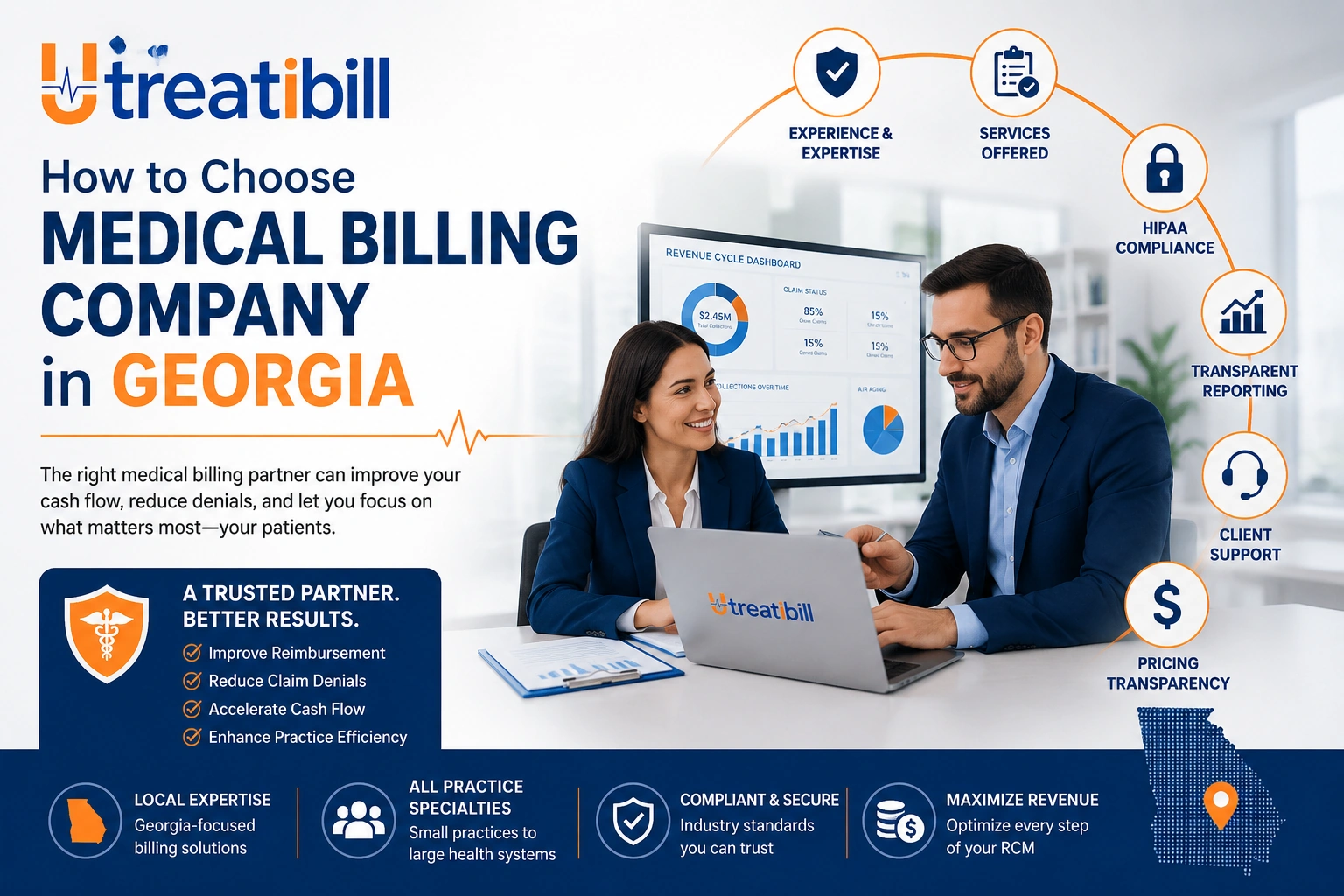

How to Choose Medical Billing Company in Georgia: A Practice Owner’s Guide
Running a medical practice in Georgia means navigating one of the most demanding payer environments in the country. If your revenue is leaking, your denials are climbing, or your cash flow feels unpredictable — your billing setup may be the root cause.
Knowing how to choose a medical billing company in Georgia can be the single most consequential financial decision you make for your practice. The wrong partner costs you time, revenue, and confidence. The right one strengthens your entire Revenue Cycle Management operation.
This guide walks you through every step — what to look for, what to ask, what to avoid, and how to switch without disrupting your cash flow.
What Does a Medical Billing Company in Georgia Actually Do?
A medical billing company in Georgia manages your full claims cycle — from charge capture and coding to denial management and payment posting. Understanding how to choose a medical billing company in Georgia means evaluating Georgia-specific expertise, payer knowledge, clean claim performance, and compliance capabilities tailored to your specialty and payer mix.
A quality medical billing company in Georgia does far more than submit claims. Core services include charge capture, medical coding, claim submission and follow-up, denial management and appeals, patient billing, and financial reporting. The best billing partners also understand Georgia-specific requirements — particularly the state’s Medicaid CMO structure and regional payer nuances that routinely catch out-of-state companies off guard.
Why Choosing the Wrong Billing Company Costs Georgia Practices Thousands
Georgia has one of the most complex billing environments in the U.S. A billing partner that performs adequately elsewhere can fail your practice here.
Georgia’s Unique Billing Landscape Every Practice Must Understand
Georgia Medicaid operates through a Care Management Organization (CMO) model — managed care organizations including Amerigroup, Peach State Health Management, WellCare, and CareSource handle most Medicaid beneficiaries. Each CMO has its own authorization requirements, timely filing deadlines, and claim formatting rules.
Any Georgia medical billing company you evaluate must demonstrate hands-on experience with Georgia Medicaid CMO billing — not just general Medicaid knowledge. Submission errors tied to CMO-specific rules are among the leading causes of denials for Georgia practices, and a billing company without that context will learn on your revenue.
The Financial Impact of Georgia’s 10.4% Claim Denial Rate
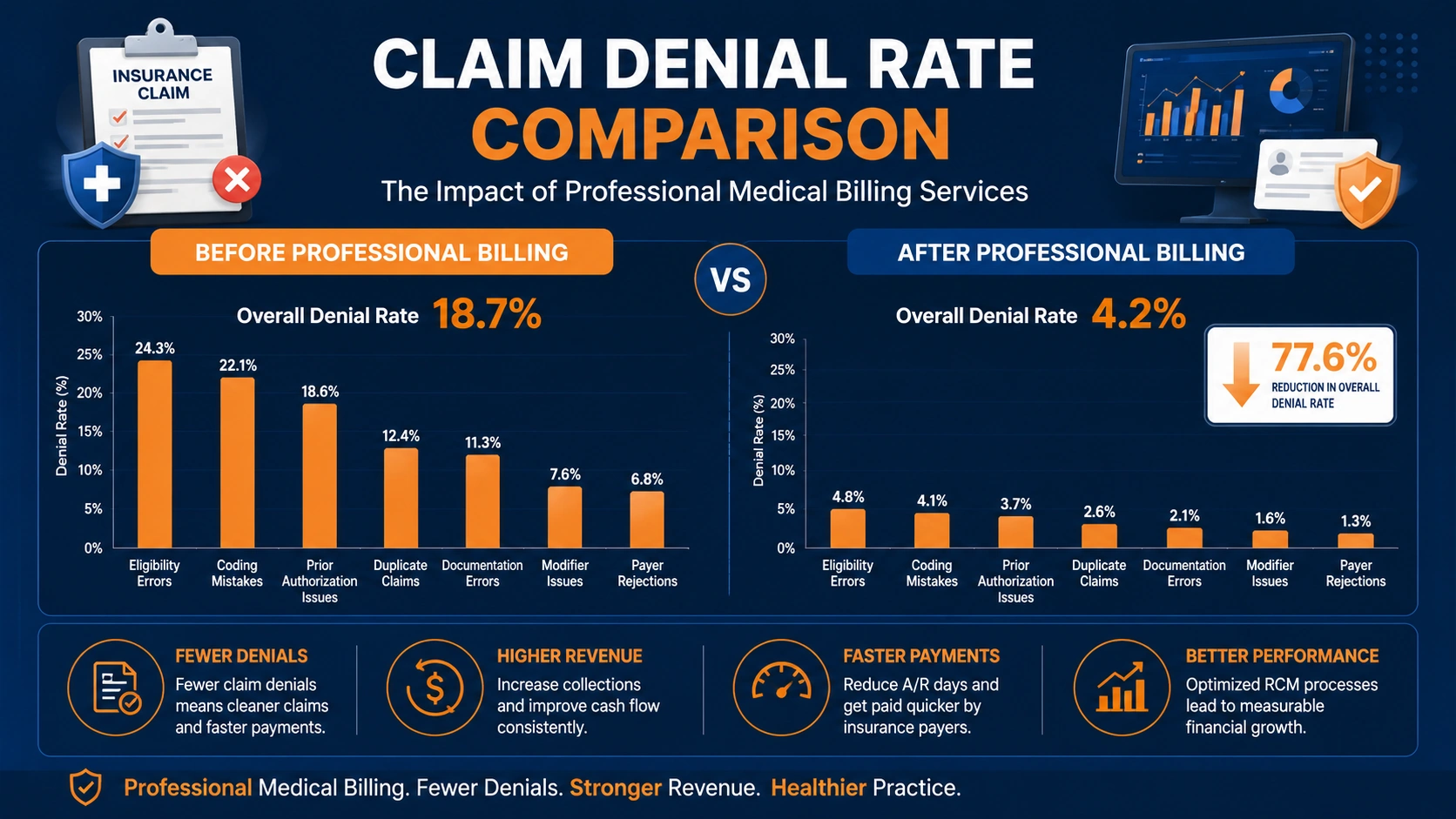
Georgia carries the highest claim denial rate in the country at 10.4%, compared to the national average of approximately 5–7% (MGMA, 2026). For a practice billing $1 million annually, that’s over $100,000 in at-risk revenue every year — before write-offs.
This benchmark defines what your billing partner must be built to perform against. It is not a margin you can absorb with an average billing company.
How the Wrong Billing Partner Silently Drains Your Revenue Cycle
A poor billing company doesn’t invoice you for the revenue they cost you — that loss is invisible. You see it through rising accounts receivable (A/R) days creeping past 45 or 60, denial spikes with no clear follow-up, clean claim rates below the 95% industry benchmark, and staff spending hours chasing billing issues instead of serving patients. These are the compounding effects of a billing relationship that’s costing more than it delivers.
Why More Georgia Providers Are Reevaluating Their Billing Setup in 2026
According to the AMA’s 2026 administrative burden report, physicians spend an average of 15–20 hours per week on administrative tasks — with prior authorization and claim management at the top of the list. Georgia providers increasingly recognize that outsource medical billing Georgia strategies are not just convenient — they are a financial advantage. Rising practice overhead and staffing costs are accelerating that shift.
What to Look for When You Choose a Medical Billing Company in Georgia
This section answers the core question: what to look for in a medical billing company in Georgia. Do not evaluate vendors on price alone. Evaluate them on demonstrated performance, Georgia-specific knowledge, and operational fit.
Georgia-Specific Payer Knowledge and CMO Experience
Your billing company must know Georgia payer requirements in detail. Ask specifically about their experience with Amerigroup, Peach State, CareSource, and WellCare CMOs; Georgia Medicaid prior authorization workflows; Blue Cross Blue Shield of Georgia submission protocols; and local credentialing timelines.
Provider Credentialing Services are a critical complement — especially when adding new providers or expanding into new payer networks. Credentialing gaps directly delay your ability to bill and collect.
Clean Claim Rates, Denial Management, and A/R Performance
Ask for hard numbers. A top-performing best medical billing company Georgia practices rely on should demonstrate a clean claim rate of 95–98% or higher, first-pass acceptance above 96%, A/R days under 35 for most specialties, and denial follow-up initiated within 7–10 business days.
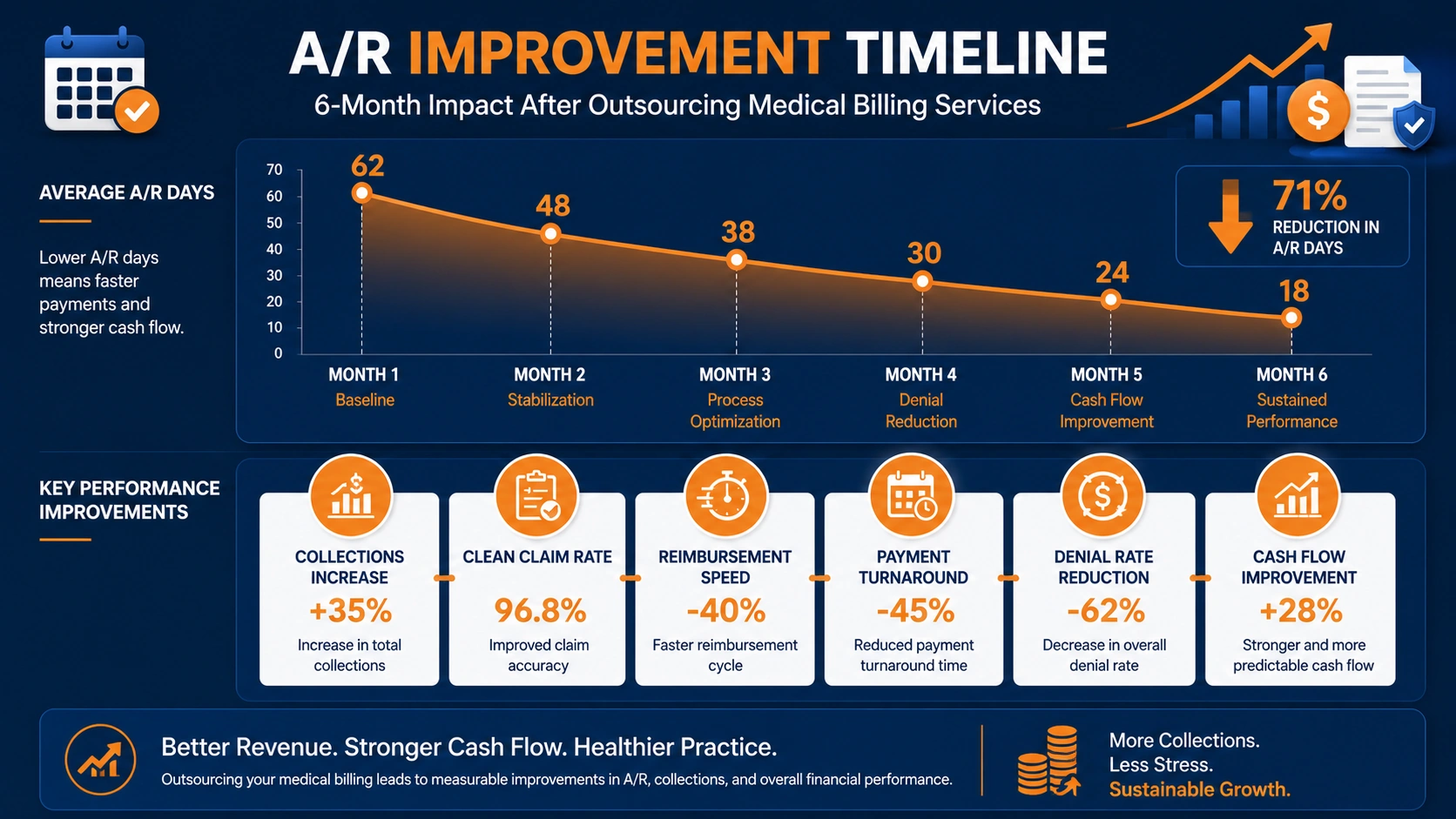
According to MGMA benchmarks, practices using high-performing outsourced billing partners average 28–32 A/R days — compared to 45–55 days for in-house billing teams in Georgia. That gap represents real cash sitting uncollected.
HIPAA-Compliant Billing Workflows and Data Security Standards
HIPAA-compliant billing Georgia is non-negotiable. Your billing partner will handle protected health information (PHI) for every patient encounter. Request their signed Business Associate Agreement (BAA), data encryption standards, staff access control policies, and incident response procedures before signing anything.
Our Medical Billing Services at UtreatiBill are built on HIPAA-compliant workflows at every stage of the revenue cycle, with documented security standards your compliance team can review.
Transparent Reporting, KPI Tracking, and Financial Visibility
Medical billing KPI tracking is how you hold your partner accountable. Expect monthly performance dashboards — not summary PDFs — with denial reason breakdowns by payer and code, clean claim rate tracking, first-pass acceptance reporting, and A/R aging reports segmented by payer class. If a billing company can’t give you real-time visibility into your own revenue, that is a significant problem.
Technology, EHR Compatibility, and Software Integration
Your billing company should integrate cleanly with your existing EHR or practice management system — whether that’s Athenahealth, eClinicalWorks, Kareo, or another platform. Confirm their clearinghouse connections, claim scrubbing software, and real-time eligibility verification capabilities before committing.
Questions to Ask Before You Outsource Medical Billing in Georgia
These are the questions to ask a medical billing company before hiring them. Do not skip a single one.
What Is Your Clean Claim Rate and First-Pass Acceptance Rate?
Any reputable company should answer this without hesitation. If they deflect, quote ranges instead of actual numbers, or can’t pull a recent performance report — move on.
How Do You Handle Claim Denials and Appeals in Georgia?
Given Georgia’s 10.4% denial rate, a detailed denial management process is non-negotiable. Ask for their follow-up timeline, appeal win rate, and whether they handle payer-specific appeals for each Georgia CMO.
Do You Have Experience Billing for My Specialty?
Cardiology billing differs significantly from behavioral health or orthopedics. Specialty-specific coding knowledge — including modifier usage and medical necessity documentation — directly affects your billing error rate and your reimbursement accuracy.
What Does Your Contract Include — and What Is Excluded?
Read every line. Common exclusions include credentialing and enrollment fees, patient billing and collections, and coding audits. A Medical Billing Audit before you sign helps you benchmark exactly what your current setup is missing — and what that gap is costing you.
How Will You Report Performance and Communicate With My Team?
Establish expectations upfront: dedicated account manager vs. shared support queue, reporting cadence, escalation paths, and response time guarantees. Accountability starts before the contract is signed.
Red Flags: Warning Signs of the Wrong Medical Billing Company in Georgia
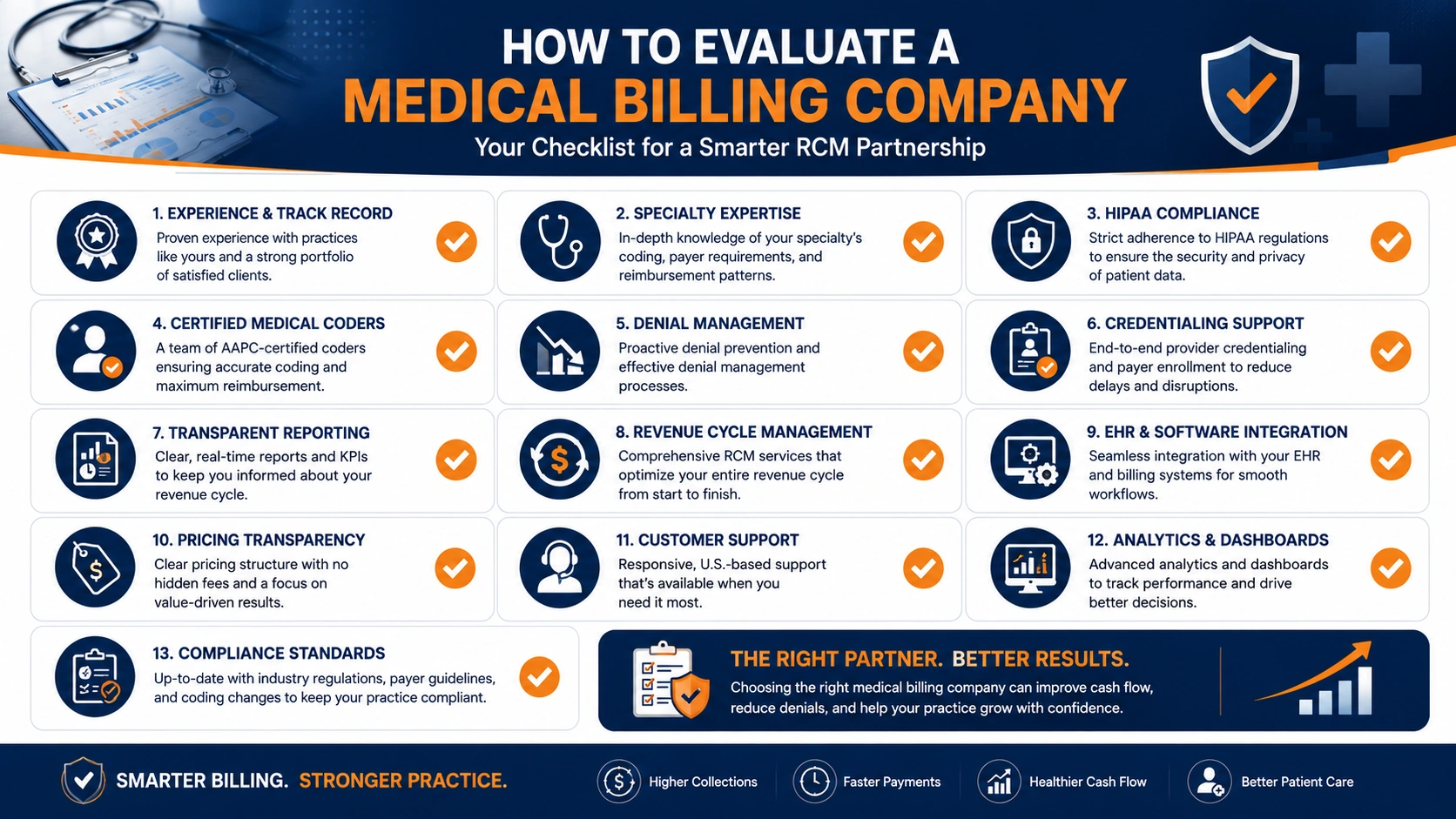
How to evaluate medical billing services in Georgia also means recognizing when to walk away.
Vague Pricing Structures and Hidden Fees
Legitimate billing companies charge a percentage of collections (typically 4–9%) or a flat per-claim fee. If pricing is unclear, or setup fees, software costs, and credentialing charges are buried in the fine print — that is a warning sign.
No Demonstrated Georgia Payer or CMO Experience
A national billing company without Georgia-specific knowledge will treat your claims like any other state’s. That means missed CMO rules, late timely filing, and preventable denials that compound over time.
No Denial Management or Appeals Process
If a company cannot explain their denial appeal workflow step-by-step — or doesn’t pursue denials beyond the first rejection — your billing error rate will climb and revenue will stall with it.
Poor Communication, Weak Reporting, and No Dedicated Account Support
If you cannot reach someone when a claim is rejected, you are working with the wrong partner. Your billing company should function as an extension of your team: responsive, transparent, and accountable.
How to Choose Medical Billing Company in Georgia: A Side-by-Side Comparison
| Factor | High-Performing Partner | Low-Performing Partner |
|---|---|---|
| Clean Claim Rate | 96–98% | Below 90% |
| A/R Days | 28–35 days | 50+ days |
| Georgia CMO Knowledge | Demonstrated, documented | General Medicaid only |
| Denial Follow-Up | 7–10 business days | Inconsistent or absent |
| Reporting | Real-time dashboards | Monthly summary PDFs |
| Communication | Dedicated account manager | Shared support queue |
| HIPAA Compliance | Full BAA + documented controls | Unverified |
Example 1 — Solo Practice That Switched Billing Companies and Recovered Revenue
A solo family practice in Savannah was experiencing denial rates of 18–20% and A/R days averaging 62. After switching to a Georgia-specialized billing partner, clean claim rates improved to 96.4%, A/R days dropped to 31, and the practice recovered an estimated $84,000 in previously written-off revenue within six months.
Example 2 — Multi-Provider Group That Reduced Denials After Outsourcing
A five-provider internal medicine group in metro Atlanta managed billing in-house with two staff members. After partnering with Atlanta medical billing services specialists, claim denials dropped by 41%, administrative hours freed up by approximately 18 per week, and practice overhead and staffing costs fell by an estimated $67,000 annually.
Example 3 — Practice That Chose Wrong and Paid for It With 6 Months of Delayed Cash Flow
A behavioral health clinic outside Marietta signed with a national billing company that had no Georgia CMO experience. Denied CMO claims accumulated, appeals were filed past timely filing limits, and the practice endured six months of severely disrupted cash flow — requiring a line of credit to cover payroll. Georgia expertise is not optional.
In-House vs. Outsourced Medical Billing in Georgia: Which Is Right for Your Practice?
When Keeping Billing In-House Makes Sense
In-house billing works when your practice has high-volume, low-complexity claims, a certified and experienced team with low turnover, or minimal payer variability. Even then, an annual Medical Billing Audit is essential to catch coding errors, compliance gaps, and performance drift before they cost you.
When Outsourcing Is the Right Move for Georgia Practices
Outsource medical billing Georgia when your denial rate exceeds 8%, A/R days are above 40, your billing staff is overwhelmed, or you’re identifying with the best medical billing company for small practice Georgia scenario — where one or two staff members can’t keep pace with payer complexity. According to CMS 2026 guidelines, practices aligned with current compliance and payer-specific submission protocols see measurably fewer rejections and faster reimbursement cycles.
How to Switch Medical Billing Companies in Georgia Without Disrupting Revenue
Steps to Transition Without a Cash Flow Gap
- Audit your current A/R — get a full aging report before transition begins
- Request a 90-day run-out period — your outgoing company continues working existing claims
- Set a clean start date — tie it to a new billing cycle or month-end
- Brief your new partner — share your top payers, denial history, and EHR setup
- Monitor the first 30 days closely — track clean claim rates and submission timelines weekly
What to Audit Before You Make the Switch
A medical billing audit Georgia review surfaces unbilled charges, undercoded or overcoded claims, payer credentialing gaps, and outstanding appeals requiring transfer. Our Medical Coding Services and audit team can perform a full revenue cycle review before your transition — so you start with a verified, clean baseline.
How to Pilot Outsourcing Before a Full Transition
Some practices pilot by shifting one payer group or one provider’s billing to the new company first. This lets you evaluate clean claim rate, denial rate, and turnaround time before full commitment — a low-risk method to test fit before you fully transition.
How UtreatiBill Helps Georgia Practices Choose the Right Billing Solution

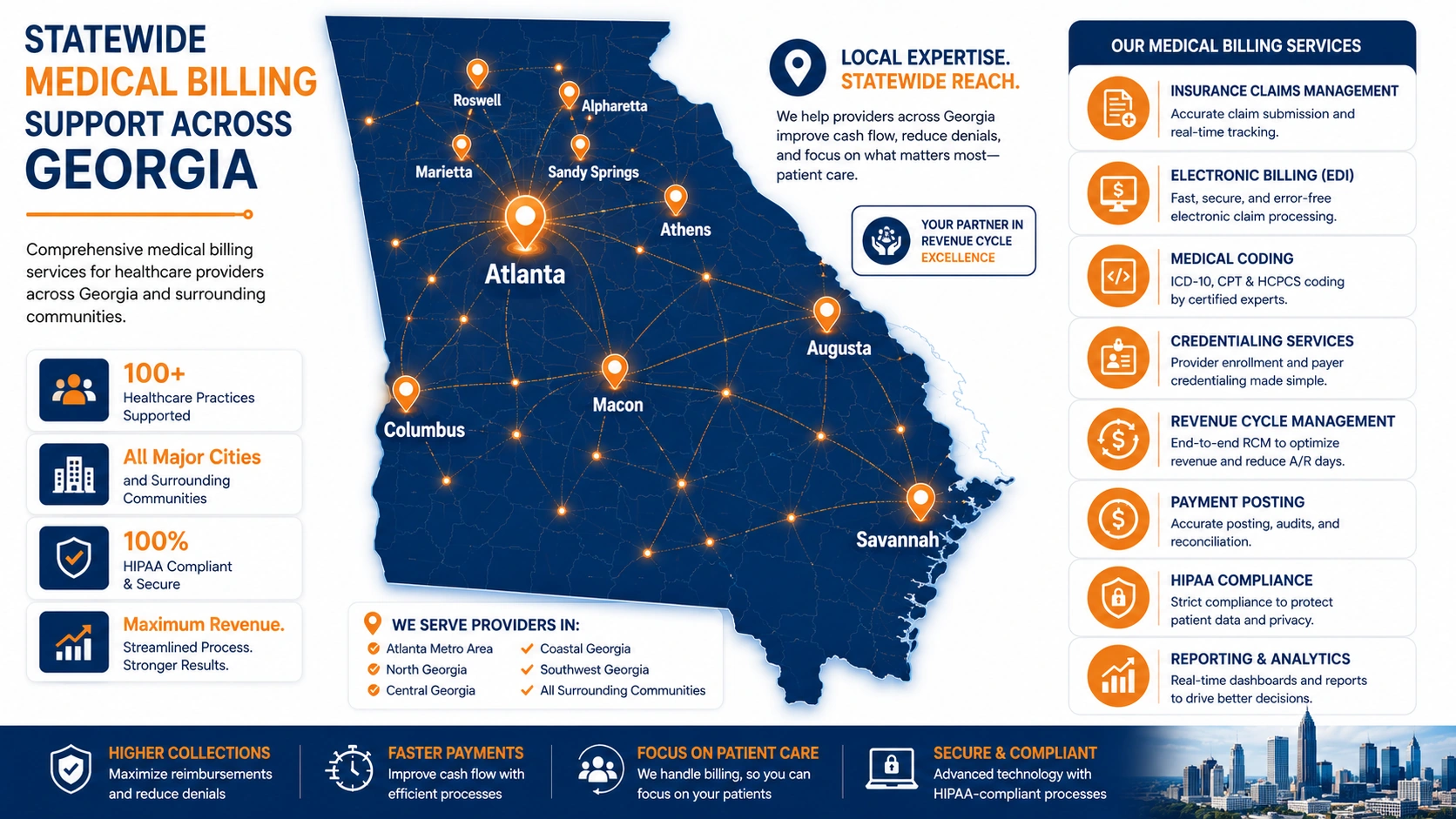
At UtreatiBill, we specialize in medical billing services in Georgia — built specifically for Georgia’s CMO landscape, payer environment, and compliance requirements. Our team serves practices across specialties including primary care, behavioral health, cardiology, and orthopedics.
What distinguishes our approach:
- Dedicated Georgia-based account managers for every client
- Clean claim rates consistently above 97%
- Full Georgia Medicaid CMO billing support across all four major CMOs
- Provider credentialing Georgia included as a core service — not an add-on
- Real-time reporting and medical billing KPI tracking dashboards you can access anytime
- Complete Revenue Cycle Management built around your specialty
If you’re evaluating billing companies or ready to transition, we make the process clear, low-risk, and built around your practice.
Explore our Medical Billing Services in Georgia →
The Data Behind Medical Billing Company Performance in Georgia [Statistics Section]
1. Georgia’s Claim Denial Rate — Highest in the U.S. Georgia’s average claim denial rate Georgia sits at 10.4% — the highest of any U.S. state, versus the national average of 5–7% (MGMA, 2026). That equals more than $100,000 in at-risk revenue per $1M billed annually.
2. Clean Claim Rate Benchmarks Top-performing outsourced Atlanta medical billing services companies achieve clean claim rates of 96–98%. In-house Georgia billing teams average 88–91% (HFMA, 2026). That 7–10 point gap directly affects how fast — and how much — you collect.
3. A/R Days: In-House vs. Outsourced In-house Georgia practices average 45–55 A/R days. High-performing outsourced billing partners bring that to 28–35 days — accelerating cash flow and reducing write-off exposure (MGMA, 2026).
4. Revenue Improvement After Outsourcing Practices that outsource medical billing Georgia typically see revenue cycle management Georgia improvements of 10–25% within the first year, driven by higher clean claim rates, faster A/R recovery, and stronger denial management (HFMA, 2026).
5. Administrative Hours Saved Outsourcing saves the average practice 15–20 administrative hours per week (AMA, 2026). For a medium-sized practice paying $25–$35/hour for billing staff, that equals $19,500–$36,400 in annual labor savings — before benefits, training, and turnover costs.
Key Takeaways
- Georgia’s 10.4% claim denial rate Georgia is the highest in the nation — your billing partner must be equipped for it
- The right medical billing services in Georgia partner delivers 95%+ clean claim rates and sub-35 A/R days
- Georgia CMO billing experience is non-negotiable — a general billing company will cost you more than it saves
- HIPAA compliance, transparent KPI reporting, and a dedicated account manager are baseline requirements
- Outsourcing medical billing services in Georgia typically improves revenue 10–25% and frees 15–20 hours per week
- Audit your current billing setup before switching to prevent cash flow disruption
- Red flags include vague pricing, no CMO experience, no denial management process, and no real-time reporting
Final Thoughts
Knowing how to choose a medical billing company in Georgia comes down to three things: Georgia-specific expertise, verifiable performance data, and a partner you can hold accountable month after month.
Your practice revenue depends on decisions made in the billing department every single day. Don’t hand those decisions to a company that treats Georgia like any other state — or leave them to an in-house team stretched past capacity.
UtreatiBill was built for Georgia practices. We understand your payer environment, your CMO structure, and exactly what it takes to protect your revenue cycle management Georgia in this market.