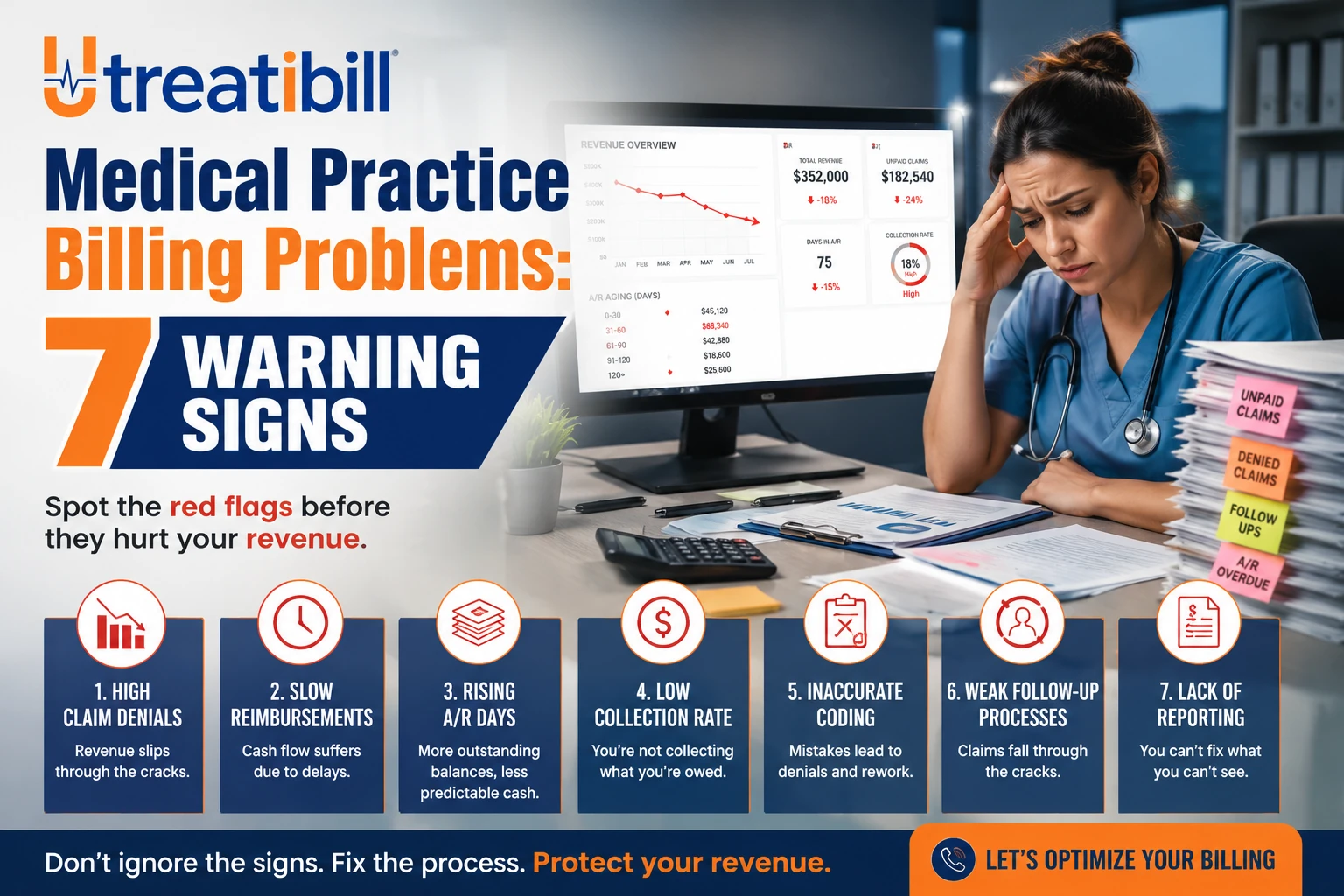

7 Signs Your Medical Practice Billing Problems Are Out of Control
If your practice’s collections feel inconsistent, your staff is constantly putting out fires, or you’re unsure why revenue keeps dipping — you may already be dealing with medical practice billing problems you haven’t fully identified yet.
Most practice owners don’t notice billing issues until they’ve compounded into something much more expensive. The good news? There are clear warning signs — and catching them early can protect your Revenue Cycle Management and your bottom line.
This guide breaks down the 7 most critical signs that your billing situation has moved beyond minor friction and into territory that demands action.
Why Medical Practice Billing Problems Are More Common Than You Think
Featured Snippet Box: Medical practice billing problems occur when claim denials, billing errors, poor reporting, or inadequate staffing erode your collections without clear warning. They affect practices of every size and specialty. Left unchecked, they quietly drain revenue, stretch accounts receivable, and overwhelm staff — often for months before anyone identifies the root cause.
According to CMS.gov, complex and frequently changing billing compliance rules, claims submission requirements, and Medicaid reimbursement guidelines create an environment where even experienced in-house teams struggle to stay current. Add in evolving payer requirements and tightening prior authorization workflows, and it’s easy to see why billing problems in medical practice settings are accelerating across the board.
The signs aren’t always obvious. But they’re always measurable — if you know what to track.
Sign #1 — Your Claim Denial Rate Is Higher Than It Should Be
What a High Denial Rate Really Means for Your Practice
Your claim denial rate is one of the most direct indicators of billing health. If a significant portion of your claims are being rejected or denied on first submission, you’re not just losing time — you’re losing revenue that may never be recovered.
A denial doesn’t just mean “resubmit.” It means your staff has to work the claim again, appeal if necessary, track payer responses, and manage follow-up timelines — all while processing new claims. That’s a compounding workload that becomes unsustainable fast.
Consider a solo internal medicine physician whose front desk staff handles billing alongside scheduling and patient intake. If that practice is submitting 200 claims per month with a 15% denial rate, that’s 30 claims per month requiring rework — each taking 30 to 60 minutes of staff time. The administrative cost alone is staggering, before you even account for delayed or lost reimbursement.
National Claim Denial Rate Benchmarks and What They Mean for Your Billing
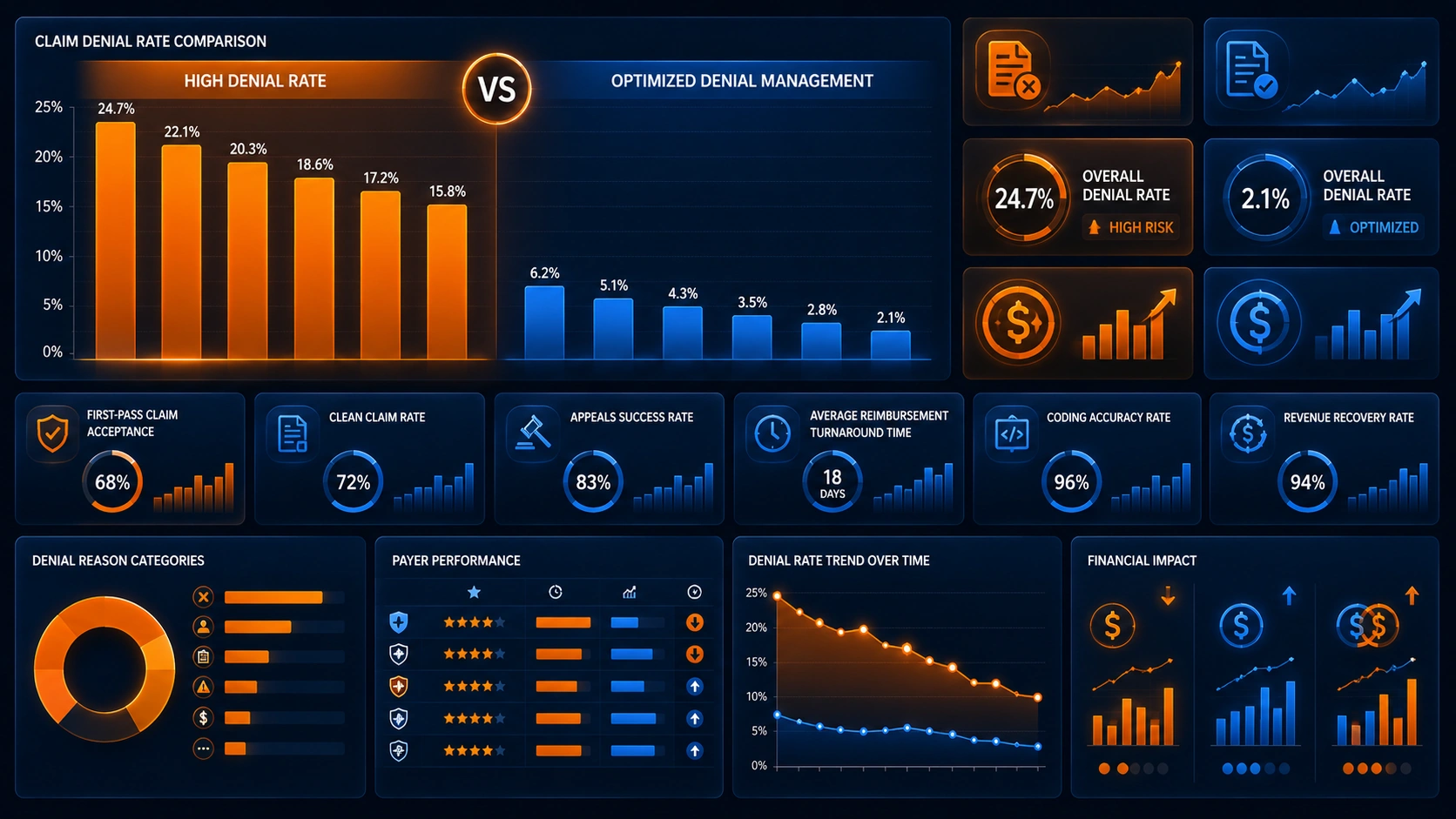
According to data published by MGMA, the national average claim denial rate hovers around 5–10% for well-managed practices, while top-performing outsourced billing partners maintain denial rates below 3%. If your denial rate is above 10%, that’s one of the most concrete signs of billing issues in healthcare settings — and it needs immediate attention.
Sign #2 — Your A/R Days Are Climbing Without Explanation
What Healthy A/R Days Look Like for a Medical Practice
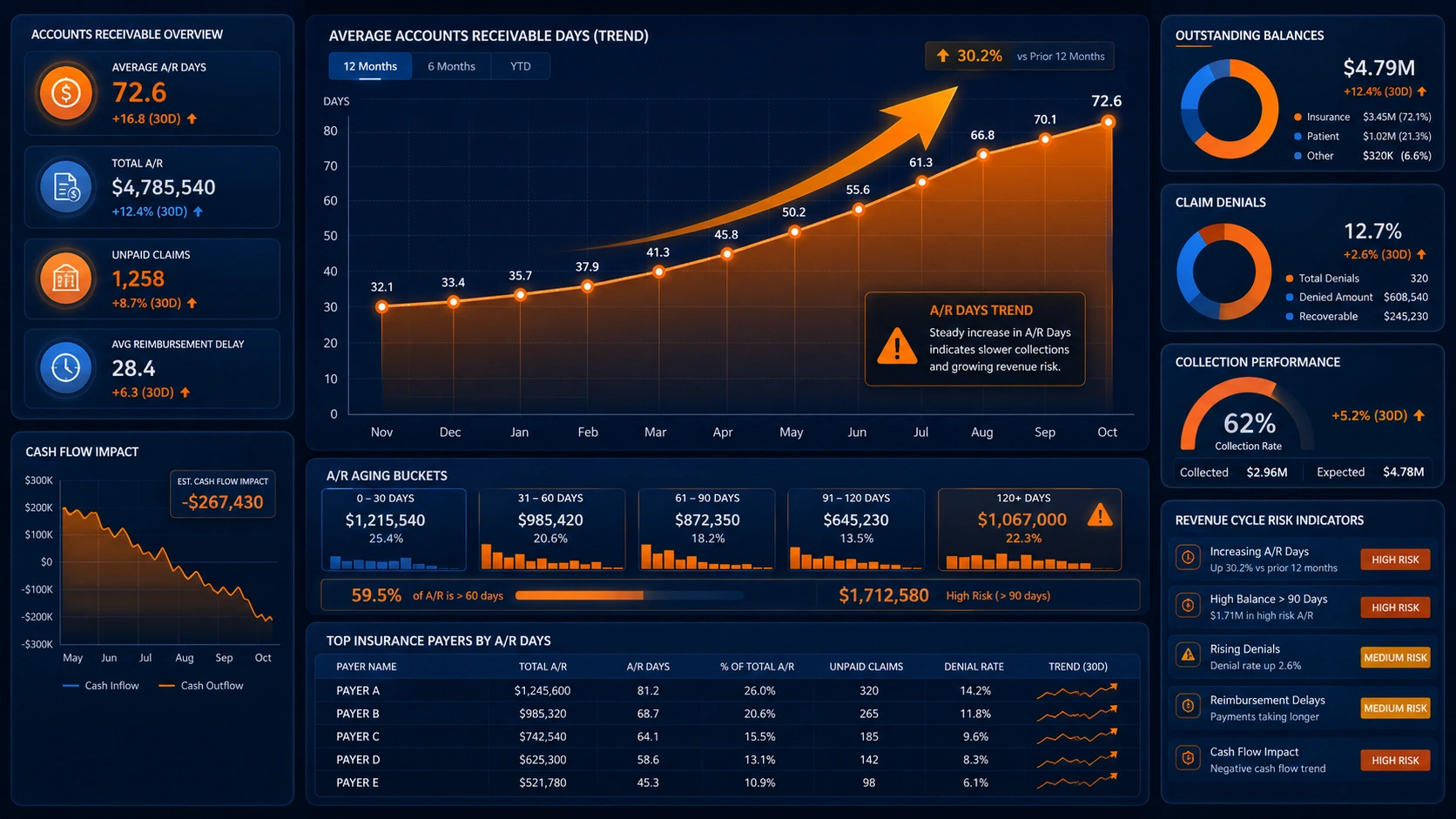
Accounts receivable (A/R) days measures how long it takes your practice to collect payment after a service is rendered. A healthy benchmark for most specialties is 30–40 days. For high-performing practices using professional billing partners, it often falls below 30.
If your A/R days are pushing past 50, 60, or beyond — and you can’t point to a specific reason — that’s a sign that claims aren’t being followed up on, denials aren’t being worked, or payments are slipping through the cracks.
Why Rising A/R Days Signal Deeper Medical Practice Billing Problems
Rising A/R days rarely have a single cause. More often, they reflect a combination of delayed submissions, unworked denials, slow payer follow-up, and gaps in your revenue cycle management process.
A multi-specialty group practice with 8 providers came to UtreatiBill with A/R days averaging 72. After a full review, the team discovered that over $180,000 in claims had been submitted and never followed up on — most of them aged past timely filing limits. The revenue was simply gone.
Sign #3 — You’re Experiencing Frequent Billing Errors and Rework
The Most Common Billing Errors Draining Your Revenue
Medical billing errors and denials often share a common root: incorrect or incomplete claim submission. The most frequent errors include:
- Wrong patient demographic or insurance information
- Missing or incorrect diagnosis codes
- Modifier errors or mismatches
- Failure to verify eligibility before the visit
- Non-covered services submitted without proper documentation
Each of these issues sends your claim to the back of the payer’s queue — or outright rejects it. Over a month, even a modest billing error rate of 8% across a busy practice translates to hundreds of claims requiring manual correction.
Professional Medical Billing Services are specifically designed to catch these errors before submission, improving your first-pass acceptance rate and reducing the administrative drag that rework creates.
How Your Billing Error Rate Affects Your Bottom Line
Your clean claim rate — the percentage of claims accepted on first submission — is one of the clearest billing KPIs available. Industry benchmarks from HFMA suggest a target clean claim rate of 95% or higher. In-house teams at smaller practices often fall in the 80–85% range. That 10–15% gap has real dollar consequences that compound month over month.
Accurate medical coding services are essential here. Medical Coding Services that stay current with CPT, ICD-10, and payer-specific coding rules are a direct investment in your clean claim rate.
Sign #4 — You Have No Visibility Into Your Billing Performance
What Good KPI Tracking and Reporting Should Look Like
Medical billing KPI tracking shouldn’t be a mystery. Every practice owner should have access to at minimum:
- Current denial rate and denial reasons by payer
- A/R aging report (30/60/90/120+ days)
- Clean claim rate by provider
- Monthly collections vs. charges vs. payments
- Net collection rate
If you can’t pull these reports within minutes — or your billing team can’t explain them clearly — that’s a fundamental transparency problem.
Why No Reporting Is One of the Biggest Medical Billing Warning Signs
Lack of visibility is one of the most overlooked medical billing warning signs. You can’t fix a problem you can’t measure. Many in-house billing teams default to reactive management: they process what comes in, work what gets denied, and report when asked. That’s not a strategy — it’s survival mode.
A clear reporting structure tied to defined KPIs is what separates practices that grow their collections from those that plateau or decline.

Sign #5 — Your Staff Is Overwhelmed and Overhead Is Rising
The Hidden Cost of In-House Billing Problems
Practice overhead and staffing costs tied to billing are frequently underestimated. Salary, benefits, training, software subscriptions, clearinghouse fees, and the time your staff spends context-switching between patient-facing tasks and billing tasks — it adds up.
The AMA has documented the substantial administrative burden that prior authorizations and billing complexity place on physician practices. Their research consistently shows that physicians and their staff spend significant hours per week on tasks that don’t directly generate revenue — and billing inefficiencies are one of the largest contributors.
When Practice Overhead and Staffing Costs Signal It’s Time to Outsource
If your billing staff turnover is high, if coverage gaps create backlogs, or if your front desk is doubling as your billing department — these are clear signs of billing issues in healthcare that go beyond staffing adjustments.
The question isn’t whether you can afford to outsource. The question is whether you can afford not to.
Sign #6 — Your Revenue Cycle Has No Denial Management Process
What Happens When Denials Go Unworked
Most practices know that denials happen. Fewer have a formal, documented process for working them. Billing problems in medical practice environments most often snowball when denied claims sit in a queue and age past payer-specific appeal windows.
Once a claim ages past the timely filing limit — which varies by payer from 90 days to one year — recovery becomes nearly impossible. That’s practice revenue loss billing that could have been prevented with a simple workflow.
A Proper Denial Management Workflow vs. No Process at All
A structured denial management process includes:
- Real-time denial tracking by payer and denial reason
- Categorization of preventable vs. clinical denials
- Root cause analysis to address upstream errors
- Appeal submission with supporting documentation
- Escalation workflows for high-dollar or persistent denials
- Monthly reporting on denial trends
If your practice doesn’t have this in place, you’re almost certainly leaving money on the table every month.
Sign #7 — You Keep Losing Revenue Without Knowing Why
Undercoding, Missed Charges, and Credentialing Gaps
Undercoding and overcoding are two sides of the same problem — inaccurate charge capture that either leaves revenue on the table or exposes your practice to audit risk. Undercoding is more common than most practice owners realize. When providers consistently use lower-level E&M codes to avoid scrutiny, they’re sacrificing significant legitimate reimbursement.
Missed charges — services rendered but never billed — often stem from incomplete documentation, lack of charge capture workflows, or disconnects between the clinical and billing teams.
Provider credentialing gaps are another silent revenue killer. If a provider in your group isn’t enrolled with a payer, every claim they generate for that payer will deny — sometimes for months before anyone catches it. Provider Credentialing Services ensure your providers are enrolled, current, and reimbursable across all active payers.
How a Medical Billing Audit Can Reveal Hidden Revenue Leaks
A Medical Billing Audit is often the fastest way to quantify how much revenue your practice is actually losing — and where it’s going. An audit reviews claim submission patterns, denial trends, coding accuracy, charge capture completeness, and payer contract compliance to surface specific, actionable findings.
For a dermatology group practice that had been operating with the same billing processes for four years, a billing audit revealed $94,000 in undercoded services over a 12-month period. They hadn’t changed anything — they just hadn’t examined their patterns either.

What Causes Medical Practice Billing Problems in the First Place?
Understanding the root causes of billing problems in medical practice settings helps you fix them at the source, not just the symptoms. The most common causes include:
- Staff turnover and training gaps — Billing knowledge walks out the door with experienced employees
- Outdated or fragmented systems — EHR and billing software that don’t communicate cleanly
- Inadequate payer contract management — Not knowing your contracted rates means you can’t catch underpayments
- No eligibility verification workflow — Skipping pre-visit verification creates downstream billing failures
- Poor documentation habits — Providers who don’t document completely can’t be billed accurately
- HIPAA-compliant billing lapses — Non-compliant data handling introduces risk that extends beyond revenue
These aren’t isolated issues. Most practices dealing with significant medical practice billing problems are experiencing several of these simultaneously.
How These 7 Billing Problems Compound Over Time

The financial impact of unresolved billing problems isn’t linear — it accelerates. Here’s what the data shows:
1. Claim Denial Rates The national average claim denial rate is 5–10%, per MGMA benchmarks. Top-performing outsourced billing partners consistently achieve denial rates below 3%. That gap represents tens of thousands of dollars annually for a mid-sized practice.
2. Clean Claim Rates According to HFMA, the industry benchmark for clean claim rate is 95%+. In-house billing teams at smaller practices frequently operate at 80–85%, meaning 10–15% of every claim batch generates rework, delays, and potential write-offs.
3. A/R Days Practices using outsourced billing partners average A/R days of 28–35, compared to in-house averages that often exceed 50 days in resource-constrained environments. Each additional A/R day represents cash sitting uncollected.
4. Revenue Improvement After Outsourcing Practices that transition to professional billing partners typically report revenue improvement of 10–25% within the first 12 months, based on MGMA and HFMA performance data — largely driven by reduced denials, faster submissions, and active denial management.
5. Staff Time Recovered Administrative teams at practices that outsource billing save an average of 15–20 hours per week in billing-related tasks. For a medium-sized practice paying staff at $22–$28/hour, that equates to $17,000–$29,000 annually in recovered staff capacity — time that can be redirected to patient care and operations.
When you combine rising denial rates, climbing A/R days, high billing error rates, and no formal denial management — practice revenue loss billing becomes the inevitable outcome.
In-House vs. Outsourced Billing: Which Setup Solves These Problems?
When Keeping Billing In-House Still Makes Sense
In-house billing can work well when your practice has a dedicated, experienced billing team with low turnover, strong EHR-to-billing integration, consistent reporting, and leadership that actively monitors KPIs. Large health systems with specialized RCM departments often fall into this category.
When Outsourcing Is the Right Move to Fix Your Billing Problems
For most independent practices, small-to-mid-size groups, and specialty practices managing complex payer requirements, outsourcing provides access to specialized expertise and technology that is difficult and expensive to replicate internally.
| Metric | In-House Billing | Outsourced Billing Partner |
|---|---|---|
| Average Claim Denial Rate | 8–15% | Under 3% |
| Clean Claim Rate | 80–85% | 95%+ |
| A/R Days | 50–75+ | 28–35 |
| Denial Management | Often reactive | Structured workflow |
| KPI Reporting | Inconsistent | Real-time dashboards |
| Staff Overhead | High + benefits | No direct staffing cost |
| Coding Accuracy | Variable | Audited regularly |
| Scalability | Limited by headcount | Scales with volume |
| HIPAA-Compliant Billing | Dependent on team | Standardized compliance |
The data is clear: if your in-house billing isn’t hitting these benchmarks, outsourcing isn’t just an option — it’s likely the fastest path to financial stabilization.
How UtreatiBill Helps Practices Fix Medical Practice Billing Problems
At UtreatiBill, we specialize in identifying and resolving medical practice billing problems before they become practice-threatening. Our RCM team provides end-to-end support across claim submission, denial management, coding accuracy, credentialing, and real-time reporting — so you always know exactly where your revenue stands.
We work with solo practitioners, multi-provider groups, and specialty practices across the country. Every engagement starts with a thorough review of your current billing performance, followed by a clear action plan tied to measurable outcomes.
If you’re seeing any of the 7 signs outlined in this post, now is the time to act — not after another quarter of unexplained revenue loss.
Book a consultation with our team → Medical Billing Services
Key Takeaways
- Medical practice billing problems often develop gradually, which is why most practices don’t catch them until collections are already declining
- A claim denial rate above 5–10%, A/R days above 40, and no formal reporting are three of the most common and measurable warning signs
- Billing errors and denials are preventable with better processes, not just more staff
- A medical billing audit is the fastest way to quantify how much revenue you’re actually losing
- Outsourcing to a professional billing partner typically produces a 10–25% revenue improvement and recovers 15–20 hours of staff time per week
- HIPAA-compliant billing, accurate coding, and active denial management are non-negotiable components of a healthy revenue cycle
Final Thoughts
Every sign in this list is a signal your practice has already sent — most just go unread for too long. The difference between practices that grow their collections and those that quietly lose ground isn’t talent or specialty. It’s process, visibility, and the right billing infrastructure.
If you’re asking what are the signs of billing problems in a medical practice — you’ve already taken the first step. The next one is getting an expert set of eyes on your billing performance before another billing cycle passes.
Schedule your free billing review with UtreatiBill today.