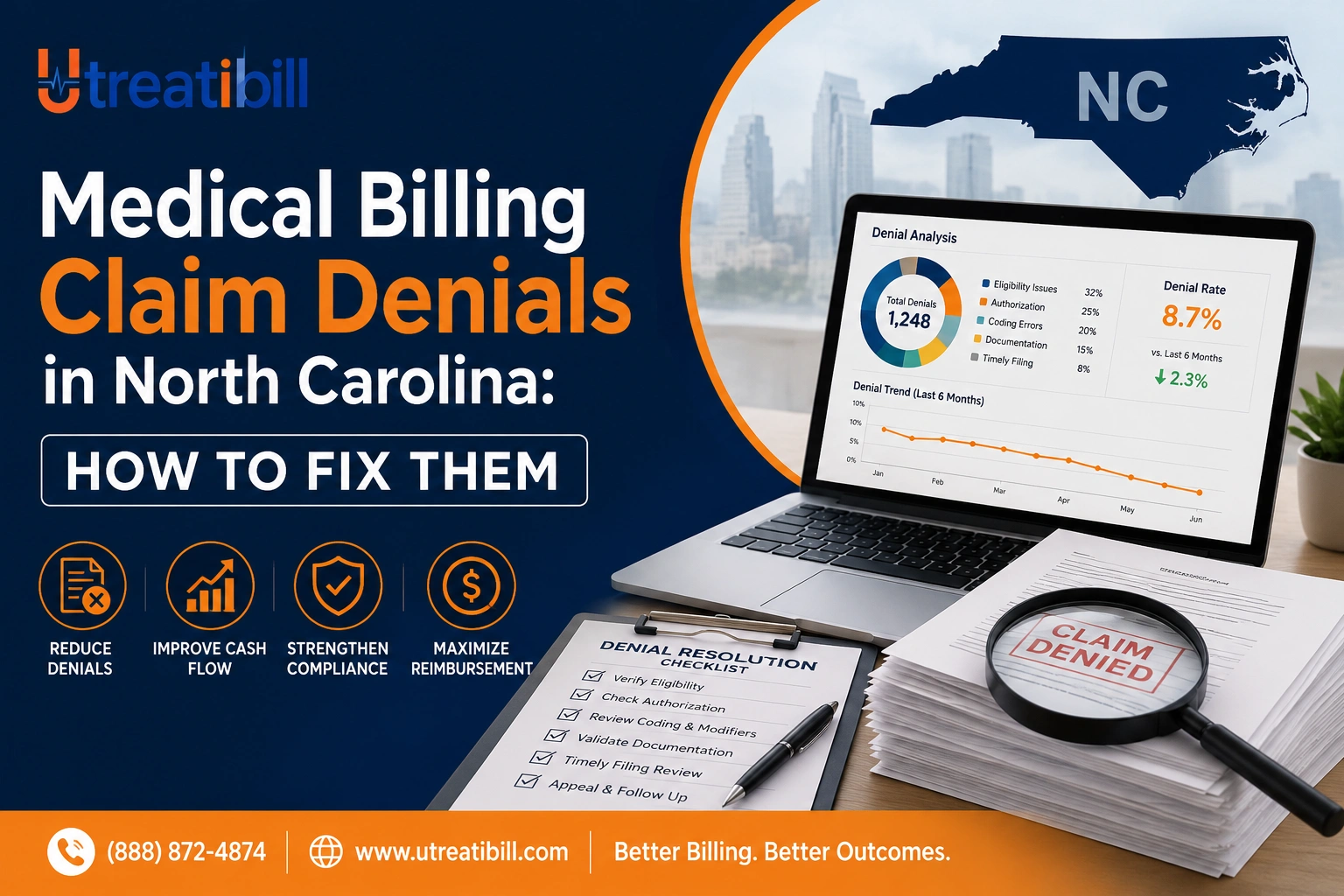

Medical Billing Claim Denials in North Carolina: 2026 Guide
If your North Carolina practice is watching revenue stall, your billing team is resubmitting the same claims on a loop, or your accounts receivable (A/R) days keep climbing — medical billing claim denials in North Carolina are almost certainly driving the problem. Denials are rising in both frequency and cost across the state, and most NC practices are losing money they don’t know how to measure or recover.
At UtreatiBill, our Revenue Cycle Management team works with NC providers across specialties to reduce denial rates, accelerate collections, and protect the revenue your practice has already earned. This guide covers everything you need to know — from the root causes driving denied medical claims NC providers face to proven recovery strategies and the exact steps for the NC medical claim appeal process.
Why Medical Billing Claim Denials Are a Growing Problem in North Carolina
What Are Medical Billing Claim Denials in North Carolina? Medical billing claim denials in North Carolina occur when payers reject submitted claims due to administrative errors, coding issues, eligibility failures, or prior authorization problems. NC practices face some of the highest denial rates in the Southeast. Understanding why claims get denied — and how to act fast — is the first step to protecting your practice’s revenue.
North Carolina’s payer landscape is uniquely complex. NC Medicaid managed care restructuring, aggressive commercial payer prior authorization requirements, and constant CPT and ICD-10 code set updates have all contributed to a rising denial burden. Practices that don’t have a proactive strategy for managing denied medical claims NC are leaving significant revenue unrecovered — often without a clear picture of how much.
The Most Common Causes of Claim Denials for NC Practices
Knowing the most common reasons for claim denials in North Carolina is the foundation of any effective prevention strategy. Denials typically fall into two categories.
Administrative and Eligibility-Related Denials
Eligibility verification failures are the single most preventable category. When a patient’s insurance isn’t confirmed before their visit — or when coverage has changed since their last appointment — the resulting claim will be denied outright.
Other common administrative triggers include:
- Missing or expired prior authorization numbers
- Incorrect patient demographic data
- Timely filing limit violations
- Duplicate claim submissions
- Coordination of benefits conflicts
Prior authorization denials have grown sharply across NC commercial payers. According to the AMA, physicians and staff spend an average of 13 hours per week managing prior authorizations — administrative time that directly erodes your practice’s bottom line.
It’s also worth understanding the difference between a claim rejection vs denial. A rejection occurs before the claim enters adjudication and can often be fixed and resubmitted quickly. A denial occurs after adjudication and requires a formal denial appeal process — a more time-intensive and deadline-driven procedure.
Clinical and Coding-Related Denials
Coding errors and claim denials are deeply connected. Incorrect CPT codes, mismatched diagnosis-procedure pairs, missing modifiers, and instances of undercoding or overcoding are among the most common reasons NC practices see claims returned unpaid. Our Medical Coding Services team catches these errors before they reach the payer.
Credentialing and denials are also closely tied. If a provider isn’t fully enrolled and credentialed with a specific payer, every claim they submit to that plan will be denied until the enrollment is resolved. Our Provider Credentialing Services close that gap before it costs your practice revenue.
How North Carolina Payers Handle Claim Denials
Payer-specific denial trends vary significantly across North Carolina. What triggers a denial with Blue Cross Blue Shield NC may not be the same issue that causes one with Aetna, UnitedHealthcare, or Cigna — and NC Medicaid operates on its own rules entirely.
NC Medicaid Managed Care Denial Trends
NC Medicaid managed care has added layers of complexity for providers across the state. Since the transition from fee-for-service to managed care, practices have reported more aggressive prior authorization requirements, shorter timely filing windows, and higher medical necessity denial rates from individual Managed Care Organizations.
NC Medicaid claim denial rates and solutions depend heavily on which MCO your patient belongs to — Healthy Blue, AmeriHealth Caritas NC, and Carolina Complete Health each maintain slightly different coverage policies and appeal timelines. CMS mandates that managed care plans provide timely grievance and appeal processes, but navigating those processes efficiently requires plan-specific expertise your billing team may not have on staff.
Commercial Payer Denial Patterns in North Carolina
Major commercial payers operating in NC — Blue Cross Blue Shield NC, Aetna, UnitedHealthcare, Cigna — each maintain their own denial logic, prior authorization requirements, and documentation standards. Medical billing compliance NC demands staying current with each payer’s policy changes, which can shift quarterly and without advance notice to providers.
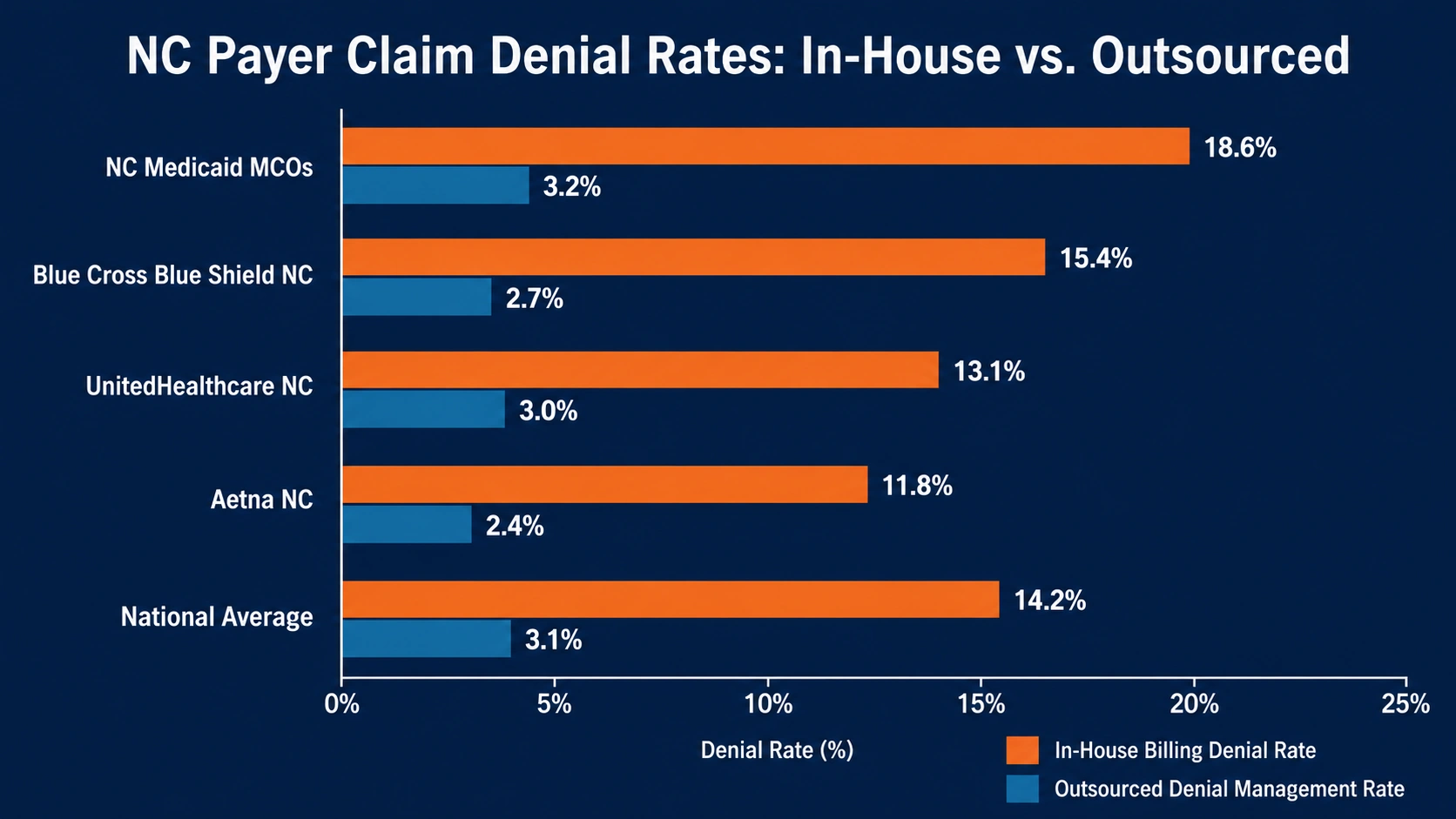
The Real Cost of Claim Denials for North Carolina Practices
Medical billing denial rates North Carolina practices are experiencing translate directly into lost revenue — and most underestimate the full dollar impact.
Direct Revenue Loss from Medical Billing Claim Denials in North Carolina
According to MGMA benchmarking data, the average practice writes off 1–3% of annual revenue to unworked denials. For a practice billing $2 million per year, that’s $20,000–$60,000 gone annually — often treated as a cost of doing business rather than a recoverable problem.
The damage compounds when billing teams lack the bandwidth to work every denial before the payer’s appeal deadline. Claims that age past that window become permanent write-offs with no recourse.
The Hidden Costs — Staff Time, Rework, and Write-Offs
Each denied claim costs far more than its face value. Research, documentation retrieval, code corrections, and resubmission all add up to significant administrative overhead per claim.
A solo primary care practice in Charlotte recently told our team they were spending more than 20 hours per week on denial rework — without tracking the cost per claim or the total dollar amount they were failing to recover. They weren’t short on effort; they were short on a systematic process.
How to Appeal Denied Medical Claims in North Carolina
Understanding how to appeal denied medical claims in North Carolina — and acting within payer deadlines — is what separates revenue recovered from revenue permanently lost.
Step-by-Step Denial Appeal Process for NC Providers
The NC medical claim appeal process follows a consistent structure across most payers:
- Pull the Explanation of Benefits (EOB) or payer portal notice and identify the denial reason code
- Classify the denial — administrative, clinical, or coding-related
- Gather the required documentation — medical records, authorization numbers, corrected codes, or a letter of medical necessity
- Draft and submit a formal appeal with all supporting attachments to the correct payer address or portal
- Track the appeal status and escalate to a second-level appeal or request an external independent review if the first appeal is upheld
Our Medical Billing Services team manages this entire workflow for NC practices, so no denial ages out and no appeal opportunity goes missed.
Timely Filing Limits and Deadlines for NC Payers
Missing a filing window permanently eliminates your right to appeal. Deadlines in North Carolina vary by payer:
| Payer | Timely Filing Limit |
|---|---|
| Medicare | 12 months from date of service |
| NC Medicaid (fee-for-service) | 180 days from date of service |
| NC Medicaid MCOs | 120–180 days (plan-specific) |
| Blue Cross Blue Shield NC | 180 days |
| Major commercial payers | 90–365 days (varies by plan) |
The NC medical claim appeal process for Medicare and commercial plans also includes specific internal appeal windows after the initial denial — typically 60–180 days from the denial date. Know your payer timelines or risk losing the ability to appeal entirely.
Denial Prevention Strategies for NC Medical Practices
The most effective way how to reduce medical billing claim denials in North Carolina is to prevent them from occurring in the first place — rather than spending resources reacting after submission.
High-impact prevention strategies for NC practices include:
- Real-time eligibility verification at scheduling and again at check-in for every visit
- Prior authorization tracking workflows with automated alerts for approaching expiration dates
- Pre-submission claim scrubbing to catch errors before the payer ever sees the claim
- Regular coder audits on high-denial CPT and ICD-10 combinations specific to your specialty
- Payer-specific claim editing rules applied by carrier before submission
Billing claim denial solutions North Carolina practices need to have both a proactive front-end process and a reactive appeals infrastructure. A Medical Billing Audit is often the fastest way to identify exactly where your denials are originating and which denial categories are costing your practice the most.
Medical Billing Claim Denials by Specialty in North Carolina [2026 Breakdown]
Not all NC specialties face the same denial profile. Understanding where your specialty sits in the denial risk spectrum helps target prevention resources appropriately.
- Orthopedic and surgical practices — highest exposure to medical necessity and prior authorization denials; payers frequently challenge surgical coding
- Behavioral health providers — frequent eligibility errors, benefit limitation denials, and out-of-network status issues
- Primary care practices — highest volume of administrative and timely filing denials; often due to understaffed billing departments
- Home health and DME providers — most complex prior authorization and face-to-face documentation requirements under both Medicare and NC Medicaid
An orthopedic group in Raleigh working with our team discovered that nearly 40% of their denials traced back to a single CPT code cluster where a commercial payer had quietly updated its documentation requirements. Catching that pattern through systematic medical billing KPI tracking recovered over $80,000 in a single quarter — revenue they had been writing off as uncollectable.

What You Should Expect from a Denial Management Service
Medical billing denial management services in North Carolina should deliver measurable, trackable results. When evaluating a vendor, hold them to performance benchmarks — not just promises.
| Performance Metric | In-House NC Billing Team | Outsourced Denial Management |
|---|---|---|
| Clean claim rate | 75–85% | 95–98% |
| Claim denial rate | 10–20% | 2–4% |
| Denial overturn rate | 40–55% | 70–85% |
| Staff hours on denials/week | 15–25 hours | 2–5 hours |
| Cost to rework per denied claim | $50–$118 | $15–$30 |
| Average A/R days | 45–60+ days | 25–35 days |
The denial overturn rate is one of the most telling indicators of vendor quality. A strong denial management partner should recover 70% or more of all appealed claims. If a vendor can’t tell you their overturn rate, that’s a significant red flag.
The Numbers Behind Claim Denials in North Carolina [Statistics Section]
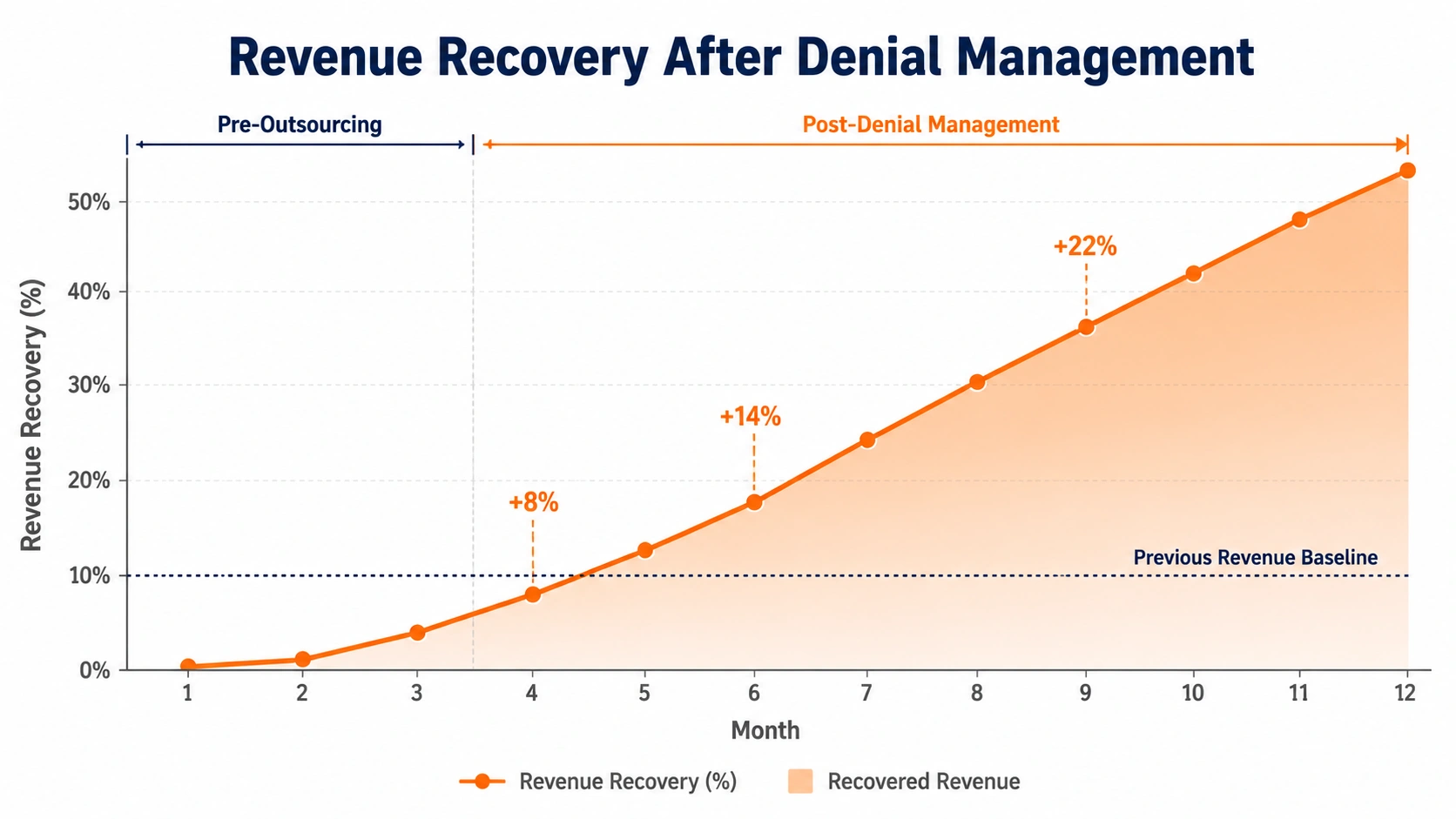
The financial case for proactive denial management in North Carolina is well-documented across industry sources.
1. Denial Rate Benchmarks The national average claim denial rate runs between 5–10% of submitted claims, per HFMA benchmarking. High-volume specialty practices in NC regularly report denial rates of 15–20%. Top-performing outsourced claim denial management North Carolina partners reduce this to 2–4% through proactive front-end controls.
2. Cost to Rework a Denied Claim Reworking a single denied claim costs an estimated $25–$118 in staff time and administrative overhead, according to AMA reporting. At scale, that cost represents a significant and often invisible drag on practice finances. Proactive denial management eliminates most of this before it occurs.
3. Clean Claim Rate Benchmarks In-house NC billing teams average a clean claim rate of 75–85%. Outsourced denial management partners consistently achieve 95–98%, meaning significantly fewer claims enter the denial and rework cycle in the first place.
4. Revenue Improvement After Outsourcing NC practices that implement professional denial management typically recover 10–25% in additional revenue — driven by reduced write-offs, faster A/R resolution, and higher overturn rates on appealed claims. For a $1.5M practice, that represents $150,000–$375,000 in additional annual collections.
5. Administrative Hours Saved Outsourcing denial management saves the average NC practice 15–20 hours of staff time per week. For a mid-sized practice with billing staff earning $25/hour, that equates to $19,500–$26,000 per year in recovered labor capacity — resources that can be redirected toward patient care, scheduling, or operational growth.
How UtreatiBill Handles Claim Denials for North Carolina Practices
The UtreatiBill team provides end-to-end denial management built specifically for North Carolina’s payer environment. Our expertise spans NC Medicaid managed care appeals, commercial payer denial logic, specialty-specific coding rules, and the state’s unique timely filing landscape.
From front-end eligibility verification and prior authorization tracking to second-level appeals and A/R follow-up, we manage the full denial cycle — so your staff can focus on patients, not paperwork.
Practices that partner with us on billing claim denial solutions North Carolina typically see measurable denial rate reductions within the first 60–90 days. Our denial overturn rate consistently exceeds 75% on appealed claims, and our clients average a 10–25% revenue improvement within the first six months.
Book a Free Consultation to see exactly what your NC practice’s current denial rate is costing — and what a realistic recovery looks like.
Key Takeaways
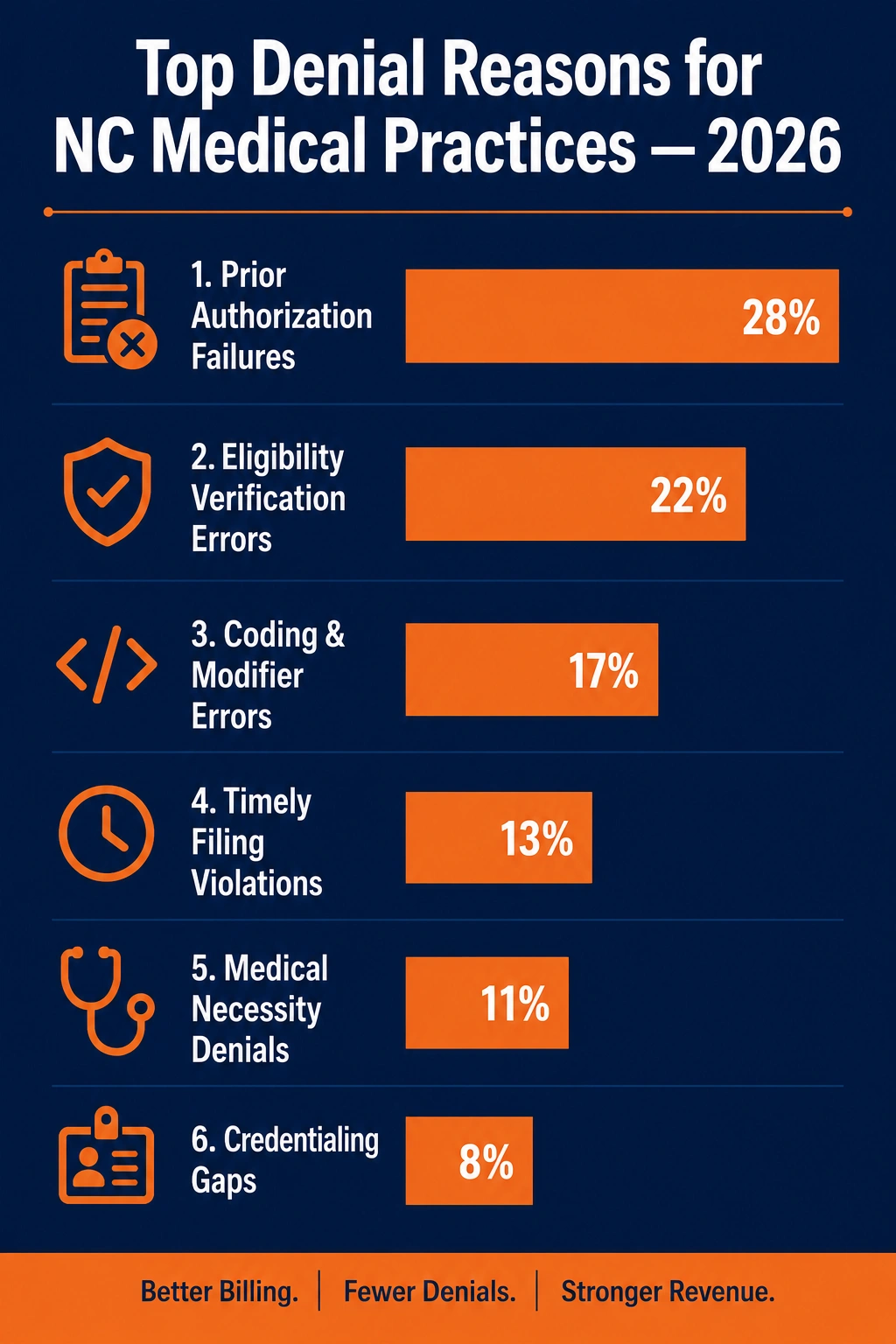
- Medical billing claim denials in North Carolina are driven by eligibility failures, prior authorization issues, coding errors, and credentialing gaps — all of which are preventable with the right workflow
- NC Medicaid managed care and major commercial payers have distinct denial patterns; effective management requires payer-specific knowledge
- The true cost of unworked denials includes staff rework overhead, write-offs, and delayed A/R — far beyond the face value of individual denied claims
- A proactive, front-end denial prevention strategy is significantly more cost-effective than reactive rework after submission
- Outsourced denial management for NC practices consistently achieves 2–4% denial rates and 95–98% clean claim rates — compared to 10–20% and 75–85% for most in-house teams
- Payer appeal deadlines in North Carolina are strict; missing them permanently forfeits your right to recover denied claims
Final Thoughts
Medical billing claim denials in North Carolina are not an unavoidable cost of operating a healthcare practice. They are a solvable, measurable, revenue-recoverable problem — and every month you delay addressing them costs your practice real money.
Whether you’re a solo physician in Charlotte dealing with a growing pile of unworked denials, an orthopedic group in Raleigh frustrated by prior authorization rejections, or a multi-specialty practice in Greensboro with no visibility into why your A/R keeps aging — the right denial management infrastructure changes what your revenue cycle is capable of.
The UtreatiBill team is ready to audit your current denial rate, identify what’s driving it, and build a plan to recover what your practice is owed.