

What Is Revenue Cycle Management? A Complete Guide for Michigan Practice Owners
If your Michigan practice is losing revenue to denied claims, delayed reimbursements, or billing errors, the problem isn’t your clinical team — it’s your revenue cycle. Revenue Cycle Management (RCM) is the financial backbone every practice needs to operate efficiently, and understanding it is the first step toward fixing what’s costing you. This guide covers everything Michigan practice owners need to know about Revenue Cycle Management in Michigan — from the seven core stages and common pitfalls to the real ROI of outsourcing. Whether you’re evaluating medical billing services Michigan for the first time or rethinking your current setup, start here.
What Is Revenue Cycle Management Michigan Providers Need to Know
Revenue Cycle Management Michigan is the end-to-end financial process that tracks each patient from first contact through final payment. For Michigan providers, a structured RCM process reduces claim denials, shortens reimbursement timelines, and protects your cash flow — so you spend less time chasing payments and more time delivering care.
What is revenue cycle management in healthcare? At its core, RCM encompasses every administrative and clinical step tied to a patient encounter — from the moment a patient calls to schedule through the day the final balance clears. It isn’t just medical billing. It’s the complete operational framework that determines whether your practice gets paid accurately, on time, and in full.
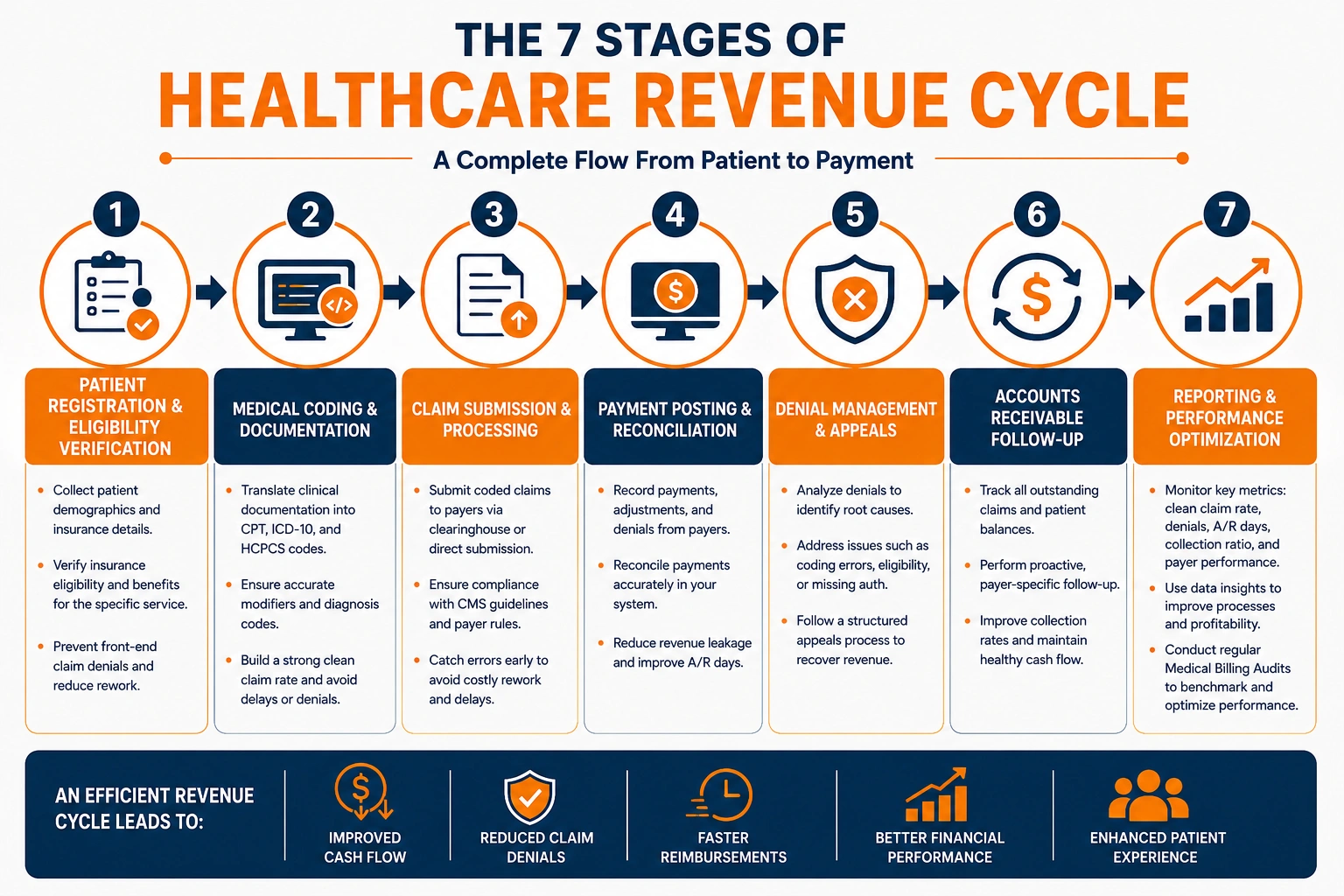
The 7 Stages of Revenue Cycle Management in Healthcare
How does revenue cycle management work for Michigan practices? It follows a structured seven-stage cycle. A breakdown at any stage affects your revenue, your cash flow, and your team’s time.
Stage 1 — Patient Registration & Eligibility Verification
The revenue cycle starts before the patient walks through your door. Your team collects demographic and insurance data, then runs patient eligibility verification to confirm active coverage and benefits for the specific service. A missed eligibility check is one of the most preventable causes of front-end claim denials — and one of the most common in practices without a structured process.
Stage 2 — Medical Coding & Documentation
Clinical documentation translates into CPT, ICD-10, and HCPCS codes. For Michigan practices, accurate Medical Coding Services are non-negotiable. A single incorrect modifier or missing diagnosis code can delay payment by weeks or trigger a full denial. Your clean claim rate is built — or broken — at this stage. Medical coding Michigan practices depend on grows more complex every year, with annual code set updates layered on top of payer-specific rules.
Stage 3 — Claim Submission & Processing
Coded claims move to the payer through a clearinghouse or direct submission. This stage drives your claims management efficiency. Per CMS.gov guidelines, claims must meet strict formatting and compliance standards before acceptance. Errors caught here are the most expensive to fix — and the most common in practices relying on manual workflows.
Stage 4 — Payment Posting & Reconciliation
Once payers adjudicate claims, payment posting records what was paid, adjusted, and denied. Inaccurate or delayed posting hides revenue leakage and inflates your A/R days — and both are problems your practice can’t afford to ignore.
Stage 5 — Denial Management & Appeals
Denial management is where practices either recover revenue or leave it on the table permanently. Every denied claim needs root-cause analysis: Was it a coding error? An eligibility issue? A missing prior authorization? Without a structured appeals process, denied claims age out, drop off the follow-up radar, and never get collected.
Stage 6 — Accounts Receivable Follow-Up
Accounts receivable management tracks every outstanding dollar across all payers and patient balances. The longer a claim sits unpaid, the lower its collection probability. Proactive, payer-specific A/R follow-up is what separates practices with stable cash flow from those constantly playing catch-up.
Stage 7 — Reporting & Performance Optimization
Measurement drives improvement. Reviewing denial trends, clean claim rates, collection ratios, and payer performance gives your practice the data to course-correct proactively. A scheduled Medical Billing Audit surfaces patterns your team may miss in day-to-day operations — and gives you a benchmark to measure against month over month.
Medical Billing vs. Revenue Cycle Management — What’s the Difference?
This is one of the most common questions practice owners ask — and the answer matters for how you staff, budget, and evaluate your vendor relationships.
Medical billing handles claim submission and payer follow-up. Revenue cycle management for medical practices is the full system — billing plus eligibility verification, coding accuracy, denial strategy, provider credentialing, compliance oversight, and financial reporting. Billing is one department. RCM is the entire operation.
Medical Billing Services are an essential component, but practices that treat billing as a standalone function consistently face higher denial rates and unpredictable revenue. A complete RCM system ties every stage together into one managed, measurable workflow.
Why Revenue Cycle Management Matters for Michigan Practices
Michigan’s healthcare landscape is demanding. Independent physicians, community health centers, and growing multi-specialty groups all face the same core pressure: get reimbursed accurately, quickly, and without drowning your admin team in paperwork.
Understanding why Michigan doctors need revenue cycle management is straightforward when you see the alternative costs real money. Practices operating without structured RCM commonly lose between 10 and 25 percent of collectible revenue annually — through unworked denials, coding errors, slow follow-up, and missed eligibility catches.
Real-world example: A solo primary care physician in Lansing came to us carrying a 42% denial rate on Medicaid claims and 58 A/R days. After implementing structured RCM workflows — including automated eligibility checks and dedicated denial follow-up — that practice brought their denial rate below 8% and reduced A/R days to 27 within four months.
Revenue cycle management for small medical practices in Michigan is not a luxury. For independent providers and small groups operating on tight margins, it’s financial infrastructure.
Common RCM Challenges Michigan Providers Face
High Claim Denial Rates Draining Revenue
Practices without structured RCM average denial rates of 15–25%, according to benchmarks from MGMA. Every denied claim costs time and money to rework — and many simply never get reworked. They expire, age out, and disappear as lost revenue.
Slow Accounts Receivable Days Hurting Cash Flow
In-house billing teams average 45–60 A/R days. For a practice billing $500,000 per month, that means $750,000 or more sitting unpaid at any given moment. Slow collections create payroll pressure, restrict hiring, and force short-term borrowing that eats into your margins.
Coding Errors & Documentation Gaps
Annual CPT and ICD-10 updates, combined with payer-specific billing rules, create compounding error risk even for experienced in-house coders. And HIPAA-compliant billing demands complete documentation at every step — an incomplete chart note can be just as damaging as an incorrect code when a payer comes back for an audit.
In-House RCM vs. Outsourced Revenue Cycle Management Michigan
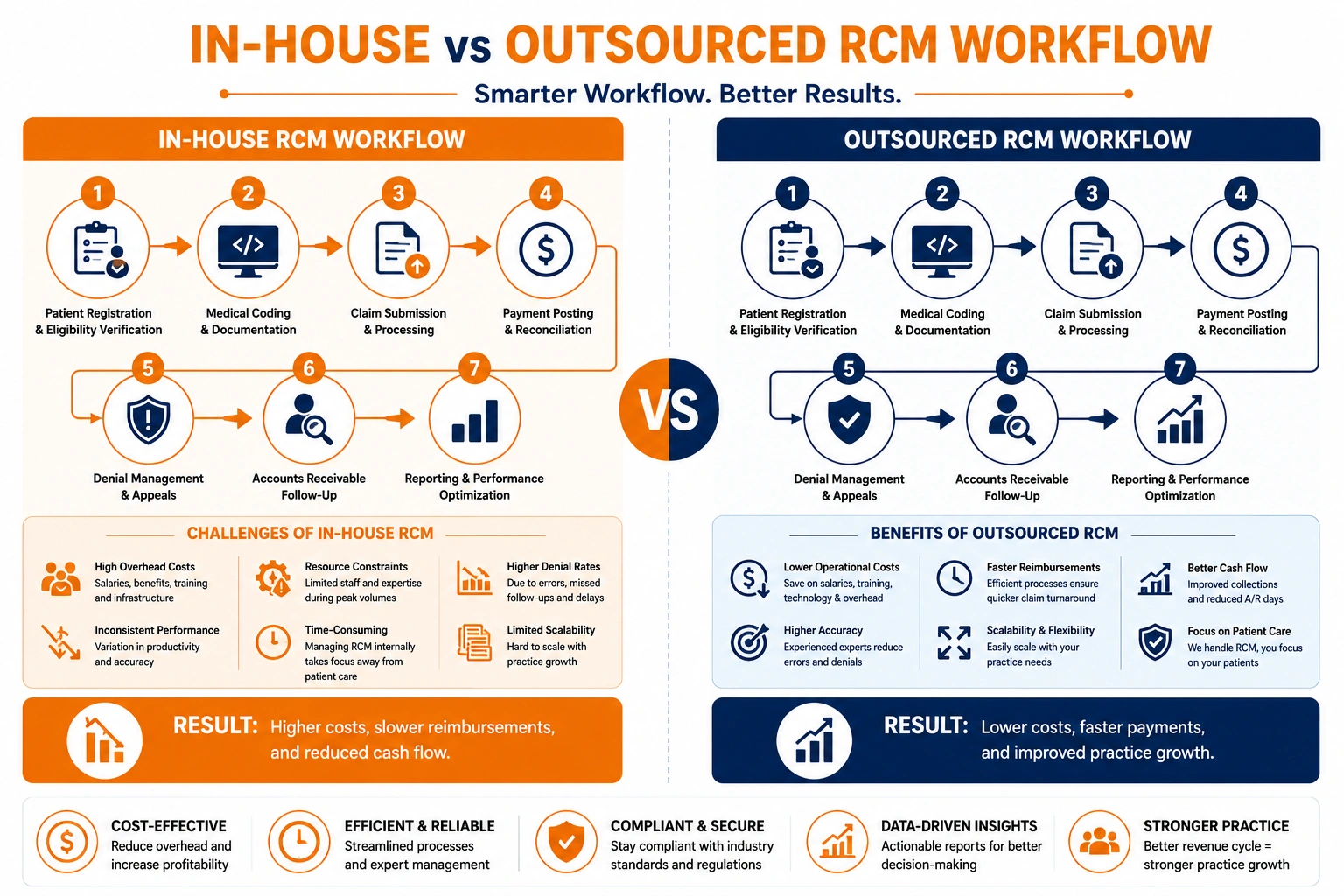
Here’s a full breakdown of how the two approaches compare for Michigan medical practices:
| Factor | In-House RCM | Outsourced RCM |
|---|---|---|
| Average Denial Rate | 15–25% | 5–8% |
| Average A/R Days | 45–60 days | 20–30 days |
| Clean Claim Rate | 75–85% | 95–98% |
| Staffing Risk | High (turnover, sick leave) | Eliminated |
| Technology Cost | Practice-funded | Included in service |
| Compliance Management | Practice-responsible | Vendor-managed |
| Scalability | Limited by headcount | Immediate |
| Cost Transparency | Variable monthly | Predictable, structured |
The True Cost of Managing RCM In-House
Staffing a billing department means salaries, benefits, software licenses, ongoing training, and lost productivity during every turnover event. According to the AMA, physicians and their staff spend an average of 16 administrative hours per week per physician — much of that tied to billing workflows and prior authorization management. For a three-provider practice, that’s roughly two full-time positions consumed entirely by non-clinical work. Revenue Cycle Management Michigan in-house teams also carry the ongoing burden of keeping up with payer policy changes and annual coding updates without dedicated compliance support.
What Outsourced RCM Services Deliver
When you outsource medical billing Michigan, you transfer the billing burden to a team purpose-built for it — certified coders, denial analysts, credentialing specialists, and reporting managers working under one integrated system.
Real-world example: An orthopedic group in Grand Rapids with five surgeons was managing their revenue cycle in-house with three billing staff. After outsourcing to a full-service RCM partner, they reduced A/R days from 51 to 24, increased total collections by 18%, and redeployed two positions to patient-facing administrative roles.
How to improve revenue cycle management for your Michigan practice often starts with an honest audit of whether your current process can realistically keep pace with your volume, your payer mix, and annual billing complexity.
Revenue Cycle Management Michigan: By Specialty [2026 Breakdown]
RCM isn’t one-size-fits-all. Healthcare revenue cycle Michigan needs vary meaningfully by specialty, patient volume, and payer mix:
- Primary Care — High volume, lower per-claim complexity. Eligibility accuracy and clean claim rate are the primary performance drivers.
- Orthopedics — Prior authorization requirements and surgical coding complexity demand specialized coders and proactive auth management.
- Mental Health — Medicaid billing rules, session caps, and telehealth-specific codes make denial management and eligibility verification especially critical.
- Internal Medicine — Chronic care management and transitional care codes require thorough documentation review on every encounter.
- Multi-Specialty Groups — Unified reporting across multiple tax IDs, payer contracts, and provider types requires a partner with sophisticated systems infrastructure.
Medical Billing Services in Michigan that are specialty-agnostic consistently miss payer nuances that cost you real reimbursement dollars.
Provider credentialing is specialty-critical, too. Outdated or incomplete credentialing causes claim rejections that can take 90-plus days to resolve. Provider Credentialing Services keep your providers enrolled and in-network across all active payer contracts — preventing revenue interruptions before they start.
Key RCM Metrics Every Michigan Practice Owner Should Track
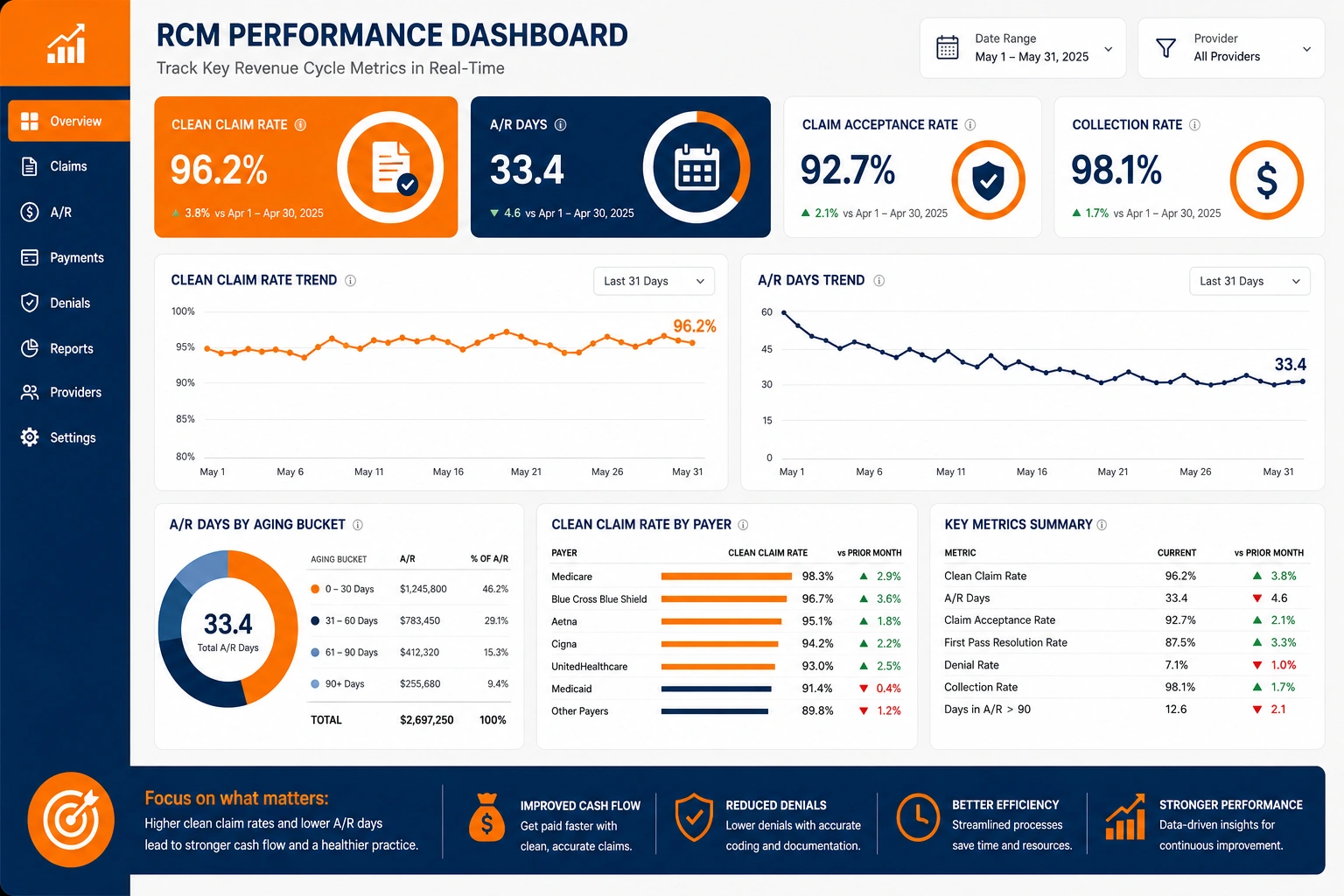
These five KPIs reveal the true health of your revenue cycle. Track them monthly:
- Clean Claim Rate — Target 95%+. Anything below 85% signals systemic coding or documentation problems that compound over time.
- Denial Rate — Target under 5%. Creeping above 10% requires immediate RCM intervention.
- A/R Days — Target under 30 days. Exceeding 45 days consistently means your follow-up process is breaking down somewhere.
- Net Collection Rate — Target 95–99%. This is your true revenue recovery rate — what you actually collected versus what you were owed.
- First-Pass Resolution Rate — The percentage of claims paid on first submission without any rework. High first-pass rates are the clearest signal of RCM efficiency.
Benchmark these against industry standards published by HFMA to make proactive decisions rather than reactive ones.
How Revenue Cycle Management Impacts Your Bottom Line [Statistics Section]
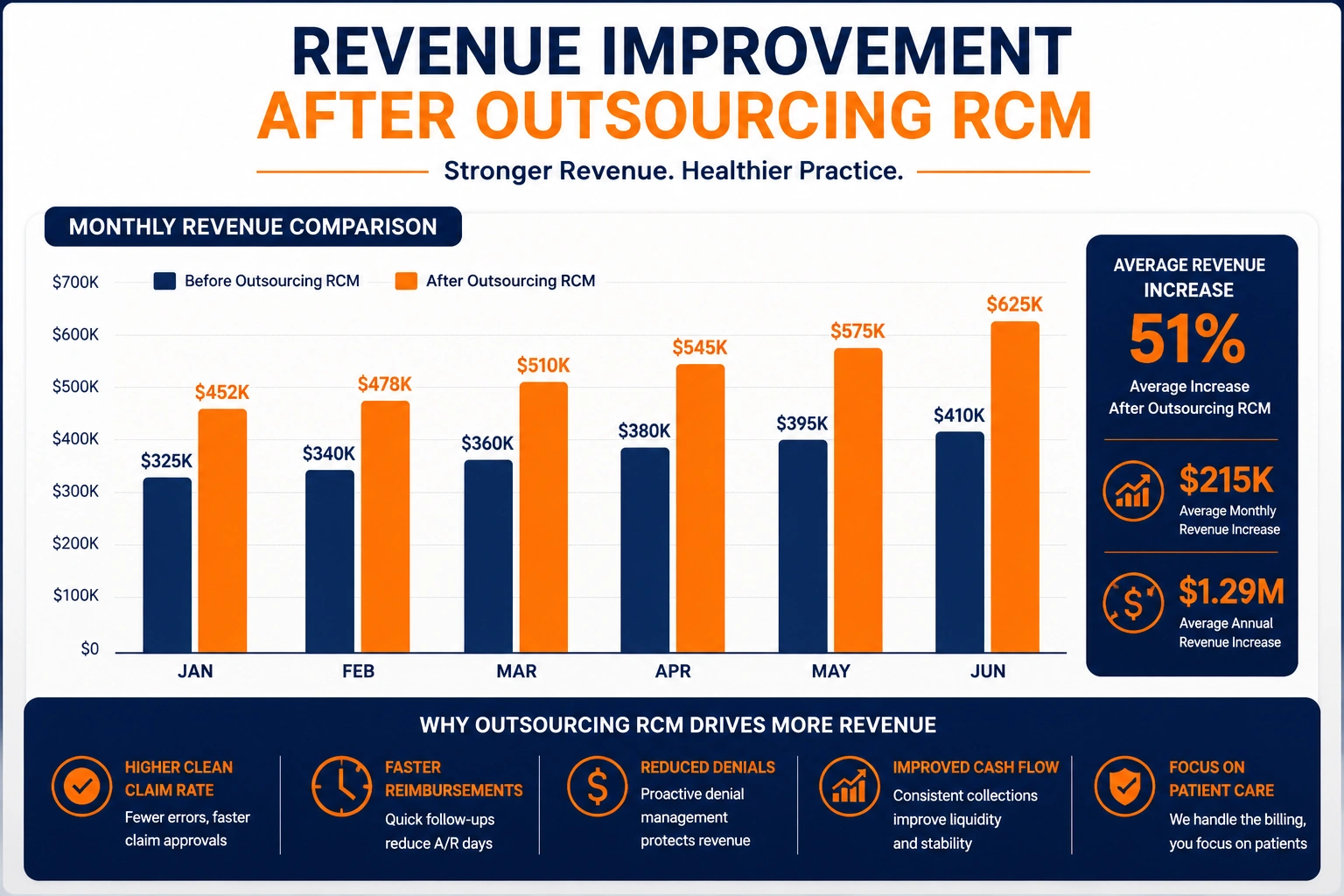
The numbers are clear for Michigan practices that make the move to structured RCM:
1. Claim Denial Rates Practices operating without structured RCM average 15–25% denial rates. Practices using outsourced RCM partners consistently achieve 5–8%, per MGMA benchmarks. That difference translates directly to recovered monthly revenue — often tens of thousands of dollars for mid-sized practices.
2. A/R Days In-house billing teams average 45–60 A/R days. Top-performing outsourced RCM partners bring that to 20–30 days. Faster collections mean better cash flow, lower financial risk, and more operational flexibility.
3. Clean Claim Rate Internal billing teams typically hit 75–85% clean claim rates. Specialized outsourced RCM teams achieve 95–98% — meaning far less rework, faster payment cycles, and lower administrative overhead.
4. Revenue Improvement Practices implementing structured RCM — through restructured in-house processes or full outsourcing — typically see 10–25% revenue improvement within the first six to twelve months of operation.
5. Administrative Hours Saved Outsourcing RCM saves the average Michigan practice 15–20 hours per week in administrative burden. At a fully-loaded cost of $35–45 per hour for billing staff, that’s $27,000–$46,000 in annual labor savings for a mid-sized practice — before accounting for the revenue upside from fewer denials and faster collections.
How UtreatiBill Delivers Revenue Cycle Management in Michigan

The UtreatiBill team provides RCM services Michigan practices depend on across all major specialties. Our end-to-end services cover patient eligibility verification, specialized medical coding, claims management, denial management, accounts receivable management, and provider credentialing — all operating under a single HIPAA-compliant billing platform with real-time performance reporting.
Real-world example: A multi-specialty practice in Detroit with 12 providers was managing fragmented billing across four separate EHR systems. After partnering with UtreatiBill, they unified their Revenue Cycle Management Michigan operations onto a single reporting framework, reduced their denial rate from 21% to 6%, and recorded a 22% increase in net collections within eight months.
Our full-service RCM pricing is transparent, volume-based, and built around your specialty — no hidden fees, no long-term lock-in contracts.
Key Takeaways
- Revenue Cycle Management Michigan is the complete financial process from patient registration through final payment — not just claim submission
- Every one of the seven RCM stages creates a risk point where revenue can be lost, delayed, or left uncollected
- Michigan practices without structured RCM lose an estimated 10–25% of collectible revenue annually
- Outsourced RCM consistently delivers lower denial rates, faster A/R days, and higher clean claim rates than in-house teams
- The right RCM partner understands your specialty, your payer mix, and Michigan-specific billing rules
- Tracking clean claim rate, denial rate, A/R days, and net collection rate monthly is non-negotiable for any financially healthy practice
Final Thoughts
Revenue Cycle Management Michigan providers build their practices on isn’t a back-office function — it’s the financial infrastructure that determines whether your practice grows or consistently falls short of its revenue potential.
Whether you’re a solo physician in Lansing, an orthopedic group in Grand Rapids, or a multi-specialty operation in Detroit, the same principle applies: a structured, technology-backed RCM process gets you paid faster, with fewer errors, and far less administrative drag on your team.
The UtreatiBill team provides medical billing services Michigan practices trust across specialties and practice sizes. We audit your current revenue cycle, show you exactly where you’re leaking revenue, and build an RCM plan that fits your operation — not a generic template.
Book a Free Consultation and start recovering the revenue your practice has already earned.