
The 2026 Efficiency Adjustment: Why Surgical, Imaging & Pain Management Codes Just Got a Pay Cut
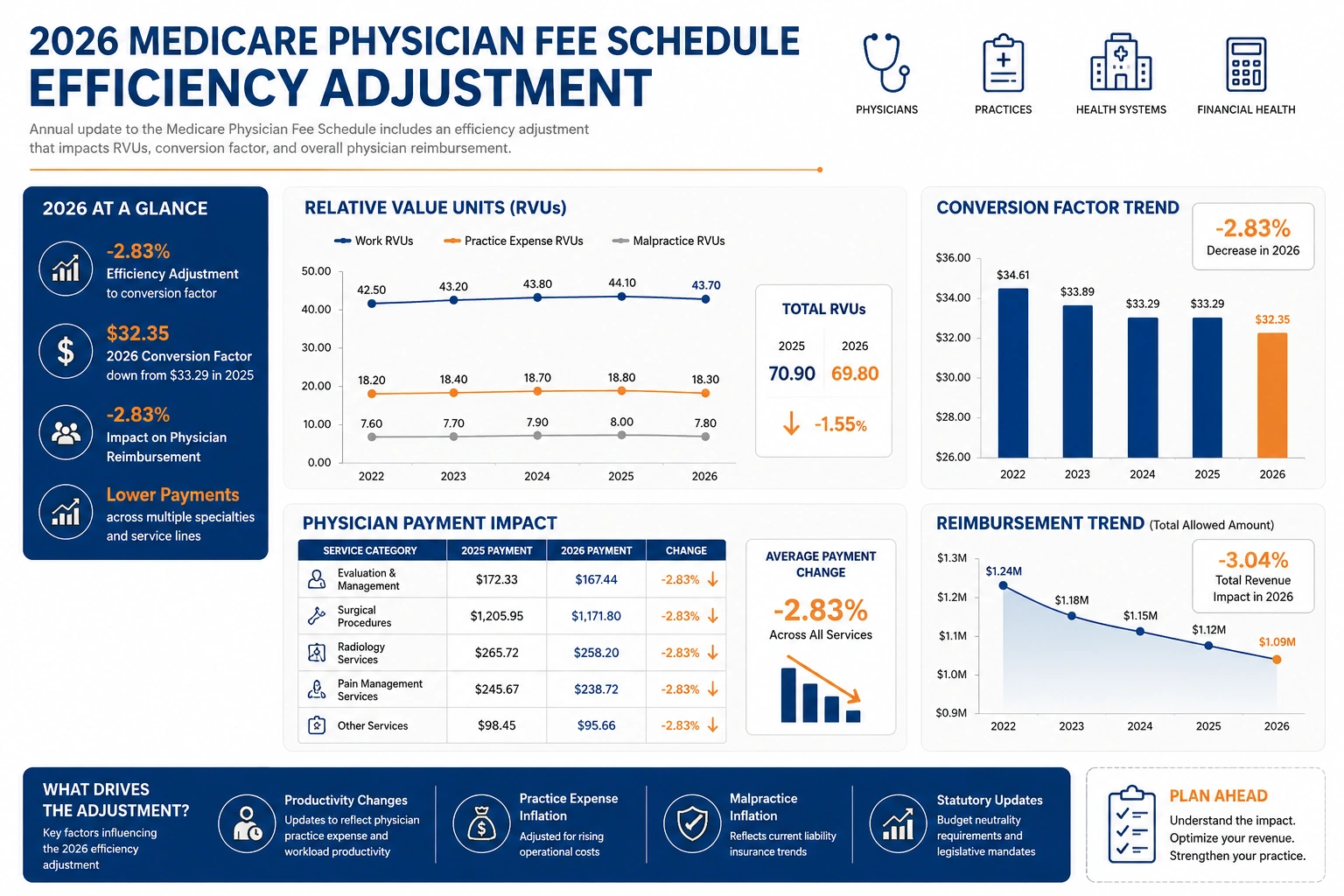
If your remittance advice looks lighter this January, the 2026 efficiency adjustment is probably why. CMS finalized this policy in the CY 2026 Medicare Physician Fee Schedule, and it strips 2.5% from the work RVUs of nearly every non-time-based procedure — including surgery, imaging, and interventional pain codes. For a clear breakdown of how this fits into your broader Revenue Cycle Management strategy, keep reading. This guide walks your practice through what changed, which codes are hit, and how to protect your reimbursement before the cuts erode your margin further.
What Is the 2026 Efficiency Adjustment? The 2026 efficiency adjustment is a CMS payment policy that cuts work RVUs by 2.5% for most non-time-based Medicare services — surgery, imaging, and pain procedures included. It assumes physicians have become more efficient over time, so CMS reduced what it pays per procedure starting January 1, 2026.
What Is the 2026 Medicare Efficiency Adjustment?
The 2026 efficiency adjustment applies a flat -2.5% reduction to work RVUs and the intraservice time tied to procedural codes. CMS calculated this figure using a five-year look-back of the Medicare Economic Index productivity adjustment — a work RVU efficiency adjustment meant to reflect the idea that practitioners perform procedures faster than they did when the codes were originally valued. It’s part of the CY 2026 Physician Fee Schedule final rule and applies across nearly 7,700 codes, roughly 91% of all physician services. What is the CMS efficiency adjustment for 2026, in plain terms? It’s a built-in pay cut layered under a conversion factor increase that looks like a raise on paper.
Why CMS Introduced the Efficiency Adjustment for 2026
CMS argues that non-time-based codes CMS hadn’t revalued in years no longer reflect how quickly procedures are actually performed. Technology, standardized workflows, and physician experience compressed procedure times — but RVUs never caught up. The efficiency adjustment is CMS’s attempt to close that gap.
What Changed in the CY 2026 Physician Fee Schedule Final Rule
CMS finalized two separate conversion factors for 2026: $33.5675 for Qualifying APM Participants (+3.77%) and $33.4009 for everyone else (+3.26%). Layered on top is the -2.5% efficiency adjustment and a 50% cut to indirect practice expense RVUs for facility-based services — a one-two punch that quietly offsets the conversion factor 2026 Medicare increase for procedural specialties.
From Time Assumptions to Efficiency — How CMS Recalculated Work RVUs
CMS replaced outdated time assumptions with a productivity-based formula. Instead of waiting for individual code resurveys, the agency applies a blanket reduction to intraservice time and the related work RVU, then plans to repeat the exercise every three years with no floor on how far values can fall.
Why Many Practices Didn’t See This Pay Cut Coming
The 3.26%–3.77% conversion factor headline made 2026 look like a rare win after years of flat or falling Medicare pay. Practices that didn’t model the efficiency adjustment alongside the practice expense methodology CMS changes assumed reimbursement was rising — until claims started posting lower than expected.
The Hidden Revenue Risk for Practices Running on Outdated Fee Schedules
Many payer contracts peg rates to a percentage of the Medicare Physician Fee Schedule. If your fee schedule and contract language weren’t updated for the Medicare Physician Fee Schedule 2026 cuts, you’re likely undercollecting on every claim tied to an affected code — even from commercial payers who never mentioned the change.
Which Codes Are Affected by the 2026 Efficiency Adjustment
The cut targets non-time-based, procedural work — not office visits. Which CPT codes are affected by the 2026 efficiency adjustment? Mostly surgery, imaging interpretation, outpatient interventions, and pain management procedures.
| Code Category | 2025 Work RVU Trend | 2026 Efficiency Adjustment Impact |
|---|---|---|
| Orthopedic surgery | Stable | ~-5% overall |
| Diagnostic radiology | Stable | ~-2% overall |
| Interventional radiology | Stable | ~+2% overall (net of other changes) |
| Interventional pain (facility/ASC) | Stable | ~-8% to -11% |
| Interventional pain (office) | Stable | ~+7% to +10% |
| E/M, care management, behavioral health | Stable | No cut (exempt) |
Surgical Procedure Codes Facing the Cut
Most surgical CPT codes lose 2.5% of their work RVU value outright. This surgical code payment cut 2026 compounds with facility practice expense reductions, so orthopedic and general surgery groups operating in hospitals or ASCs are seeing overall impacts closer to -5%, per published specialty modeling.

Diagnostic Imaging Interpretation Codes Affected
Imaging interpretation — X-ray, CT, MRI reads — sits squarely inside the efficiency adjustment’s scope. The imaging reimbursement cut 2026 brings diagnostic radiology down roughly 2% overall, even though interventional radiology nets a slight gain once other RVU changes are factored in.
Interventional Pain Management Codes Hit Hardest
Facet injections, epidural steroid injections, and similar interventional codes took some of the steepest hits. The pain management RVU cut 2026 combines with the facility practice-expense reduction to drop facility and ASC-based reimbursement by 8%–11%, even as equivalent office-based services see a modest increase.
Outpatient Intervention and Orthopedic Service Codes
CMS specifically named orthopedic services and outpatient interventions as adjustment targets. Diagnostic imaging CPT codes payment cut alongside orthopedic surgery Medicare reimbursement 2026 changes mean multi-specialty groups need a code-by-code view, not a single blended percentage.
Which Time-Based Codes Are Exempt (E/M, Care Management, Behavioral Health)
E/M visits, care management, behavioral health, telehealth-list services, and maternity codes with an MMM global period are exempt. New CY 2026 codes were also excluded in the final rule, which trimmed the affected code list from roughly 9,000 to about 7,700.
The Complete 2026 Playbook for Protecting Revenue From the Efficiency Adjustment
Surviving the 2026 efficiency adjustment takes more than absorbing the cut. It takes a plan.
Recalculate Your Fee Schedule and Contracted Rates
Pull your top revenue-driving codes and rebuild your fee schedule using the 2026 Medicare RVUs and conversion factors — not last year’s numbers. A Medical Billing Audit is the fastest way to confirm your schedule reflects current rates.
Run a Code-Level Revenue Impact Analysis
Don’t rely on specialty-wide averages. RVU revaluation CMS changes hit codes unevenly, so a code-level review shows you exactly which procedures lost the most and where to focus renegotiation efforts.
Renegotiate Payer Contracts Where Possible
Many commercial contracts reference the Medicare fee schedule by formula. Use your impact analysis to flag any contract where a rate cut wasn’t disclosed, and bring data — not assumptions — to the renegotiation table.
Shift Volume Toward Time-Based and Care Management Codes
Where clinically appropriate, time-based services like care management and behavioral health integration aren’t subject to the efficiency adjustment. Diversifying your billing mix can soften the overall hit.
How Much Revenue Is Your Practice Losing to the Efficiency Adjustment?
How much will my reimbursement drop under the CY 2026 Medicare Physician Fee Schedule? It depends on your specialty and site of service — here’s what it looks like in practice.
Example 1 — Orthopedic Surgery Practice Revenue Impact
A facility-based orthopedic group billing high volumes of joint and spine procedures can expect an overall impact near -5%, once the efficiency adjustment and facility practice-expense cuts are combined — even with the conversion factor increase included.
Example 2 — Diagnostic Imaging Center Revenue Impact
An imaging center reading mostly CT and MRI studies faces roughly a -2% overall shift under the new rule. Centers heavily weighted toward interventional radiology may see a smaller net impact, or even a modest gain.

Example 3 — Interventional Pain Management Practice Revenue Impact
A pain management group performing 2,000 facet and epidural procedures annually can lose an estimated $18,000–$32,000 a year from the efficiency adjustment alone — before facility-setting practice expense cuts of 8%–11% are added on top.
In-House Billing vs. Outsourced RCM: Managing the 2026 Pay Cuts
Why In-House Teams Struggle to Model Multi-Code Rate Changes
Modeling thousands of affected codes against multiple payer contracts, two conversion factors, and a new site-of-service differential is a heavy lift for staff who are also working denials and posting payments daily.
What an Outsourced RCM Partner Brings to Fee Schedule Defense

A dedicated RCM partner brings outsourced billing revenue protection through dedicated modeling tools, payer-specific benchmarking, and staff whose only job is tracking rate changes like the 2026 efficiency adjustment as they land.
Nearshore vs. Offshore RCM Models for Cost Containment in 2026
Nearshore teams often offer closer time-zone alignment and faster turnaround on payer escalations, while offshore models can lower per-claim costs further. The right fit depends on your volume, specialty mix, and how fast you need contract issues resolved.
Documentation and Coding Strategies to Maximize Reimbursement Under the New Rule
Coding for Complexity Within the New RVU Framework
With base RVUs reduced, accurately capturing every billable component of a complex procedure — bundled supplies, add-on codes, modifiers — matters more than ever to recover legitimate revenue.
Avoiding Undercoding That Compounds the Pay Cut
Undercoding on top of the efficiency adjustment is a double loss. Review documentation templates to ensure coders have everything needed to bill at the full, supported level of service.
Building Audit-Ready Documentation From Day One
Tighter margins increase scrutiny on every claim. Documentation that clearly supports medical necessity and code selection protects revenue if a payer questions a claim post-payment.
Strategies Every Practice Should Implement Right Now
Audit Your Top 20 CPT Codes for Efficiency Adjustment Exposure
Start with your highest-volume codes. A focused audit shows your real efficiency adjustment exposure faster than a full fee-schedule rebuild.
Update Your Fee Schedule and Patient Cost Estimates
Patient cost-share estimates built on old fee schedules will be wrong. Update them so patient billing matches actual 2026 rates.
Diversify Revenue With Value-Based and Care Management Programs
Care management, chronic care, and value-based arrangements aren’t subject to the efficiency adjustment and can help stabilize revenue mix.
Train Billing Staff on the New RVU Calculations
Make sure billing staff understand how the efficiency adjustment interacts with the conversion factor and practice-expense changes — confusion here leads to missed appeals and underbilled claims.
Outsource to an RCM Partner That Models Payer-Specific Impact
A partner who can show payer-by-payer impact, not just a Medicare-only estimate, gives you the clearest path to recovering lost revenue.
How Outsourced Billing Protects Your Revenue From the Efficiency Adjustment
Proactive Fee Schedule Modeling Before the Cuts Hit
The best RCM partners model rate changes before the effective date, not after the first underpayment shows up on an EOB.
Faster Contract Renegotiation Support
Outsourced teams with payer relationships and benchmarking data can move renegotiations along faster than an in-house team juggling daily claims work.
Code-Level Revenue Tracking and Trend Reporting
Ongoing, code-level reporting flags new underpayments quickly, instead of waiting for a quarterly review to notice the trend.
How UtreatiBill Helps Practices Navigate the 2026 Efficiency Adjustment
UtreatiBill’s revenue cycle management team builds 2026-specific fee schedule models for surgical, imaging, and interventional pain management reimbursement clients, flags affected codes before claims go out the door, and supports payer renegotiations with hard data. We also coordinate closely with Medical Coding Services and Credentialing Services so your documentation, coding, and enrollment all stay aligned with the new rule — and we help orthopedic groups specifically address Orthopedic Claim Denials tied to the revised RVU framework.
The Financial Cost of the 2026 Efficiency Adjustment
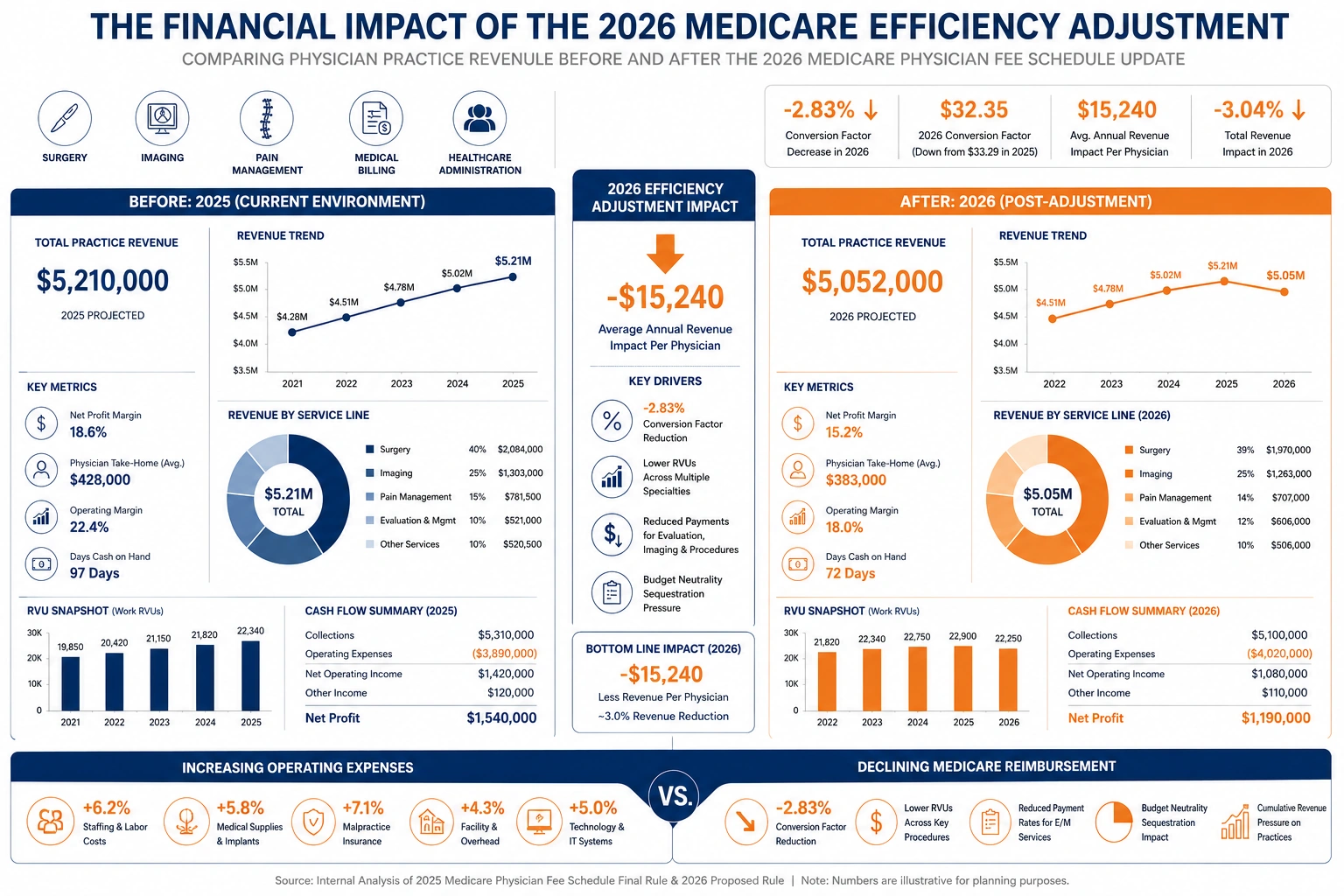
- Size and scope: The efficiency adjustment cuts work RVUs by -2.5% across roughly 7,700 non-time-based codes — more than 90% of physician services — covering surgery, imaging, outpatient interventions, orthopedics, and interventional pain management, according to CMS.
- Budget impact: CMS hasn’t published one standalone savings figure for the efficiency adjustment alone, but it’s structured to fund part of a 0.49% positive budget-neutrality adjustment elsewhere in the fee schedule — separate from CMS’s $19.6 billion skin-substitute payment reform also finalized for 2026.
- Conversion factor split: CY 2026 introduced two conversion factors for the first time — $33.5675 for APM Qualifying Participants (+3.77%) and $33.4009 for non-qualifying clinicians (+3.26%) — a shift the American Medical Association says the efficiency adjustment largely offsets for procedural specialties.
- Specialty-level impact: Reported overall effects include roughly -5% for orthopedic surgery, -2% for diagnostic radiology, and -8% to -11% for facility-based interventional pain management, per specialty-society and MGMA-cited modeling.
- The real-world gap: The headline -2.5% RVU cut understates actual cash-flow impact for many practices, since commercial payer contracts that peg rates to the Medicare fee schedule reprice automatically — compounding the cut across every payer, not just Medicare, once contracts catch up.
Key Takeaways
- The 2026 efficiency adjustment cuts work RVUs by 2.5% on most non-time-based codes, including surgery, imaging, and interventional pain procedures.
- Time-based codes — E/M, care management, behavioral health — are exempt.
- Facility and ASC-based services face additional cuts from a separate practice-expense methodology change.
- Commercial payer contracts tied to the Medicare fee schedule mean the impact extends well beyond Medicare claims.
- Code-level analysis, fee schedule updates, and payer renegotiation are the fastest ways to offset the 2026 Medicare pay cut.
Final Thoughts
The 2026 efficiency adjustment isn’t a one-time event — CMS plans to revisit it every three years with no floor on how far values can fall. Practices that build a repeatable process now for tracking RVU revaluation CMS changes will handle the next round far more easily than those scrambling after each new rule drops. If you haven’t modeled your exposure yet, that’s the place to start.