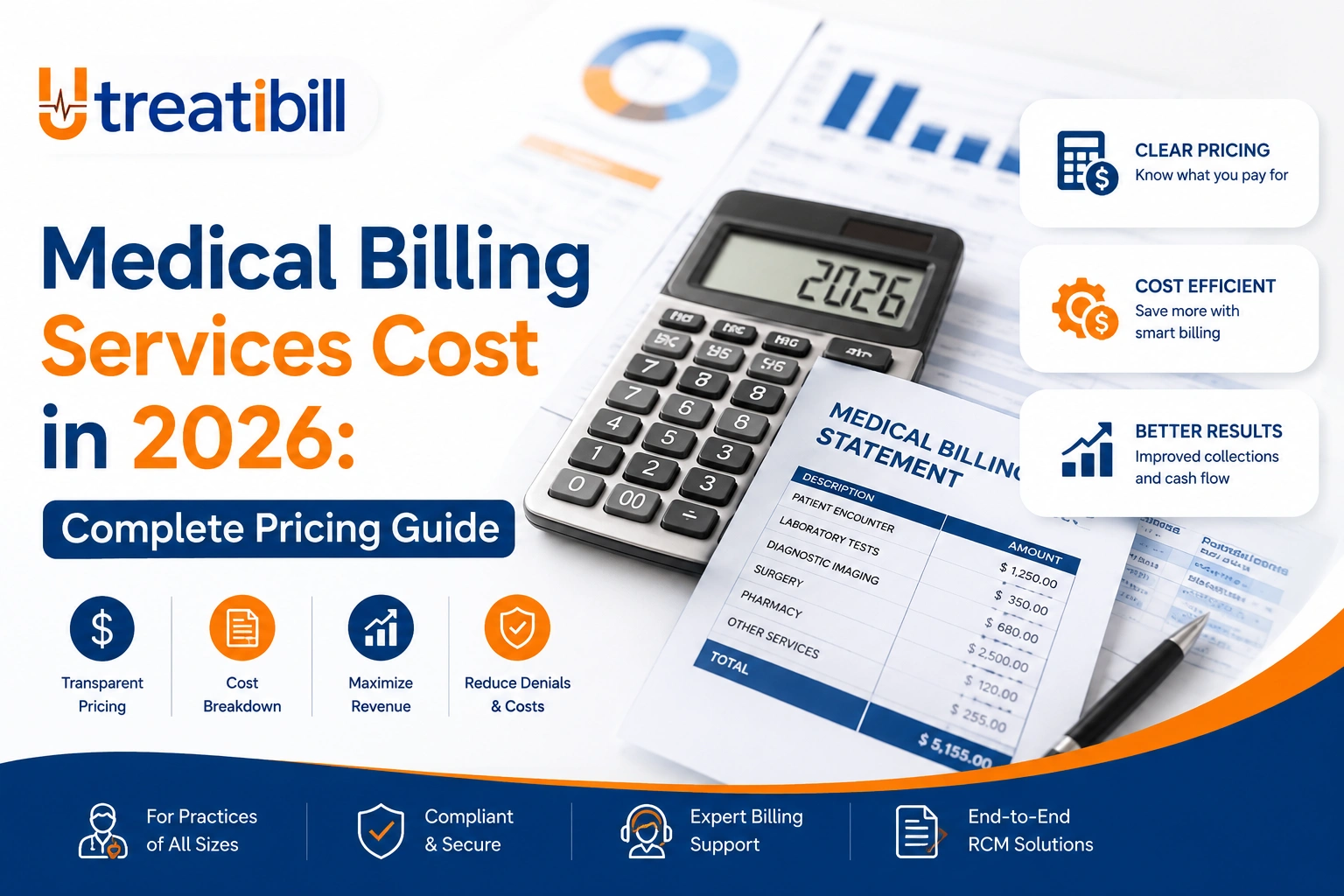

Medical Billing Services Cost in 2026
Understanding medical billing services cost is one of the most consequential financial decisions your practice will make in 2026. Knowing how much does it cost to outsource medical billing — and what you actually get for that investment — changes how you budget, negotiate, and grow.
As the Revenue Cycle Management team at UtreatiBill, we work with solo physicians, orthopedic groups, and multi-specialty practices every day. This guide delivers a clear breakdown of medical billing pricing models, what drives cost, and how to calculate whether outsourcing makes financial sense for your practice.
What Medical Billing Services Cost — And Why It Varies So Much
At a Glance: Medical billing services cost typically ranges from 4% to 9% of monthly collections under percentage-based contracts, $3–$8 per claim for per-claim models, or $500–$2,500/month for flat-rate plans. Your specialty, claim volume, and payer mix determine where you fall in that range.
Medical billing pricing models are not interchangeable. The cost of outsourcing medical billing varies based on your specialty, payer complexity, current denial rate, and the scope of services included.
Three medical billing fees structures dominate the market: percentage of collections, per-claim flat fees, and monthly flat-rate plans. Each serves different practice types. The wrong model can quietly cost your practice far more than the billing fee itself — in lost revenue, staff hours, and denied claims that never get worked.
Before selecting a billing partner, evaluating each model against your practice’s actual volume and revenue profile helps you negotiate from an informed position.
Pricing Model #1 — Percentage of Collections (Most Common)
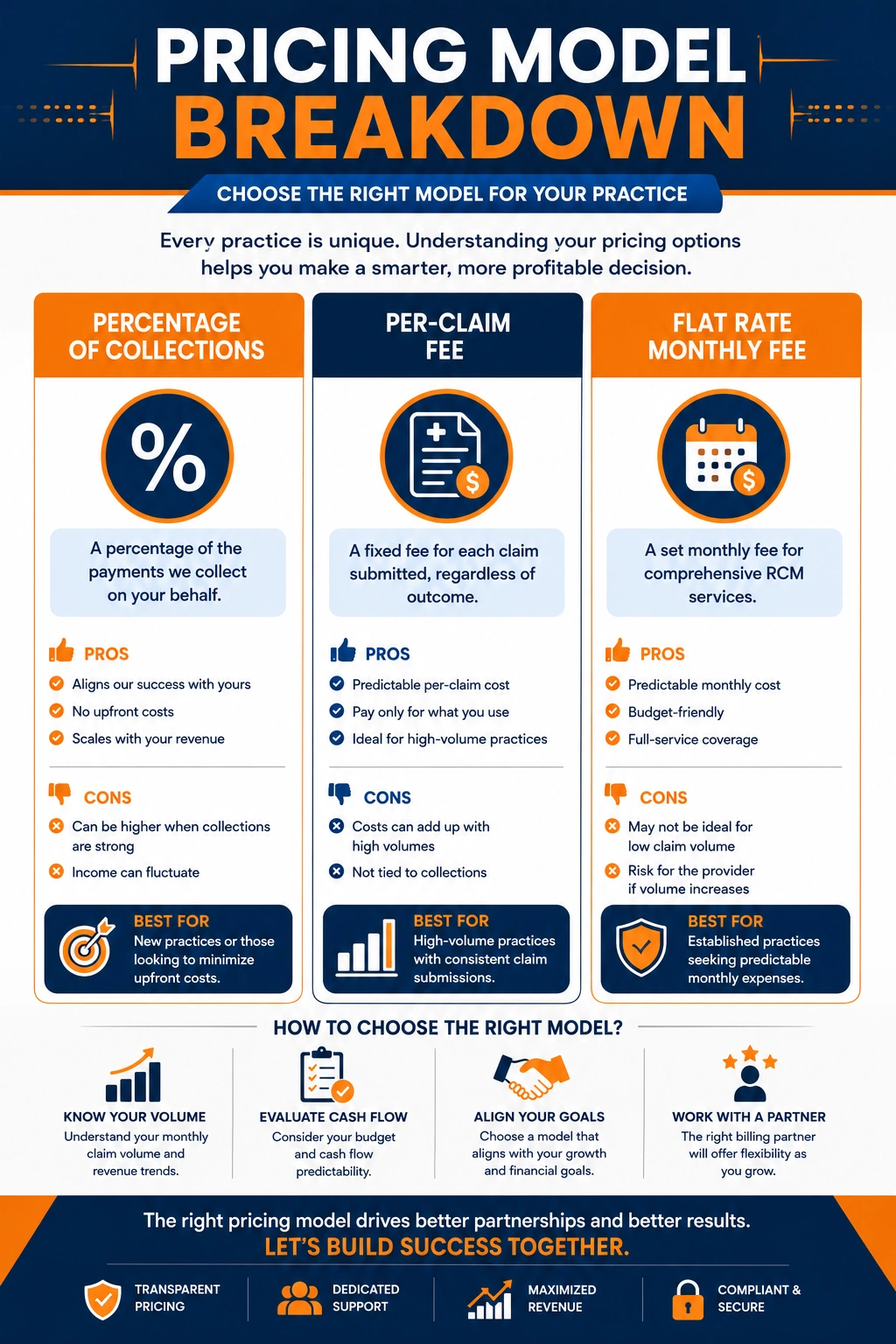
The majority of Medical Billing Services companies use percentage of collections billing as their default structure — tying their compensation directly to what your practice collects, not what it submits.
What the Percentage Fee Actually Covers
Rates typically run 4% to 9% of monthly collections. The industry average for primary care and internal medicine sits at 5–7%, with procedural and surgical specialties toward the higher end.
A standard percentage contract covers:
- Charge entry and claim submission
- Payment posting and ERA reconciliation
- Denial management and appeals follow-up
- Basic monthly performance reporting
Provider credentialing, coding audits, and advanced analytics are routinely excluded. Always read your billing service contract carefully — every line — before committing.
Practice example: A solo primary care physician collecting $600,000 annually at 6% pays $36,000/year — typically less than the cost of a single full-time biller with benefits, training, and software.
When Percentage-Based Pricing Works Best for Your Practice
Percentage billing aligns incentives powerfully: if your billing partner doesn’t collect, they don’t earn. It works best for practices with moderate-to-high claim volumes and variable monthly collections. If your payer mix skews heavily toward flat-rate Medicare reimbursement, a per-claim or flat-rate structure may offer stronger value.
Pricing Model #2 — Per-Claim Flat Fee Billing
Per-claim billing charges a fixed per-claim billing fee for each claim submitted — regardless of the dollar amount collected. Typical rates range from $3 to $8 per claim, depending on specialty and what services are included.
How Per-Claim Pricing Compares Across Specialties
Per-claim pricing suits high-volume, lower-complexity practices well. An urgent care center submitting 600 claims/month at $4/claim pays $2,400/month — predictable and often competitive. For an orthopedic group managing complex surgical billing and multi-payer environments, per-claim pricing may cost less on paper but leave significant denial recovery incomplete if appeals aren’t bundled in.
The Hidden Variables in Per-Claim Medical Billing Fees
Before agreeing to per-claim pricing, clarify exactly what counts as a “claim.” Some vendors charge per submission — including resubmissions of denied claims. Ask whether secondary claims, patient statements, and appeal filings are included. These variables can quietly double your actual medical billing fees without any warning on your invoice.
Pricing Model #3 — Monthly Flat-Rate Plans
Flat-rate billing plans charge a fixed monthly amount — typically $500 to $2,500/month — regardless of claim volume or collections.
What’s Included — and What Often Isn’t
Flat-rate billing offers predictable budgeting, which appeals to smaller practices managing tight overhead. Most plans cover basic claim submission and payment posting, but routinely exclude:
- Active denial appeals and resubmissions
- Outbound patient billing calls
- Medical billing software cost when using the vendor’s proprietary platform
- Detailed A/R reporting and payer trend analysis
Practice example: A two-provider multi-specialty practice paying $1,500/month for flat-rate billing may lose far more in unworked denials than the plan saves — especially in complex payer environments with high prior authorization volume.
When a Flat-Rate Medical Billing Plan Makes Sense
Medical billing services cost for small practices is often lowest under flat-rate plans — predictable, simple, and easy to budget. This model fits practices submitting fewer than 150 claims/month with a consistent payer mix. Above that threshold, percentage-based billing almost always delivers stronger revenue outcomes.
In-House vs. Outsourced Medical Billing: True Cost Comparison
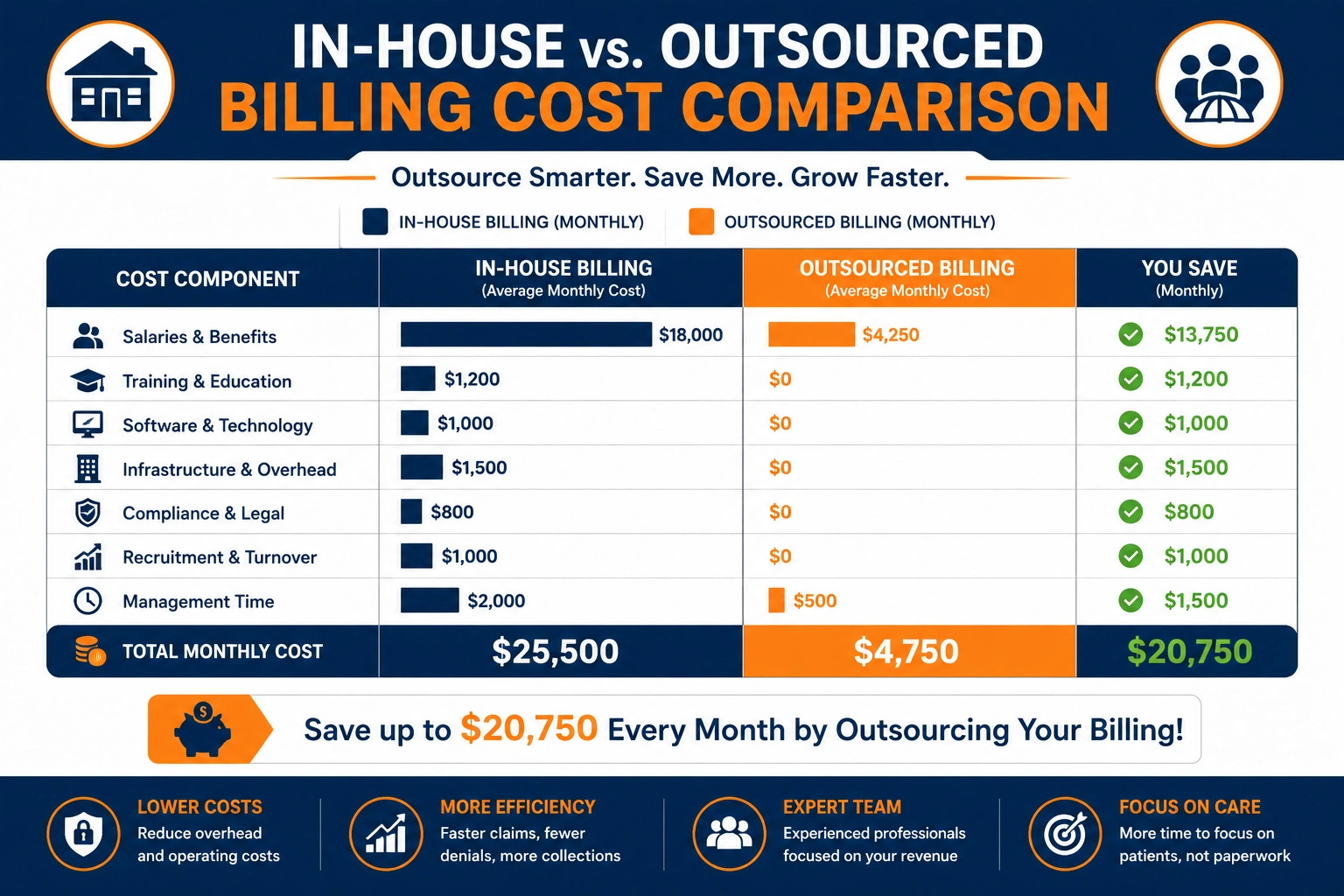
The in-house vs outsourced billing cost debate requires honest, comprehensive accounting. Most practices significantly underestimate what in-house billing actually costs when all variables are included.
The Full Annual Cost of Running In-House Billing

Running billing internally involves far more than one salary. Here’s what practice overhead and staffing costs look like for a standard two-person billing team:
| Cost Category | Annual Estimate |
|---|---|
| Billing Staff Salaries (2 FTEs) | $130,000–$190,000 |
| Benefits + Payroll Taxes (~30%) | $39,000–$57,000 |
| Medical Billing Software Cost (EHR/PM System) | $15,000–$40,000 |
| Training & Certification | $2,000–$5,000 |
| Practice Overhead (space, equipment) | $5,000–$12,000 |
| Total Annual Estimate | $191,000–$304,000 |
According to the AMA, practices spend an average of $99,000 per physician per year on billing-related administrative costs — a figure that continues rising annually as payer complexity increases.
What Outsourced Medical Billing Services Cost — and What You Gain Back
For a practice collecting $1.5M annually, outsourcing at 6% costs approximately $90,000/year — a fraction of in-house overhead. The cost of outsourcing medical billing is routinely 40–60% less than maintaining a full in-house team when staffing, software, benefits, and operational overhead are fully accounted for.
A Medical Billing Audit regularly reveals that in-house teams leave 10–20% of collectible revenue uncollected due to understaffing, coding gaps, and unworked denials. Outsourcing to a performance-driven partner closes that gap — and frequently pays for itself within the first 6–12 months.
What Factors Drive Medical Billing Services Cost for Your Practice
Medical billing service pricing doesn’t exist in a vacuum. These variables most directly determine what your practice will pay:
- Specialty complexity — Procedural and surgical specialties require more intensive coding and carry higher rates
- Claim volume — Higher volume can lower per-claim cost but pushes flat-rate tier pricing up
- Payer mix — Medicare/Medicaid-heavy practices face additional compliance layers that increase service cost
- Accounts receivable (A/R) days — Poor A/R health signals a larger recovery workload upfront, which vendors may price accordingly
- Credentialing needs — Provider Credentialing Services are typically billed separately at $150–$300 per provider
- Current denial rate — High existing denial rates mean more remediation work at the outset
- EHR integration requirements — Custom integrations may carry one-time setup fees that standard implementations do not
Knowing these levers helps you negotiate effectively and avoid paying a premium rate for a straightforward billing profile.
Medical Billing Services Cost by Specialty [2026 Breakdown]
Specialty billing rates in 2026 reflect the coding complexity and compliance requirements each practice type carries:
| Specialty | Typical Rate | Notes |
|---|---|---|
| Primary Care | 4%–7% | Lower complexity, high volume |
| Internal Medicine | 5%–7% | Similar profile to primary care |
| Orthopedics | 6%–9% | Complex surgical billing |
| Cardiology | 6%–9% | Diagnostic + procedural mix |
| Mental Health / Behavioral Health | 4%–7% | Credentialing and payer variation |
| Urgent Care | $3–$5/claim | Per-claim model typically preferred |
| Anesthesiology | 6%–10% | Highly specialized billing rules |
| Multi-Specialty Groups | 5%–8% | Varies significantly by specialty mix |
For high-complexity practices, pairing billing with specialized Medical Coding Services meaningfully reduces denial rates and accelerates revenue recovery — often offsetting the service cost entirely through improved collections.
What You Should Expect to Get for the Price You Pay
If you’re wondering how to compare medical billing service pricing across vendors, start with performance benchmarks — not just the rate. A quality billing partner consistently delivers:
- Clean claim rate of 95% or higher on first submission
- Documented denial management workflows with transparent appeal timelines
- Regular reporting on accounts receivable (A/R) days, collection ratios, and payer trends
- A billing service contract free of hidden fees — every charge disclosed upfront
- HIPAA-compliant processes with audit-ready documentation
- A dedicated account manager, not a rotating support queue
Request a sample contract and 90-day performance report from any vendor you’re seriously evaluating. The answers reveal more than any rate card can.
How Medical Billing Costs Compound or Pay Off Over Time
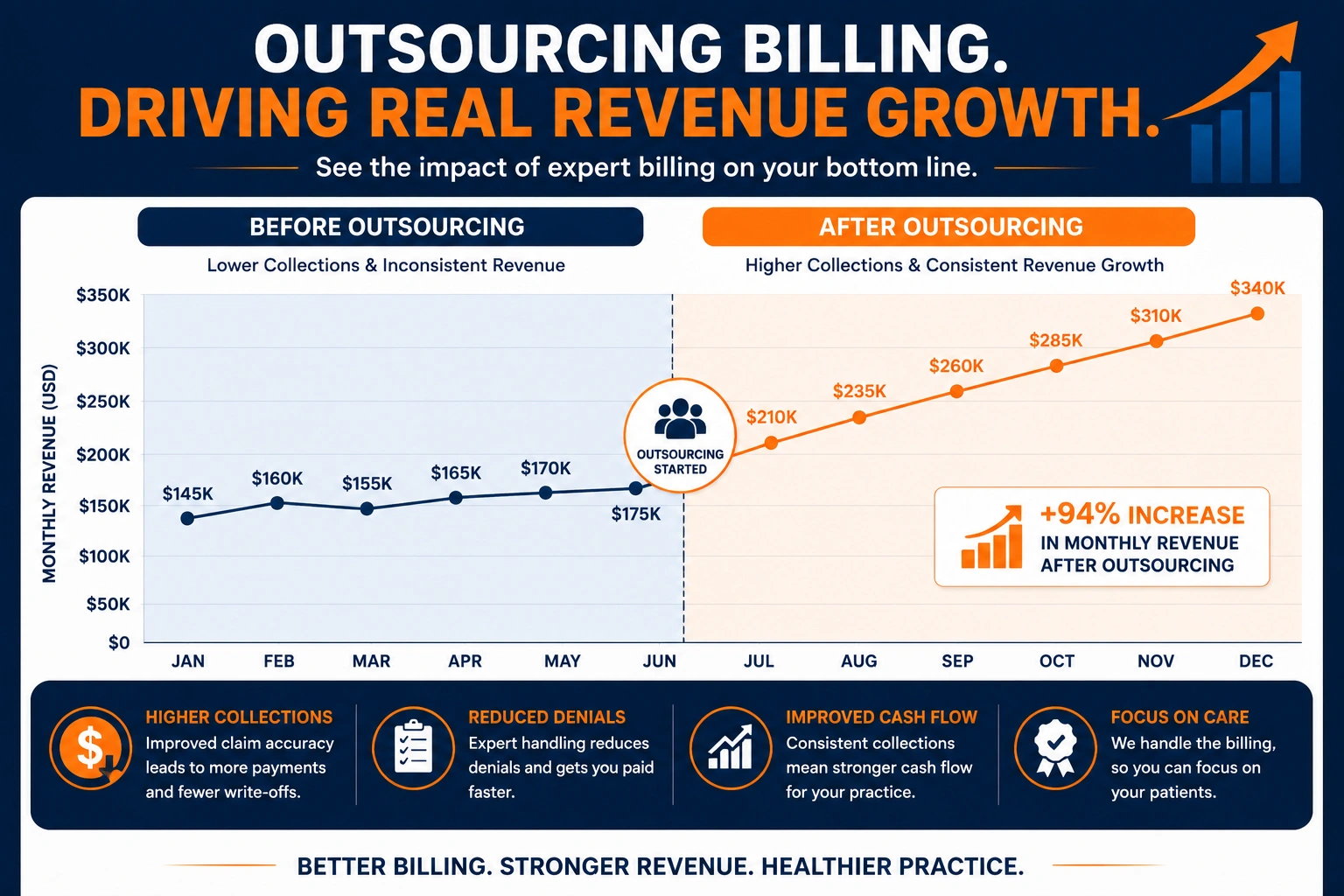
The long-term financial impact of your billing decisions is measurable — and substantial. Here’s what the data shows:
1. Fee range benchmarks: The industry average for percentage-based billing runs 5–9%, while top-performing outsourced services consistently deliver at 4–7% with demonstrably stronger collection outcomes, per benchmarks tracked by MGMA.
2. In-house vs. outsourced total annual cost: In-house billing for two FTEs costs $191,000–$304,000 annually in combined salaries, benefits, software, and overhead. Outsourcing the equivalent volume at 6% on $1.5M in collections costs $90,000 — a difference that regularly exceeds $100,000/year.
3. Clean claim rate benchmarks: In-house billing teams average a clean claim rate of 75–85% on first submission. Top outsourced billing partners achieve 95–98% consistently, according to MGMA industry standards. Every percentage point of improvement reduces rework costs and accelerates cash flow directly.
4. Revenue improvement after outsourcing: Practices switching to full-service outsourced billing typically see a 10–25% increase in collected revenue within the first 12 months — driven by higher clean claim rates, faster denial follow-up, and reduced write-offs, per CMS reimbursement analysis and independent billing performance studies.
5. Administrative hours recovered: Outsourcing recovers an average of 15–20 staff hours per week for a mid-sized practice. At $22/hour, that’s $17,000–$23,000 in annual labor recovered — time redirected to patient care, scheduling, and practice growth rather than billing administration. That’s the billing ROI case. For most practices, it’s compelling.
How UtreatiBill Prices Its Medical Billing Services
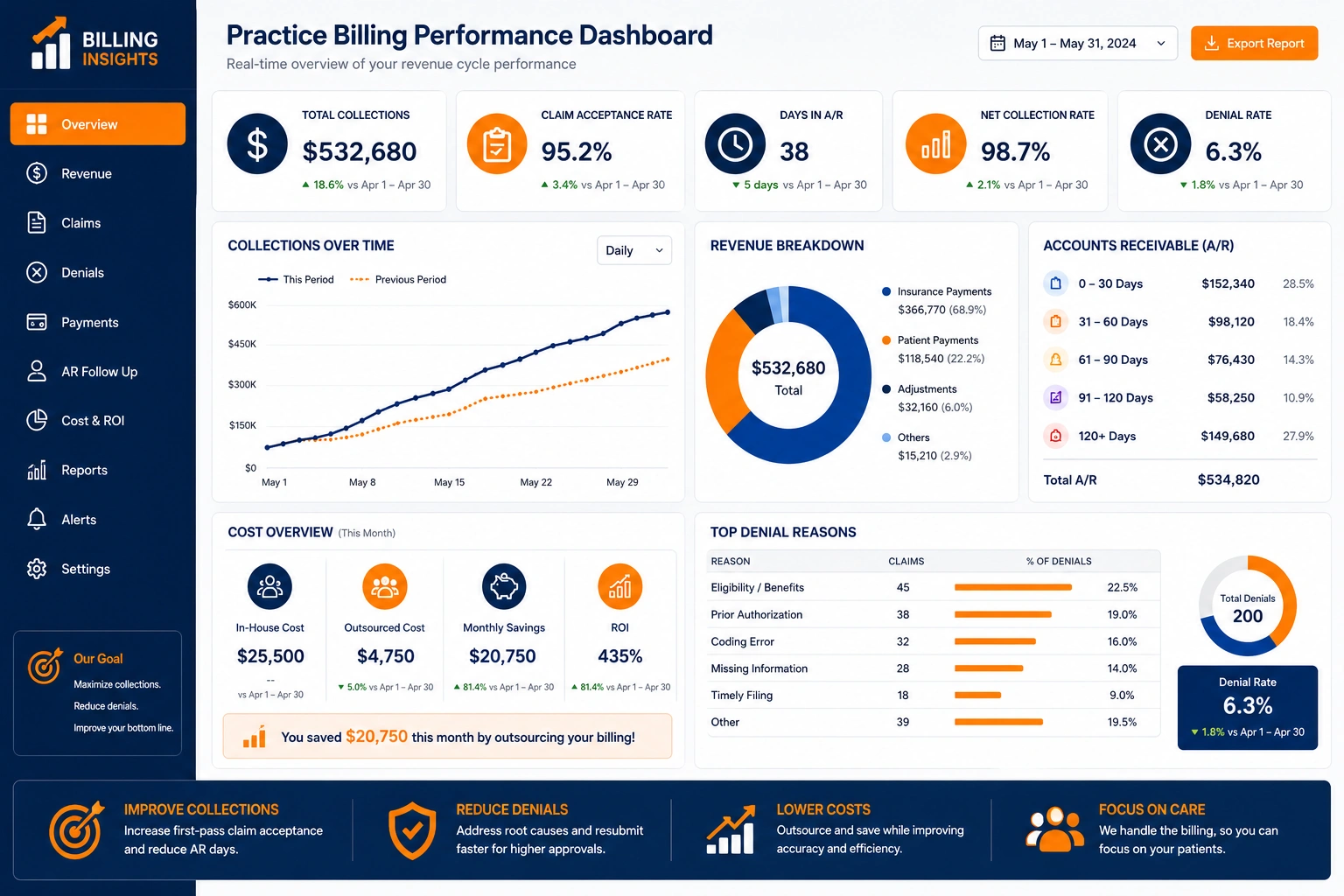
UtreatiBill’s full-service RCM pricing is transparent, performance-aligned, and tailored to your practice — not pulled from a generic rate schedule.
Our medical billing pricing models are primarily percentage-based, determined by:
- Your specialty and coding complexity
- Monthly claim volume and annual revenue
- Scope of services — billing-only vs. comprehensive revenue cycle management
- Credentialing and coding support requirements
No setup fees for standard EHR integrations. No hidden line items. Every client receives a dedicated account manager, real-time performance reporting, and a clear billing service contract before we begin.
We serve solo primary care physicians, orthopedic groups, and complex multi-specialty practices — every engagement priced to reflect your actual volume and needs.
Book a Free Consultation and get a customized rate and ROI projection based on your real revenue data — no obligation.
Key Takeaways
- Medical billing services cost ranges from 4–9% of collections, $3–$8/claim, or $500–$2,500/month depending on the pricing model
- In-house billing for a two-person team costs $191,000–$304,000 annually — far more than most practices initially project
- The in-house vs outsourced billing cost gap regularly exceeds $100,000/year when staffing, software, and overhead are fully included
- Top outsourced billing partners achieve a clean claim rate of 95–98% versus 75–85% for in-house teams
- The cost of outsourcing medical billing routinely pays for itself through revenue improvement, lower overhead, and recovered staff hours
- Specialty, payer mix, claim volume, and accounts receivable (A/R) days all shape your final billing cost
Final Thoughts
Medical billing services cost is not a fixed number — it’s a function of your specialty, volume, payer mix, and the quality of your billing partner. The right question isn’t “what does billing cost?” It’s “what is poor billing costing me?”
For most practices, outsourcing delivers stronger collections, lower total overhead, and more predictable cash flow than any in-house alternative. Is outsourcing medical billing worth the cost for your practice? The data says almost always — when you choose the right partner.
What is the average cost of medical billing services for your specialty? UtreatiBill will give you the answer in real numbers — with pricing that’s competitive, transparent, and tied to the outcomes your practice deserves.
Book a Free Consultation and receive a customized cost-benefit analysis — no obligation, no pressure, just clarity.