
How Dermatology Practices Lose Revenue Through Underbilling
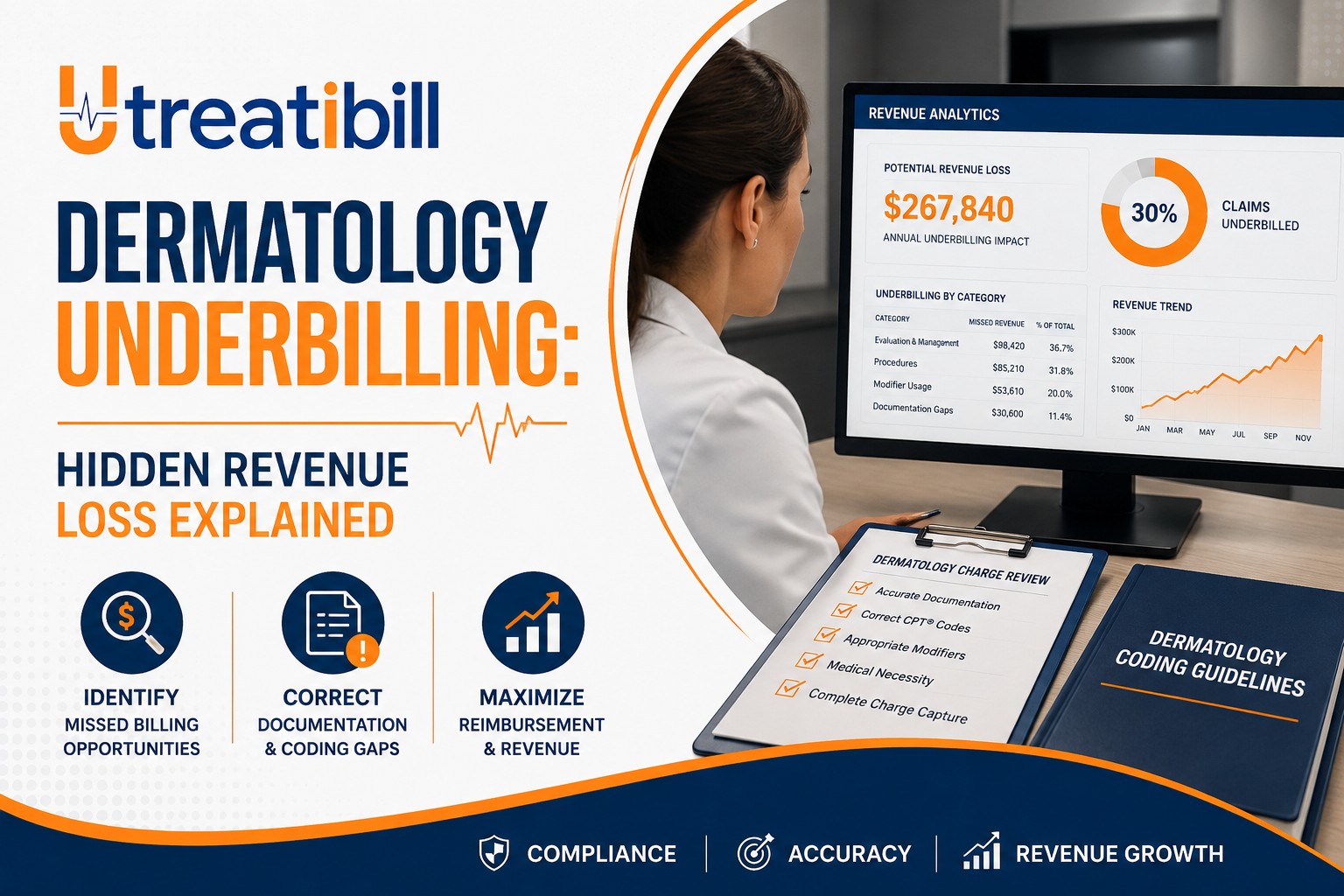
Every dermatology practice puts in the work — long patient days, complex procedures, detailed documentation. But there’s a persistent, largely invisible problem quietly draining revenue from practices across the country: dermatology underbilling. Unlike a denied claim that generates an alert and demands follow-up, underbilling leaves no footprint. The charge was either never submitted, coded too low, or missing a modifier. And because nothing visibly “breaks,” it’s easy to assume everything is fine — right up until a formal audit reveals otherwise.
At Utreatibill, our team of Dermatology Medical Billing Services specialists works with dermatology practices every day. We see the same revenue leakage patterns repeat across solo practitioners and multi-provider groups alike: procedures delivered but never billed, evaluation and management (E/M) visits coded a level too low, modifiers omitted that would have unlocked full reimbursement. The financial damage is real, it’s recurring, and it’s almost always preventable.
This guide walks you through exactly how dermatology underbilling happens, why it’s more widespread than most practices realize, and what you can do — starting today — to capture every dollar your clinical work earns.
What Is Dermatology Underbilling?
Dermatology underbilling occurs when a practice submits claims for less than it’s entitled to receive based on the services it actually delivered and documented. It’s not overbilling. It’s not fraud. It’s the quiet opposite: billing less than you earned.
Here’s a simple way to picture it. Your providers see patients, perform procedures, complete documentation — and then the billed amount simply doesn’t reflect the full scope of that work. The wrong CPT code gets selected. A second procedure isn’t captured on the charge sheet. A modifier is left off. The claim processes, the payment comes in, and everyone moves on — unaware that a portion of rightful revenue was never claimed at all.
This kind of medical billing inaccuracy is especially common in dermatology, a specialty with high procedure volumes, frequent same-day multi-service encounters, and CPT coding for dermatology that spans hundreds of procedure-specific codes. Biopsies, excisions, Mohs surgery, phototherapy, cryotherapy, dermoscopy — each carries its own coding rules, documentation requirements, and reimbursement nuances. When a practice doesn’t have specialty-specific billing expertise governing every claim, gaps are inevitable.
Dermatology underbilling is, in the most literal sense, leaving money on the table. But unlike a physical item you can see on a table, you often don’t even know it’s there.

Why Dermatology Underbilling Is More Common Than Most Practices Realize
Most practice managers and physicians assume their billing is reasonably accurate. After all, claims are being submitted, payments are coming in, and denials are being worked. What else could be going wrong? Quite a lot, it turns out — and the answer lies in what you’re not seeing.
The Difference Between Underbilling and Claim Denials
Claim denials are measurable. They show up in your accounts receivable, trigger work queues, and demand action. Your billing team knows about them because the system forces visibility.
Dermatology underbilling works in exactly the opposite way. When a provider bills CPT 99213 for a visit that genuinely meets 99214 criteria, no rejection notice appears. The payer processes the claim. A payment arrives. But your practice received $40–$60 less than it should have — and that scenario played out dozens or hundreds of times this month without anyone noticing.
This is the defining quality of underbilling: it doesn’t look like a problem. It looks like normal operations. That’s precisely why it persists.
Why Many Practices Never Notice Lost Revenue
Practices naturally measure what gets collected. What rarely gets measured is what should have been collected. Without benchmarking your claim reimbursement rates against payer fee schedules, comparing your E/M code distribution against specialty norms, or auditing charge capture completeness, there’s no baseline that reveals a shortfall.
Many practices also rely on providers to self-report billable services at the point of care. For straightforward office visits, this works reasonably well. But for ancillary services, add-on codes, and complex procedure encounters, a step missed in that manual process means a charge that never gets submitted — and a revenue gap that never gets flagged.
The Hidden Cost of Small Billing Errors
Individually, small billing errors feel minor. A missed $65 charge here. An undercoded visit worth $38 there. But small errors compound fast. A single omitted lesion destruction charge — at $65 per encounter, 10 times a week — adds up to $33,800 in annual revenue leakage in healthcare. One habitual level of E/M undercoding across 200 weekly patient encounters erodes six figures annually.
Dermatology billing mistakes don’t need to be dramatic to be devastating. They just need to be consistent.
The Biggest Causes of Dermatology Underbilling
Understanding where revenue gets lost is the foundation of preventing dermatology revenue loss. These are the most frequently occurring causes our billing specialists identify during practice audits.

Undercoded Evaluation and Management Services
E/M coding underwent significant updates in 2021 when the AMA revised its guidelines, shifting the framework from time and history-taking to medical decision-making complexity. Despite these changes — which were designed in part to make higher-level coding more achievable — many practices continue defaulting to conservative E/M codes. Providers choose 99212 or 99213 when documentation clearly supports 99214 or 99215, either out of habit, unfamiliarity with updated guidelines, or a cautious instinct that assumes a lower code is safer.
For a detailed breakdown of the updated coding framework, the AMA’s CPT and coding guidance provides the authoritative reference for accurate E/M selection. The reality is that when documentation supports a higher-level service, billing it correctly isn’t aggressive — it’s accurate.

Missed Procedure Charges
Dermatologists frequently perform multiple procedures in a single patient encounter. A provider might shave a seborrheic keratosis, perform a punch biopsy on a suspicious lesion, and apply liquid nitrogen to two actinic keratoses — all in one visit. If any of those procedures fails to make it onto the charge sheet, that revenue disappears entirely.
Missed charges in dermatology are especially common in high-volume practices where charge capture depends on manual processes: handwritten superbills, verbal reports to medical assistants, or end-of-day memory. Each of these creates opportunities for a billable service to fall through the cracks.
Incorrect Modifier Usage
Modifiers are two-digit additions to CPT codes that tell payers important information about how or when a service was delivered. Used correctly, they protect reimbursement. Used incorrectly — or left off entirely — they reduce payment or create denials.
In dermatology, common modifier errors include:
- Omitting Modifier 25 when a separately identifiable E/M service is performed on the same day as a procedure — this modifier is what allows both the visit and the procedure to be billed and reimbursed in the same encounter
- Missing Modifier 59 on distinct procedural services that are separately reportable but might otherwise appear bundled
- Failing to apply bilateral modifiers for treatments applied to multiple sites on both sides of the body
- Incorrect use of Modifier 51 on multiple procedure claims, affecting reimbursement sequencing
Each of these omissions carries a direct, quantifiable cost per claim.
Documentation Gaps
Medical billing accuracy lives or dies with documentation. If a clinical note doesn’t clearly support the level of service billed — or if required elements are missing — coders and billers face a choice: downcode the claim or risk a compliance issue. Most experienced billing teams choose the downcode. And while that’s the right compliance decision, it’s a revenue loss your practice absorbs every time it happens.
Dermatology procedures carry specific documentation requirements. Biopsy notes need the anatomical site, clinical indication, and technique. Excision records must include lesion measurements and the method of closure. E/M notes need to reflect the complexity of medical decision-making in sufficient detail. When those elements are vague, incomplete, or absent, revenue is lost — not through anyone’s negligence, but through preventable documentation habits.
Coding Errors in Dermatology Procedures
Dermatology coding errors range from selecting the wrong CPT code for a biopsy type to misapplying Mohs surgery staging codes or incorrectly combining primary and add-on codes. A shave biopsy, punch biopsy, and incisional biopsy are all coded differently. Mohs surgery reimbursement changes based on the number of stages and tissue sections. Excision codes are size-dependent and site-specific.
When dermatology coding errors occur — even with the best intentions — reimbursement drops, denials increase, or both. The cumulative effect on dermatology revenue loss over months and years is substantial.
Failure to Capture Ancillary Services
Ancillary services are frequently the most overlooked source of missed charges in dermatology. These are services delivered during an encounter that are separately billable but don’t always make it onto the claim:
- Dermoscopy (CPT 96931–96936) when used diagnostically
- Photodynamic therapy (PDT) services and associated supply charges
- Patch testing interpretation services
- Cryotherapy applied to multiple lesions beyond the first
- Wound care services performed following an excision
- Cosmetic consultations billed under appropriate codes when applicable
When these ancillary services aren’t captured, the revenue from them simply doesn’t exist in your practice’s financials — even though the clinical work was completed and documented.
How Dermatology Practices Lose Thousands Through Revenue Leakage
Hypothetical examples put real numbers on how dermatology underbilling compounds over time.
Example 1 — Missed Procedure Billing
A mid-size dermatology practice performs approximately 18 cryotherapy treatments per week across two providers. Due to inconsistencies in the charge capture process — primarily reliance on handwritten charge slips — roughly 3 of those 18 are never submitted for billing each week. At an average Medicare reimbursement of $58 per cryotherapy session, that’s $174 in missed charges weekly, totaling approximately $8,700 annually from one overlooked procedure type alone. Add similar gaps across two or three other procedure categories, and the annual revenue leakage easily exceeds $25,000.
Example 2 — Underreported E/M Services
A busy solo dermatologist sees 35 patients per day. An external billing audit reveals that approximately 22% of visits — roughly 8 encounters per day — are coded at 99213 when the documented medical decision-making complexity supports 99214. The average reimbursement difference under the Medicare Physician Fee Schedule is approximately $37. That’s $296 per day in uncaptured E/M revenue, or nearly $73,000 per year from E/M undercoding alone.
This is one of the most impactful common underbilling mistakes in dermatology practices — and one of the easiest to miss without an active audit program.
Example 3 — Incorrect Coding Combinations
A Mohs surgery center performs three to four complex cases per week, each requiring primary closure or multi-layer repair. When the repair codes aren’t appended to the Mohs codes — or when a simpler repair code is selected instead of the appropriate layered closure code — the practice forfeits $200–$500 per case in reimbursement. Over 50 cases annually, that represents $10,000 to $25,000 in revenue the practice earned but didn’t collect.
How to Identify Dermatology Underbilling in Your Practice
Learning how to identify dermatology underbilling issues starts with knowing where to look and what signals to take seriously.

Key Warning Signs
These practice-level patterns deserve immediate attention:
- Skewed E/M distribution toward lower codes — If 75% or more of your E/M codes are 99212 or 99213 for a practice with complex patient populations, undercoding is likely
- Revenue flat despite growing patient volume — When visits increase but revenue doesn’t track proportionally, missed charges or undercoding are almost certainly at play
- Low average revenue per procedure type — Compare your collected payment per CPT code against the published Medicare Physician Fee Schedule and your contracted payer rates
- Claims consistently carrying only one billable service — If your claims rarely include more than one CPT code per encounter, ancillary services are probably being missed
- High charge lag — When the time between service delivery and claim submission routinely exceeds 48 hours, charge capture accuracy typically suffers
Revenue Cycle Metrics to Monitor
Effective dermatology revenue cycle management means monitoring the right metrics with regularity. Per benchmarking data published by MGMA, comparing your practice performance against specialty-specific and regional peers is one of the clearest ways to surface dermatology billing performance gaps.
Track these metrics monthly:
- Average net collection rate for dermatology by payer and procedure type
- E/M code distribution across providers
- Average revenue per patient encounter
- Denial rate by CPT code
- Charge lag (service date to submission date)
- Ancillary service billing rate per encounter type
Conducting Billing Audits
Coding and billing audits are the most direct tool for identifying undercoded dermatology claims. A properly conducted audit reviews a random sample of 25–50 claims per provider and compares the billed code against the documented service. The goal is to identify patterns — not to assign blame — so corrections can be implemented systematically.
Effective audits examine:
- E/M code accuracy against documentation
- Procedure code appropriateness for the service performed
- Modifier presence, sequencing, and accuracy
- Charge capture completeness for all services in the encounter
- Documentation sufficiency for the level of service billed
For coding compliance and documentation standards, the CMS guidelines on medical billing and claim submission provide the foundational framework that should anchor your audit methodology. Practices should conduct internal audits quarterly and engage external coding and billing audits at least once per year.
Strategies to Prevent Dermatology Underbilling
Preventing revenue loss in dermatology billing requires a proactive, ongoing commitment — not a one-time fix. Here are the strategies that make the most meaningful impact.

Strengthen Charge Capture
Your charge capture process is the first line of defense. Every billable service must be identified, documented, and submitted. Practical steps include:
- Implementing structured EHR templates or encounter forms that prompt providers to capture all services — including ancillary items commonly missed
- Training clinical and administrative staff to recognize billable ancillary services during the encounter
- Reconciling end-of-day charge sheets against the schedule to ensure no encounters — or services within those encounters — are missing
Improve Documentation
Dermatology reimbursement optimization begins with clinical documentation. The chart needs to support whatever is billed — not because auditors are watching, but because accurate documentation of accurate care is both the right thing and the profitable thing. Effective practices:
- Use structured note templates for common procedures that include all required billing elements as default fields
- Create feedback loops from billing coders back to clinical staff when documentation gaps force a downcode
- Conduct provider education sessions focused on the documentation requirements for the most frequently billed services
Conduct Coding Reviews
Regular, lightweight coding reviews catch systematic errors before they become ingrained habits. A monthly sample review of 10–15 claims per provider gives billing teams and physicians actionable data without requiring a full audit. Even identifying one recurring pattern — say, a provider consistently omitting Modifier 25 — can recover thousands in previously lost reimbursement.
Use Certified Dermatology Coders
Dermatology billing mistakes are significantly more likely when claims are coded by generalist billers unfamiliar with specialty-specific rules. Dermatology is not general medicine billing. Certified coders with hands-on dermatology experience understand Mohs surgery staging, excision size-based code selection, modifier logic in multi-procedure encounters, and the nuances of correctly pairing primary and add-on codes. That expertise directly translates into higher claim accuracy and better reimbursement rates.
Invest in Revenue Cycle Oversight
Dermatology revenue cycle management requires designated ownership. Whether that’s an in-house billing manager, a physician champion who reviews monthly metrics, or a specialized outsourced billing partner — someone must be responsible for monitoring performance, catching negative trends early, and driving continuous improvement. Practices that treat billing as a passive administrative function consistently leave more revenue uncaptured than those that approach it as a strategic priority.
How Outsourced Dermatology Billing Helps Recover Lost Revenue
For many practices, outsourcing billing to a specialty-focused team is the most effective and efficient solution to endemic underbilling.
Revenue Audits
Experienced dermatology billing specialists can conduct the kind of thorough, pattern-based revenue audits that internal teams — stretched by daily operational demands — rarely have bandwidth to perform. These audits quantify revenue leakage, identify the specific dermatology coding errors driving it, and produce a prioritized action plan for recovery.
Coding Accuracy Improvements
Outsourced coders who work exclusively in dermatology bring a different level of scrutiny to every claim. They know when a biopsy type warrants a different CPT code. They catch missing add-on codes. They recognize when documentation supports a higher E/M level and flag it appropriately. The result is systematic improvement in medical billing accuracy — not as a project, but as a standard operating condition.
Reimbursement Optimization
Dermatology reimbursement optimization isn’t a single initiative — it’s an ongoing discipline. A specialized billing partner maintains current payer contract knowledge, monitors fee schedule changes, and ensures your charge master reflects every billable service your practice delivers. That sustained, expert attention is what closes the gap between what practices earn and what they collect.
To see how our team approaches this for dermatology practices, explore our Dermatology Billing and Revenue Cycle Services.
How UtreatiBill Helps Dermatology Practices Maximize Revenue
At Utreatibill, our billing and coding team focuses entirely on dermatology practices. We understand that this specialty has unique billing demands — and that generic billing solutions consistently fall short.
Our process starts with a comprehensive billing audit to surface undercoded dermatology claims, missed charges, modifier gaps, and documentation patterns that are costing your practice revenue. From there, we implement certified coder review, structured charge capture tools, and ongoing performance monitoring to ensure your practice captures every dollar it has earned.
We work as an integrated extension of your team — not a remote vendor. That means transparent monthly reporting, clear communication, and billing strategies tailored to your actual workflow, patient population, and payer mix. Whether you’re a solo dermatologist navigating complex payer contracts or a multi-site practice group managing high claim volumes, our dermatology billing expertise is built for exactly your situation.

Final Thoughts
Dermatology underbilling doesn’t announce itself. It doesn’t trigger alarms or show up on a denial report. It simply erodes your revenue — quietly, methodically, claim after claim — until the cumulative loss is significant enough to wonder where it all went.
The good news is that it’s both detectable and fixable. The practices that protect their revenue aren’t necessarily doing anything complicated. They’re auditing regularly, using coders with genuine dermatology expertise, capturing every charge from every encounter, and treating billing accuracy as a strategic priority rather than a background administrative function.
If you’re not certain how much revenue your practice may be missing right now, that’s exactly where an objective billing review can help. Our team at Utreatibill offers a free billing audit designed to surface underbilling patterns, coding gaps, and charge capture weaknesses in your current workflow — with clear, actionable findings and no obligation to proceed.
You’ve delivered the care and earned the revenue. The next step is making sure your billing reflects it. Reach out to our Dermatology Billing and Coding Support team today to schedule your free audit and start capturing every dollar your practice has earned.