
Can Hyperbaric Oxygen Therapy Help Veterans With PTSD?
For many veterans returning from combat, the wounds hardest to treat are the ones you cannot see. Post-traumatic stress disorder affects hundreds of thousands of military veterans across the United States — trapping them in cycles of hypervigilance, nightmares, emotional numbness, and debilitating anxiety. Standard treatments help many, but not all. That gap is driving serious clinical interest in hyperbaric oxygen therapy for PTSD as a neurologically grounded, research-supported option for veterans who have not found relief through conventional care.
At UtreatiBill, we partner with hyperbaric therapy clinics every day through our Hyperbaric Oxygen Therapy Billing Services. We see firsthand how practices are expanding into veteran mental health care — and how billing complexity can quietly undermine even the most compassionate, well-run programs. This article covers what the science shows, how HBOT affects the brain, and exactly what your practice needs to know to bill these services accurately and sustainably.
What Is Hyperbaric Oxygen Therapy for PTSD?
Quick Answer: Hyperbaric oxygen therapy for PTSD is a treatment in which patients breathe 100% pure oxygen inside a pressurized chamber, typically at 1.5 to 3 times normal atmospheric pressure. This process increases oxygen delivery to the brain, promotes neurological healing, reduces neuroinflammation, and may help reverse trauma-related brain changes — particularly in veterans who also have traumatic brain injury.
Understanding PTSD in Veterans: The Scale of the Problem
PTSD is not a new diagnosis, but its burden on the veteran community remains staggering. The Department of Veterans Affairs estimates that PTSD affects between 11% and 20% of veterans who served in Operations Iraqi Freedom and Enduring Freedom — and up to 30% of Vietnam-era veterans. Those numbers translate into hundreds of thousands of individuals whose daily lives are disrupted by psychological wounds that conventional medicine has not fully solved.
What makes veteran PTSD particularly difficult to treat is that it frequently co-occurs with traumatic brain injury. TBI, especially blast-related TBI from the wars in Iraq and Afghanistan, shares overlapping symptoms with PTSD and compounds its neurological impact. This intersection is one of the primary reasons that alternative PTSD therapies — and HBOT specifically — are drawing serious research attention.
How PTSD Affects the Brain and Body
PTSD is not simply a psychological response to trauma. Neuroimaging research has shown that trauma physically changes brain structure and function. The amygdala — the brain’s threat-detection center — becomes chronically hyperactive. The prefrontal cortex, responsible for emotional regulation and rational thought, shows reduced activity and volume. The hippocampus, critical for memory and contextual learning, often shrinks measurably in people with long-term PTSD.
The physiological effects extend beyond the brain. Chronic PTSD dysregulates the hypothalamic-pituitary-adrenal axis, elevates systemic inflammation, and alters immune function. Veterans living with untreated PTSD carry elevated risks for cardiovascular disease, metabolic disorders, substance use, and suicide. This is a whole-body condition — and treating it requires more than talk therapy alone.
Why Conventional PTSD Treatments Fall Short for Many Veterans
The current standard of care for PTSD includes cognitive processing therapy, prolonged exposure therapy, and pharmacological interventions such as SSRIs. These are evidence-based approaches that produce meaningful improvement for many veterans. But not for all.
Research suggests that between 40% and 60% of veterans with PTSD do not achieve full remission with first-line treatments. Dropout rates from trauma-focused therapies are high — many veterans find re-engaging with traumatic memories intolerable. Medications carry side effects that affect quality of life, adherence, and long-term compliance. For veterans whose PTSD is entangled with neurological TBI damage, psychological therapies alone may be insufficient. The treatment gap is real, and it is exactly why veteran PTSD therapy options like HBOT are receiving growing clinical attention.
How Hyperbaric Oxygen Therapy for PTSD Works
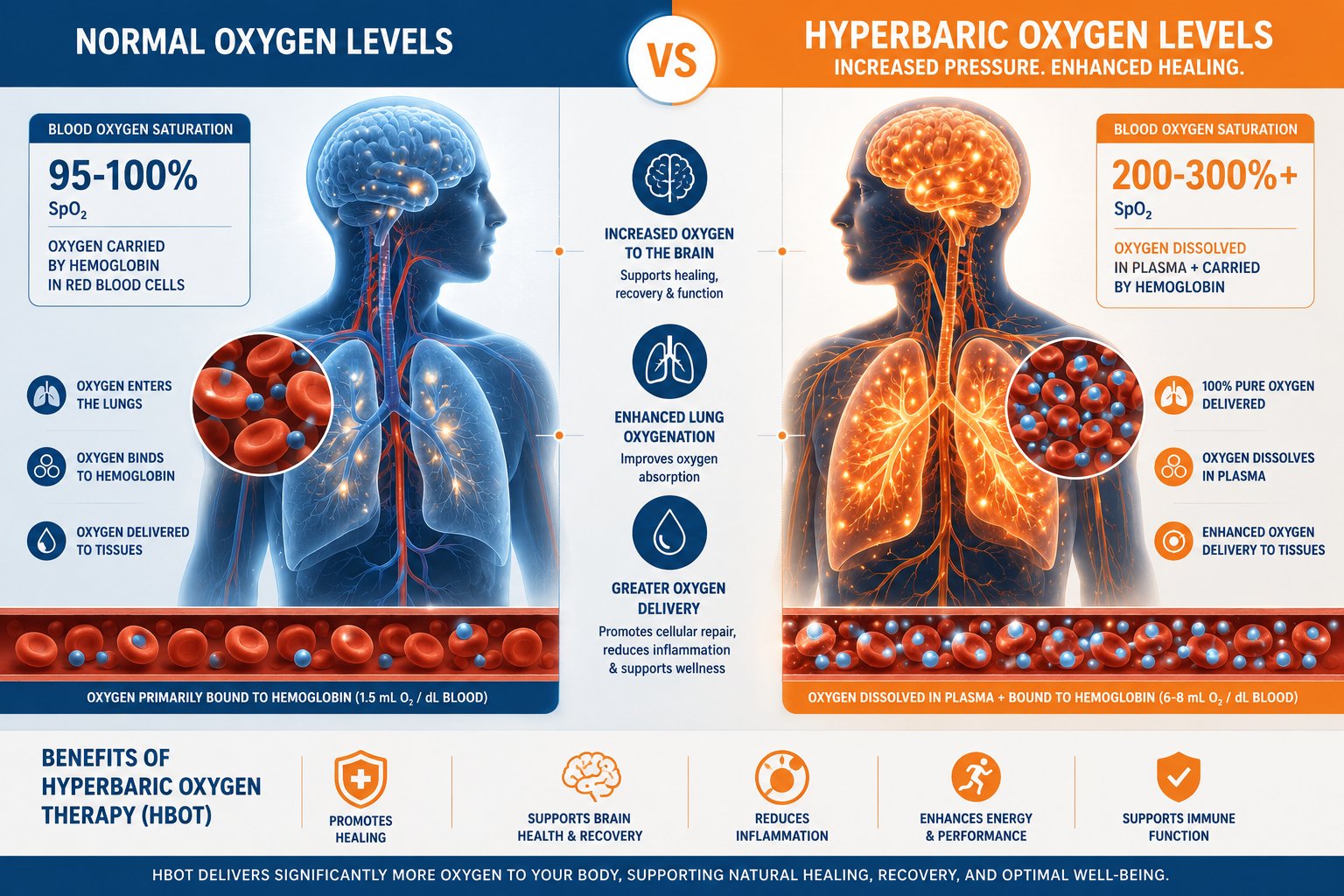
The mechanism behind HBOT is scientifically grounded. When a patient enters a pressurized hyperbaric chamber and breathes 100% oxygen, that oxygen dissolves directly into the plasma, cerebrospinal fluid, and tissue fluids — bypassing the hemoglobin-dependent delivery system that limits normal oxygen transport. This oxygen-saturated environment triggers a set of physiological responses with direct relevance to PTSD and TBI.
How HBOT Works on the Brain
At the cellular level, hyperbaric oxygen therapy stimulates angiogenesis — the formation of new blood vessels that restore perfusion to damaged brain tissue. It promotes neuroplasticity by activating growth pathways that support synaptic repair and reorganization. It supports mitochondrial function in neurons stressed by trauma, ischemia, or chronic inflammation. And it upregulates neurotrophic factors — including brain-derived neurotrophic factor (BDNF) — that encourage neuronal survival, growth, and connectivity.
Elevated BDNF levels are associated with improved memory, mood regulation, and cognitive function, all of which are commonly impaired in veterans with PTSD. The neurological case for hyperbaric oxygen therapy in PTSD treatment is not speculative — it is rooted in established mechanisms of oxygen physiology and brain repair.
HBOT and Neuroinflammation in PTSD
One of the most important targets of HBOT in PTSD treatment is neuroinflammation. Chronic PTSD is associated with persistent inflammatory signaling in the brain, driven by activated microglia and elevated pro-inflammatory cytokines including IL-6, TNF-alpha, and IL-1beta. This inflammatory state contributes to the cognitive impairment, emotional dysregulation, sleep disruption, and hyperarousal that define the disorder.
Hyperbaric oxygen therapy has demonstrated consistent anti-inflammatory effects across multiple organ systems, and peer-reviewed research supports these effects in neural tissue specifically. By addressing the neuroinflammatory substrate of PTSD, HBOT targets root causes — not just surface symptoms.
The Connection Between Traumatic Brain Injury and PTSD
For a large subset of veterans, PTSD and TBI are neurologically inseparable. Blast-related TBI, one of the signature injuries of the post-9/11 wars, is frequently accompanied by PTSD — and the neurological damage from TBI can make conventional PTSD therapies harder to tolerate and less effective. The cognitive impairment, headaches, and emotional dysregulation from TBI compound every dimension of PTSD.
HBOT has a growing evidence base in TBI recovery. The same mechanisms that support oxygen therapy and brain healing in TBI — angiogenesis, neuroplasticity, BDNF upregulation, and inflammation control — apply directly to the PTSD symptom profile. For veterans navigating both conditions simultaneously, HBOT represents a treatment approach with genuine dual-action potential.
What the Research Says About Hyperbaric Oxygen Therapy for PTSD
The Research Behind Hyperbaric Oxygen Therapy for PTSD
The statistics surrounding veteran mental health underscore the urgency of expanded treatment options:
- Approximately 20 veterans die by suicide each day in the United States, and PTSD is a major contributing factor.
- Up to 30% of veterans who served in major combat operations develop PTSD at some point in their lives, according to the U.S. Department of Veterans Affairs.
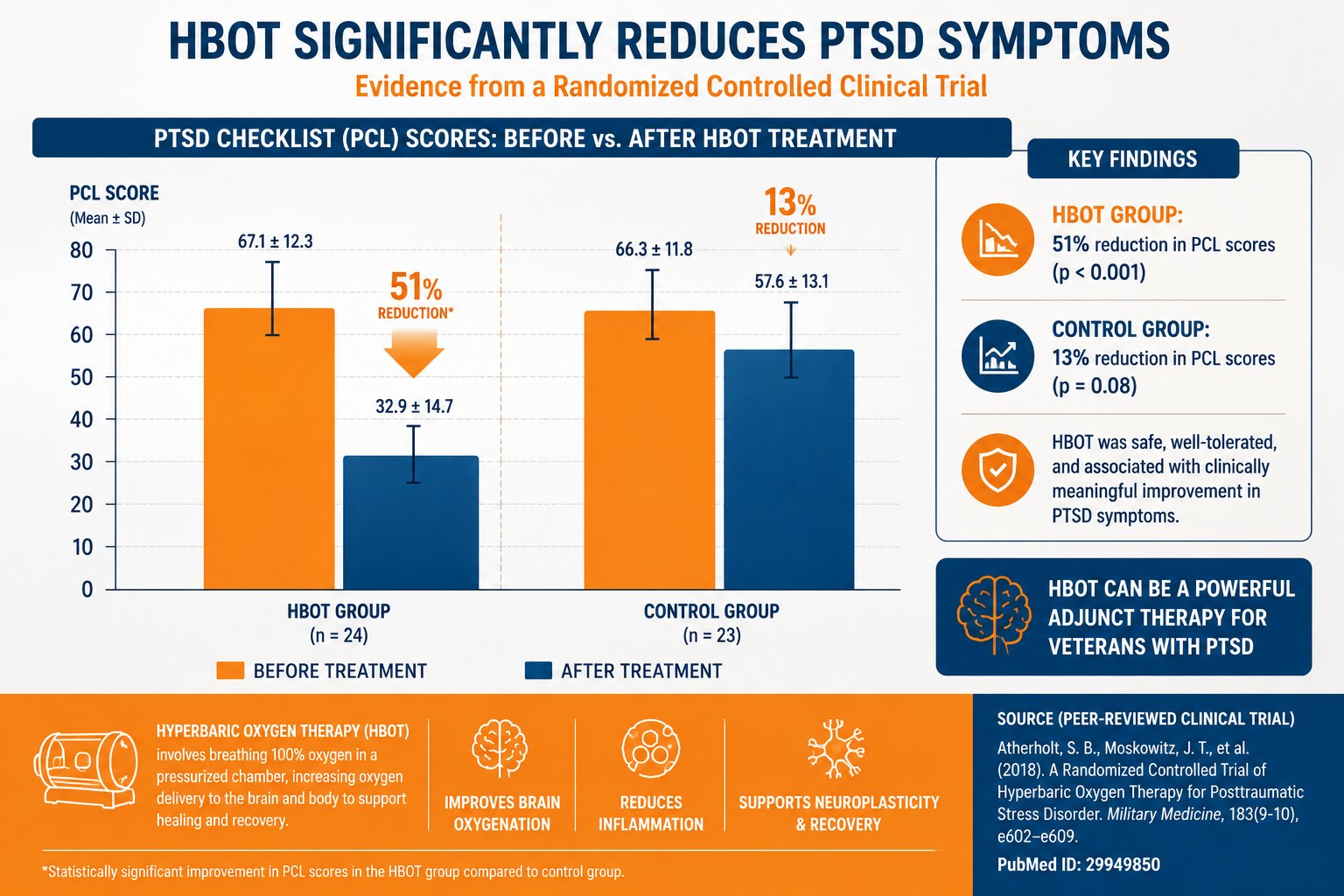
- A landmark randomized controlled trial (Boussi-Gross et al., 2013, published in PLOS ONE) found that HBOT produced significant improvements in both PTSD symptom severity scores and measurable brain function in veterans with chronic TBI and PTSD — including increases in cerebral blood flow captured by neuroimaging.
- A 2022 randomized controlled trial (Tal et al., PLOS ONE) demonstrated that HBOT significantly reduced hyperarousal and re-experiencing symptoms compared to control conditions, as documented in studies accessible through the NIH National Library of Medicine (PubMed).
- Neuroimaging studies have documented measurable improvements in cerebral metabolic activity following HBOT in veterans with chronic PTSD and TBI — evidence that treatment is producing biological change, not just patient-reported outcomes.
- Less than half of veterans with PTSD achieve full remission through VA-covered first-line treatments, creating a substantial underserved population actively seeking alternatives.
- HBOT clinical trials at institutions including the Sagol Center for Hyperbaric Medicine and Research have produced results significant enough to prompt serious reconsideration of PTSD treatment protocols in military medicine.
These figures are not just clinically meaningful — they represent a clear market signal. Veterans are actively seeking HBOT mental health benefits, and demand for qualified, credentialed hyperbaric providers is accelerating.
Key Clinical Trials and Study Findings
The most methodologically rigorous HBOT clinical trials for PTSD to date have emerged from Israel’s Sagol Center, where researchers conducted double-blind randomized trials comparing high-pressure HBOT to sham treatment in veterans with chronic PTSD and TBI. Participants receiving genuine HBOT showed statistically significant improvements in PTSD Checklist scores, quality-of-life metrics, and brain imaging markers of metabolic activity. These are peer-reviewed findings, published in respected journals, and reproducible across research cohorts.
In the United States, the VA has funded and participated in investigational trials exploring HBOT for TBI — a closely related condition with overlapping mechanisms. As additional HBOT clinical trials reach publication, the evidence base for this treatment in veteran populations continues to strengthen. The scientific momentum is real.
HBOT vs. Traditional PTSD Therapies: A Comparison
Mechanism:
- Cognitive Processing Therapy: Cognitive restructuring of trauma-related beliefs
- SSRIs: Serotonin modulation in the limbic system
- Hyperbaric Oxygen Therapy: Neuroplasticity, angiogenesis, BDNF upregulation, anti-inflammation
Response Rate:
- Cognitive Processing Therapy: Approximately 50–60%
- SSRIs: Approximately 40–60%
- Hyperbaric Oxygen Therapy: Emerging evidence — significant improvement in RCT participants
Side Effect Profile:
- Cognitive Processing Therapy: Emotional distress during trauma processing
- SSRIs: Weight gain, sexual dysfunction, insomnia, discontinuation syndrome
- Hyperbaric Oxygen Therapy: Temporary ear pressure, rarely oxygen toxicity
TBI Co-Treatment Capacity:
- Cognitive Processing Therapy: Limited — does not address underlying neurological damage
- SSRIs: Limited — symptom management only
- Hyperbaric Oxygen Therapy: Directly targets TBI-related neurological injury
Insurance Coverage:
- Cognitive Processing Therapy: Widely covered
- SSRIs: Widely covered
- Hyperbaric Oxygen Therapy: Variable — primarily off-label for PTSD
Limitations and What We Still Need to Learn
Clinical honesty matters — both for your patients and for your practice’s compliance posture. HBOT for PTSD remains off-label in the United States. The FDA has not approved HBOT specifically for PTSD or TBI. Most published studies, while methodologically sound, involve relatively small sample sizes and limited follow-up periods. Optimal treatment protocols — the right number of sessions, pressure parameters, and session duration for maximum benefit — are still being refined through ongoing HBOT clinical trials.
None of this diminishes the treatment’s promise. It means your practice must document carefully, code accurately, and counsel patients with transparency about what the evidence does and does not yet confirm.
The Financial Impact of Billing Hyperbaric Oxygen Therapy for PTSD
Clinical outcomes depend on billing accuracy. Even the best HBOT program can lose significant revenue if coding, documentation, and charge capture processes are not rigorously managed. These are three real scenarios we encounter regularly in our work with hyperbaric therapy practices.
Example 1 — Lost Reimbursement From Incorrect HBOT Coding
A mid-sized hyperbaric clinic begins offering HBOT to veterans under an investigational protocol. The billing team continues using CPT code 99183 (physician attendance during HBOT) without correctly separating the physician professional component from facility billing codes. Payers process only a fraction of eligible reimbursement. Over twelve months, the practice loses tens of thousands of dollars — not from coverage denials, but from coding errors that systematically undervalue every session.

Example 2 — Missed Charges in Multi-Session HBOT Treatment Plans
Veterans undergoing HBOT for PTSD typically require 40 or more sessions over an 8-week treatment course. When charge capture is handled manually or when session logs are incomplete, individual sessions slip through. A practice serving 20 veteran patients through a 40-session protocol has 800 billable sessions per cohort. Losing just 5% of those through incomplete charge capture means 40 missed reimbursements — each potentially valued between $150 and $400. That is $6,000 to $16,000 in recoverable revenue gone from a single patient cohort.
Example 3 — Coverage Denials From Poor HBOT Documentation
Payers reviewing HBOT claims for PTSD scrutinize medical necessity documentation closely — especially for off-label indications. If physicians are not documenting specific diagnoses with accurate ICD-10 codes, prior treatment history, session-by-session progress notes, and clear clinical rationale for HBOT, claims will be denied. Recouping those denials through appeals takes time, staff resources, and administrative bandwidth that most practices cannot absorb.
Is Hyperbaric Oxygen Therapy for PTSD Covered by Insurance?
This is the question veterans and their families ask most frequently — and the one that most directly shapes your practice’s financial planning. The honest answer: it depends, and your billing team needs to understand the nuances precisely.
VA Coverage and HBOT
The U.S. Department of Veterans Affairs does not currently include HBOT among its covered PTSD treatments under standard benefit guidelines. VA clinical practice guidelines for PTSD do not list HBOT as an approved or recommended intervention. However, the VA has funded investigational trials studying HBOT for TBI and PTSD, and some VA medical centers participate in research protocols that give veterans access to HBOT outside standard coverage. VA community care programs may offer additional pathways for some veterans. Your practice should be positioned to counsel veterans on exactly what the VA does and does not currently cover, and what alternative funding options may exist.
Medicare and Insurance Reimbursement for HBOT
The Centers for Medicare and Medicaid Services covers HBOT for 14 specific approved conditions — primarily wound-care diagnoses including diabetic foot ulcers, osteomyelitis, wound dehiscence, and decompression sickness, as outlined in the CMS National Coverage Determination for HBOT. PTSD and TBI are not included in this approved list. Standard HBOT Medicare coverage for PTSD-related claims is therefore not available under current policy.
Commercial payers vary significantly. Some have developed coverage policies for HBOT that extend to TBI under specific circumstances, and a small number of plans may review PTSD-related HBOT claims on a case-by-case basis. Navigating this landscape requires up-to-date knowledge of individual payer policies — knowledge most generalist billing teams do not maintain.
Navigating Off-Label HBOT Coverage Challenges
Off-label HBOT billing is one of the most technically demanding areas in hyperbaric therapy reimbursement. Your billing team must understand each payer’s specific medical policy for HBOT, know how to write clinically compelling appeal letters supported by peer-reviewed research, and manage the full cycle of prior authorization, submission, denial, and appeal with precision. This is where specialized expertise separates practices that recover revenue from those that absorb losses.
How to Identify HBOT Billing and Reimbursement Issues in Your Practice
Key Warning Signs
If your practice is experiencing any of the following, your HBOT revenue cycle likely has significant gaps:
- Claim denial rates exceeding 10% for hyperbaric sessions
- Frequent requests for additional documentation from payers
- Accounts receivable aging beyond 60 days on HBOT claims
- Inconsistent charge capture across providers or shifts
- Billing staff without verified HBOT coding experience
- Missing or incomplete physician attestation records
- Patients receiving HBOT without verified insurance eligibility
Revenue Cycle Metrics to Monitor for HBOT Services
Your practice should track these performance indicators specifically for hyperbaric claims — not buried inside aggregate billing data:
- First-pass claim acceptance rate for HBOT (target: 95%+)
- Days in accounts receivable for hyperbaric services (target: under 35 days)
- Denial rate by payer and denial category
- Appeals success rate for off-label HBOT claims
- Net collection rate per hyperbaric session
Conducting HBOT Billing Audits
A focused billing audit of your HBOT services should review a representative sample of claims across a 90-day window, examining coding accuracy, documentation completeness, charge capture consistency, and payer payment patterns against contracted rates. Our team regularly identifies 8% to 15% in recoverable revenue during initial audits of hyperbaric programs that have never been formally reviewed. These audits pay for themselves — and then some.
Strategies to Maximize Hyperbaric Oxygen Therapy for PTSD Reimbursements
Strengthen Charge Capture for HBOT Sessions
Every session must be captured and billed without exception. In busy hyperbaric departments managing veterans across multi-week treatment protocols, manual charge capture systems fail — regularly. Implement automated session tracking tied directly to your EHR, and run daily reconciliation between treatment logs and billing records. A missed session is revenue your practice will not recover.
Improve Documentation for PTSD-Related HBOT Claims
Documentation is the foundation of every successful HBOT claim — and the primary target when payers look for denial justification. For each patient and each session, your clinical team must record:
- The specific diagnoses being treated with accurate ICD-10 codes
- The clinical rationale connecting HBOT to the patient’s documented condition
- A history of prior treatments attempted and their outcomes
- Session-by-session progress notes reflecting clinical response
- Physician attestation for each hyperbaric session attended
This documentation serves both billing and compliance — and it demonstrates the medical necessity that payers require before reimbursing off-label therapies.
Use Certified HBOT Coders
Hyperbaric billing requires specialized knowledge that most generalist coders do not have. CPT code 99183, the facility-side HBOT codes, applicable modifiers, and bundling rules all carry specific conditions that, when misapplied, result in systematic underpayment or denial. Certified hyperbaric coders reduce your denial rate, protect your practice from audit exposure, and consistently outperform generalist billing staff on HBOT-specific claims.
Understand Payer-Specific HBOT Policies
No two payers handle HBOT the same way. Your billing team should maintain a living payer matrix documenting each commercial payer’s covered HBOT indications, prior authorization requirements, session limits, documentation standards, and appeal procedures. For practices serving veterans, this matrix must also address VA community care billing requirements — a distinct and often misunderstood billing environment.
How Outsourced HBOT Billing Helps Practices Recover Lost Revenue
Managing HBOT billing in-house stretches most administrative teams beyond their expertise. The specialized knowledge required — across coding, payer policy, documentation standards, and appeals — is simply not feasible to develop and maintain internally without dedicated investment. Outsourcing to a specialized billing partner delivers three compounding advantages.
Revenue Audits
A comprehensive revenue audit identifies every place your practice has left money behind — missed charges, undercoding, denied claims that were never appealed, and payment variances against contracted rates. These audits establish the financial baseline from which recovery strategies are built, and they frequently reveal patterns that in-house teams have missed for months or years.
Coding Accuracy Improvements
Specialized HBOT billing partners bring certified coders with verified hyperbaric-specific expertise. The reduction in denial rates from improved coding accuracy reduces your administrative burden and accelerates cash flow — making the billing operation a revenue-generating function rather than a cost center.
Reimbursement Optimization for Hyperbaric Services
Beyond coding, expert billing partners optimize every stage of the revenue cycle — from pre-service eligibility verification and prior authorization management to payer contract analysis and reimbursement benchmarking. For hyperbaric therapy reimbursement, this integrated approach consistently recovers more revenue than in-house billing for practices without dedicated HBOT expertise on staff.
How UtreatiBill Helps Practices Offering Hyperbaric Oxygen Therapy for PTSD
At UtreatiBill, we specialize in the billing complexities that define hyperbaric therapy programs — including practices treating veterans with PTSD and TBI. Our team includes certified coders with HBOT-specific credentials, revenue cycle specialists who understand payer policies across commercial, Medicare, and VA community care channels, and billing auditors who know precisely where hyperbaric practices lose revenue.
We offer full-service HBOT Billing and Coding Services — encompassing claims submission, denial management, appeals, documentation review, and reporting. Our hyperbaric clients consistently achieve higher first-pass acceptance rates and lower accounts receivable aging compared to their pre-engagement benchmarks. The result is more revenue, less administrative friction, and more capacity to focus on the veterans in your care.
Our billing services are purpose-built for hyperbaric practices — not adapted from a generalist billing operation. In HBOT billing, that distinction matters.
Is Your Practice Ready to Offer Hyperbaric Oxygen Therapy for PTSD? A Billing Readiness Checklist
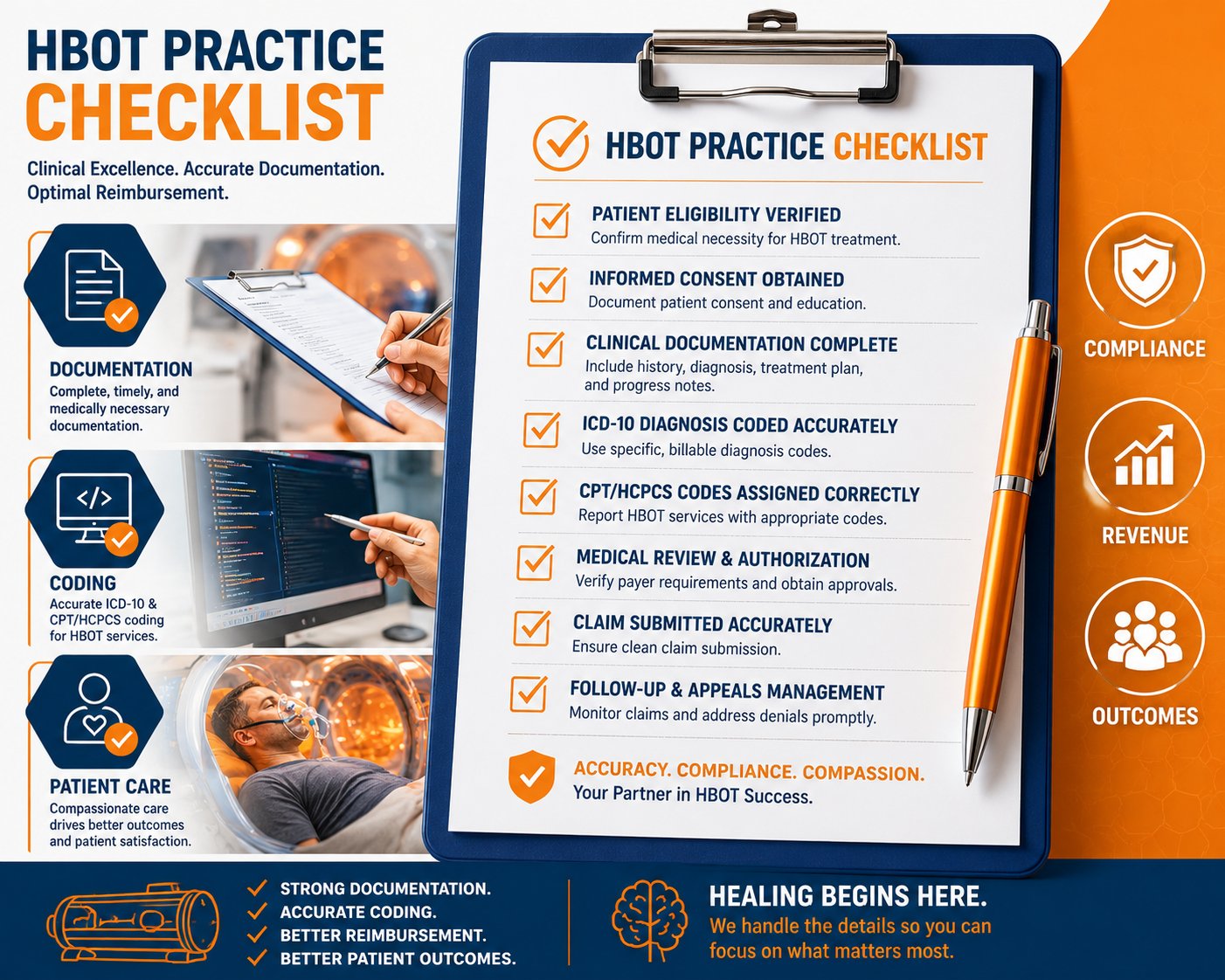
Before launching or expanding your HBOT program for veterans, evaluate your practice against each of these billing readiness benchmarks:
- Your billing team can accurately apply CPT code 99183 and all relevant facility-side HBOT billing codes without relying on general coding references
- You have a documented, automated charge capture process that reconciles treatment logs against billing records on a daily basis
- Your EHR templates include HBOT-specific fields for diagnosis, treatment rationale, prior treatment history, and physician attestation
- You maintain an up-to-date payer matrix tracking HBOT covered indications, prior authorization requirements, documentation standards, and session limits for each payer in your network
- Your billing team can clearly distinguish covered HBOT indications from off-label indications and can counsel patients accordingly before services begin
- You have denial management workflows specific to HBOT claims, including appeal letter templates supported by peer-reviewed clinical literature
- At least one coder on your billing team holds verified HBOT coding experience or a recognized hyperbaric billing certification
- You track HBOT-specific revenue cycle metrics — denial rate, AR aging, net collection rate — separately from your general billing data
- You conduct formal billing audits of hyperbaric claims at least quarterly
- You have a documented process for verifying VA community care eligibility and entitlements before treating veteran patients
- You provide written financial counseling for patients pursuing off-label HBOT services so that cost exposure is understood before treatment begins
- Your compliance documentation addresses off-label HBOT use and the applicable CMS and OIG guidelines governing billing for investigational therapies
- You review payer-specific HBOT policy updates at least quarterly to stay current with coverage changes
- You have a formal process for submitting, tracking, and following up on prior authorization requests for HBOT
- Your physicians receive periodic training on HBOT documentation requirements and understand how their clinical notes directly drive reimbursement outcomes
Key Takeaways
- Hyperbaric oxygen therapy for PTSD targets the neurological and inflammatory mechanisms underlying trauma — offering a biologically grounded treatment pathway for veterans who have not found relief through conventional therapies.
- HBOT and neurological recovery are linked through angiogenesis, neuroplasticity, BDNF stimulation, and anti-neuroinflammatory effects that are directly relevant to both PTSD and TBI.
- Peer-reviewed randomized controlled trials have shown significant improvements in PTSD symptom scores and brain function following HBOT — evidence that is growing stronger with each new published study.
- HBOT for PTSD is not currently covered by the VA or Medicare for this indication, making billing accuracy, prior authorization management, and documentation quality critical for any practice offering these services.
- Billing errors, missed charges, and documentation deficiencies are costing hyperbaric practices significant, recoverable revenue — and can be corrected with the right expertise and process.
- A specialized HBOT billing partner provides the coding precision, audit capability, and payer intelligence that practices need to build and sustain financially viable veteran PTSD programs.
Final Thoughts
The veterans who seek hyperbaric oxygen therapy for PTSD are not looking for a miracle. They are looking for a chance — a chance to sleep through the night, to be present with their families, to reclaim the quality of life that trauma interrupted. The growing body of research on HBOT mental health benefits suggests that hyperbaric therapy may genuinely be part of that chance for a meaningful subset of veterans who have exhausted conventional options.
Your practice plays a critical role in making that care accessible, sustainable, and financially viable. But it only works if your billing infrastructure keeps pace with your clinical ambitions. Every denied claim, every missed session charge, every underdocumented encounter is revenue that your practice cannot reinvest in the veterans you serve — and a barrier to the care those veterans need.
The right billing partner changes that equation.
At UtreatiBill, we are committed to helping hyperbaric practices build billing systems that are as precise and purposeful as the care they deliver. Whether you are launching a veteran PTSD program or looking to recover revenue from an existing one, our team is ready to help.